


Exploring factors influencing asthma control and asthma-specific health-related quality of life among children
- PMID: 23432913
- PMCID: PMC3599064
- DOI: 10.1186/1465-9921-14-26
Exploring factors influencing asthma control and asthma-specific health-related quality of life among children
Abstract
Background: Little is known about factors contributing to children's asthma control status and health-related quality of life (HRQoL). The study objectives were to assess the relationship between asthma control and asthma-specific HRQoL in asthmatic children, and to examine the extent to which parental health literacy, perceived self-efficacy with patient-physician interaction, and satisfaction with shared decision-making (SDM) contribute to children's asthma control and asthma-specific HRQoL.
Methods: This cross-sectional study utilized data collected from a sample of asthmatic children (n = 160) aged 8-17 years and their parents (n = 160) who visited a university medical center. Asthma-specific HRQoL was self-reported by children using the National Institutes of Health's Patient-Reported Outcomes Measurement Information System (PROMIS) Pediatric Asthma Impact Scale. Satisfaction with SDM, perceived self-efficacy with patient-physician interaction, parental health literacy, and asthma control were reported by parents using standardized measures. Structural equation modeling (SEM) was performed to test the hypothesized pathways.
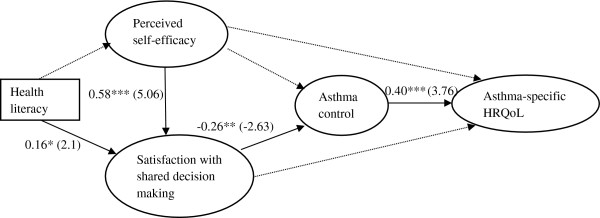
Results: Path analysis revealed that children with better asthma control reported higher asthma-specific HRQoL (β = 0.4, P < 0.001). Parents with higher health literacy and greater perceived self-efficacy with patient-physician interactions were associated with higher satisfaction with SDM (β = 0.38, P < 0.05; β = 0.58, P < 0.001, respectively). Greater satisfaction with SDM was in turn associated with better asthma control (β = -0.26, P < 0.01).
Conclusion: Children's asthma control status influenced their asthma-specific HRQoL. However, parental factors such as perceived self-efficacy with patient-physician interaction and satisfaction with shared decision-making indirectly influenced children's asthma control status and asthma-specific HRQoL.
Figures
References
-
- Akinbami LJ, Moorman JE, Liu X. Asthma prevalence, health care use, and mortality: United States, 2005 – 2009. National Health Statistics Report. 2011;32: . http://www.cdc.gov/nchs/data/nhsr/nhsr032.pdf. - PubMed
-
- Koster ES, Raaijmakers JA, Vijverberg SJ, Koenderman L, Postma DS, Koppelman GH, van der Ent CK, Maitland-van der Zee AH. Limited agreement between current and long-term asthma control in children: The PACMAN cohort study. Pediatr Allergy Immunol. 2011;22(8):776–783. doi: 10.1111/j.1399-3038.2011.01188.x. - DOI - PubMed
Publication types
MeSH terms
Grants and funding
LinkOut - more resources
Full Text Sources
Other Literature Sources
Medical
