


Gender differences in the association of visceral and subcutaneous adiposity with adiponectin in African Americans: the Jackson Heart Study
- PMID: 23433085
- PMCID: PMC3586352
- DOI: 10.1186/1471-2261-13-9
Gender differences in the association of visceral and subcutaneous adiposity with adiponectin in African Americans: the Jackson Heart Study
Abstract
Background: Adiponectin, paradoxically reduced in obesity and with lower levels in African Americans (AA), modulates several cardiometabolic risk factors. Because abdominal visceral adipose tissue (VAT), known to be reduced in AA, and subcutaneous adipose tissue (SAT) compartments may confer differential metabolic risk profiles, we investigated the associations of VAT and SAT with serum adiponectin, separately by gender, with the hypothesis that VAT is more strongly inversely associated with adiponectin than SAT.
Methods: Participants from the Jackson Heart Study, an ongoing cohort of AA (n = 2,799; 64% women; mean age, 55 ± 11 years) underwent computer tomography assessment of SAT and VAT volumes, and had stored serum specimens analyzed for adiponectin levels. These levels were examined by gender in relation to increments of VAT and SAT.
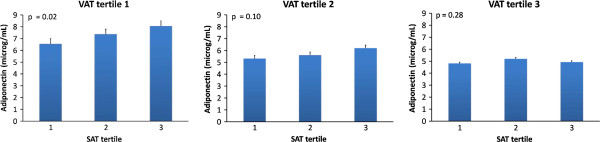
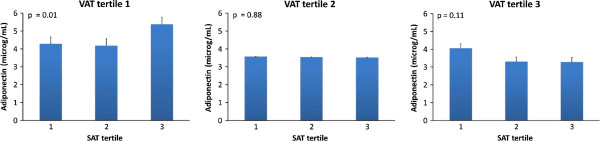
Results: Compared to women, men had significantly lower mean levels of adiponectin (3.9 ± 3.0 μg/mL vs. 6.0 ± 4.4 μg/mL; p < 0.01) and mean volume of SAT (1,721 ± 803 cm(3) vs. 2,668 ± 968 cm(3); p < 0.01) but significantly higher mean volume of VAT (884 ± 416 cm(3) vs. 801 ± 363 cm(3); p < 0.01). Among women, a one standard deviation increment in VAT was inversely associated with adiponectin (β = - 0.13; p < 0.0001) after controlling for age, systolic blood pressure, fasting plasma glucose, high-density lipoprotein cholesterol, triglycerides, education, pack-years of smoking and daily intake of alcohol. The statistically significant inverse association of VAT and adiponectin persisted after additionally adjusting for SAT, body mass index (BMI) and waist circumference (WC), suggesting that VAT provides significant information above and beyond BMI and WC. Among men, after the same multivariable adjustment, there was a direct association of SAT and adiponectin (β = 0.18; p = 0.002) that persisted when controlling for BMI and WC, supporting a beneficial effect of SAT. Insulin resistance mediated the association of SAT with adiponectin in women.
Conclusion: In African Americans, abdominal visceral adipose tissue had an inverse association with serum adiponectin concentrations only among women. Abdominal subcutaneous adipose tissue appeared as a protective fat depot in men.
Figures
References
-
- Ouchi N, Kihara S, Arita Y, Okamoto Y, Maeda K, Kuriyama H, Hotta K, Nishida M, Takahashi M, Muraguchi M. Adiponectin, an adipocyte-derived plasma protein, inhibits endothelial NF-kappaB signaling through a cAMP-dependent pathway. Circulation. 2000;102(11):1296–1301. doi: 10.1161/01.CIR.102.11.1296. - DOI - PubMed
Publication types
MeSH terms
Substances
Grants and funding
LinkOut - more resources
Full Text Sources
Other Literature Sources
Medical
Research Materials
Miscellaneous
