. 2013 Apr 1;23(7):2197-201.
doi: 10.1016/j.bmcl.2013.01.107. Epub 2013 Jan 30.

Improved guanide compounds which bind the CXCR4 co-receptor and inhibit HIV-1 infection

Affiliations

Improved guanide compounds which bind the CXCR4 co-receptor and inhibit HIV-1 infection

Royce A Wilkinson et al. Bioorg Med Chem Lett. .

Abstract

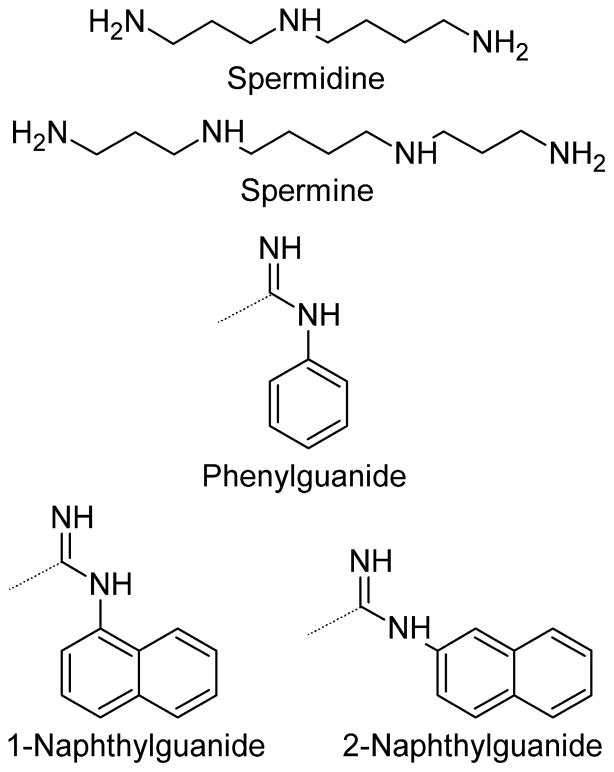
The G-protein coupled receptor CXCR4 is a co-receptor for HIV-1 infection and is involved in signaling cell migration and proliferation. In a previous study of non-peptide, guanide-based CXCR4-binding compounds, spermine and spermidine phenylguanides inhibited HIV-1 entry at low micromolar concentrations. Subsequently, crystal structures of CXCR4 were used to dock a series of naphthylguanide derivatives of the polyamines spermidine and spermine. Synthesis and evaluation of the naphthylguanide compounds identified our best compound, spermine tris-1-naphthylguanide, which bound CXCR4 with an IC(50) of 40 nM and inhibited the infection of TZM-bl cells with X4, but not R5, strains of HIV-1 with an IC(50) of 50-100 nM.


Figures

Figure 1
Figure 1
Guanide derivative structures. Spermidine and spermine were derivatized to make the phenylguanide, 1-naphthylguanide, or 2-naphthylguanide derivatives. The dotted lines on the guanide functional groups show the attachment point to the nitrogens of the spermidine and spermine starting amines.
Figure 2
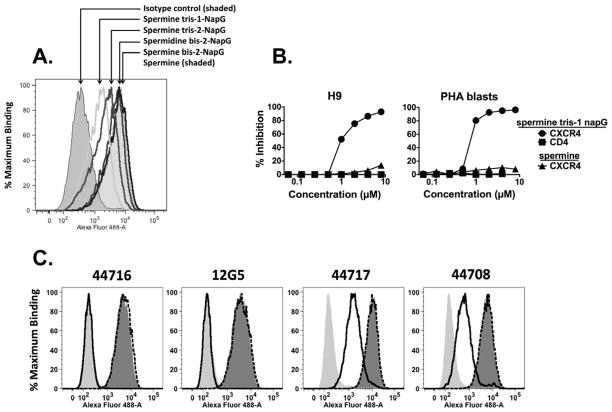
Figure 2. Inhibition of binding of anti-CXCR4 mAbs to cells by naphthylguanide derivitives
a. H9 lymphoma cells were incubated at 4°C with 1 μM naphthylguanide derivatives in PBS/BSA/azide. After 20 min, anti-CXCR4 mAb 44716 or an isotype control was added to 1 μg/ml. After 1 h at 4°C, the cells were washed and Alexa-fluor 488-conjugated anti-mouse IgG was added. Cells were incubated at 4°C for one hour, washed, and fixed in 2% paraformaldehyde. Fluorescence of the cells (10,000 events) was then analyzed by flow cytometry. b. H9 cells or primary T cell blasts were incubated with varying concentrations of spermine tris-1-NapG or spermine alone, and then stained with anti-CXCR4 mAb 12G5 or, as a control, anti-CD4 mAb Sim.2 as described in panel A. c. Inhibition of four different anti-CXCR4 mAbs by 3 μM spermine tris-1-NapG or spermine. Cells were stained as in panel A.
Figure 3
Figure 3. Neutralization of HIV infectivity by naphthylguanide derivatives
Neutralization of X4 isolates of HIV-1 was measured using TZM-bl cells. Compounds were added to cells, followed by a virus dilution representing 10–20 TCID50. Cells, drug, and virus were incubated for 72 h. The cells were lysed and chemiluminescence measured in relative luminescence units. Samples were run in duplicate. Percent inhibition was calculated and is displayed as mean and SEM. a. Isolate 92-HT-599 was tested against four naphthylguanide derivitives, spermine, and spermidine. b. Four different X4 isolates were tested against spermine tris-1-NapG.

References

    1. Muller A, Homey B, Soto H, Ge N, Catron D, Buchanan ME, McClanahan T, Murphy E, Yuan W, Wagner SN, Barrera JL, Mohar A, Verastegui E, Zlotnik A. Nature. 2001;410:50. - PubMed
    1. Wu B, Chien EY, Mol CD, Fenalti G, Liu W, Katritch V, Abagyan R, Brooun A, Wells P, Bi FC, Hamel DJ, Kuhn P, Handel TM, Cherezov V, Stevens RC. Science. 2010;330:1066. - PMC - PubMed
    1. Dorr P, Westby M, Dobbs S, Griffin P, Irvine B, Macartney M, Mori J, Rickett G, Smith-Burchnell C, Napier C, Webster R, Armour D, Price D, Stammen B, Wood A, Perros M. Antimicrob Agents Chemother. 2005;49:4721. - PMC - PubMed
    1. Connor RI, Sheridan KE, Ceradini D, Choe S, Landau NR. J Exp Med. 1997;185:621. - PMC - PubMed
    1. Wagner TA, Frenkel LM. Aids. 2008;22:2393. - PMC - PubMed

Publication types

MeSH terms