


Design and baseline characteristics of the PODOSA (Prevention of Diabetes & Obesity in South Asians) trial: a cluster, randomised lifestyle intervention in Indian and Pakistani adults with impaired glycaemia at high risk of developing type 2 diabetes
- PMID: 23435795
- PMCID: PMC3586081
- DOI: 10.1136/bmjopen-2012-002226
Design and baseline characteristics of the PODOSA (Prevention of Diabetes & Obesity in South Asians) trial: a cluster, randomised lifestyle intervention in Indian and Pakistani adults with impaired glycaemia at high risk of developing type 2 diabetes
Abstract
Objectives: To describe the design and baseline population characteristics of an adapted lifestyle intervention trial aimed at reducing weight and increasing physical activity in people of Indian and Pakistani origin at high risk of developing type 2 diabetes.
Design: Cluster, randomised controlled trial.
Setting: Community-based in Edinburgh and Glasgow, Scotland, UK.
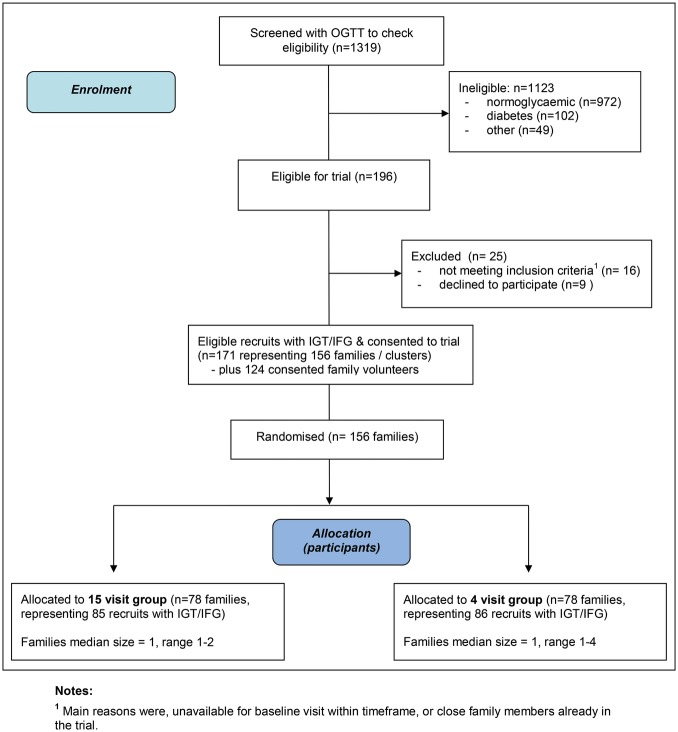
Participants: 156 families, comprising 171 people with impaired glycaemia, and waist sizes ≥90 cm (men) and ≥80 cm (women), plus 124 family volunteers.
Interventions: Families were randomised into either an intensive intervention of 15 dietitian visits providing lifestyle advice, or a light (control) intervention of four visits, over a period of 3 years.
Outcome measures: The primary outcome is a change in mean weight between baseline and 3 years. Secondary outcomes are changes in waist, hip, body mass index, plasma blood glucose and physical activity. The cost of the intervention will be measured. Qualitative work will seek to understand factors that motivated participation and retention in the trial and families' experience of adhering to the interventions.
Results: Between July 2007 and October 2009, 171 people with impaired glycaemia, along with 124 family volunteers, were randomised. In total, 95% (171/196) of eligible participants agreed to proceed to the 3-year trial. Only 13 of the 156 families contained more than one recruit with impaired glycaemia. We have recruited sufficient participants to undertake an adequately powered trial to detect a mean difference in weight of 2.5 kg between the intensive and light intervention groups at the 5% significance level. Over half the families include family volunteers. The main participants have a mean age of 52 years and 64% are women.
Conclusions: Prevention of Diabetes & Obesity in South Asians (PODOSA) is one of the first community-based, randomised lifestyle intervention trials in a UK South Asian population. The main trial results will be submitted for publication during 2013.
Trial registration: Current controlled trials ISRCTN25729565 (http://www.controlled-trials.com/isrctn/).
Figures
References
-
- Danaei G, Finucane MM, Lu Y, et al. National, regional, and global trends in fasting plasma glucose and diabetes prevalence since 1980: systematic analysis of health examination surveys and epidemiological studies with 370 country-years and 2.7 million participants. Lancet 2011;378:31–40 - PubMed
-
- Shaw JE, Sicree RA, Zimmet PZ. Global estimates of the prevalence of diabetes for 2010 and 2030. Diabetes Res Clin Pract 2010;87:4–14 - PubMed
-
- Hex N, Bartlett C, Wright D, et al. Estimating the current and future costs of Type 1 and Type 2 diabetes in the UK, including direct health costs and indirect societal and productivity costs. Diabet Med 2012;29:855–62 - PubMed
Grants and funding
LinkOut - more resources
Full Text Sources
Other Literature Sources
Molecular Biology Databases
