


Stress urinary incontinence in pregnant women: a review of prevalence, pathophysiology, and treatment
- PMID: 23436035
- PMCID: PMC3671107
- DOI: 10.1007/s00192-013-2061-7
Stress urinary incontinence in pregnant women: a review of prevalence, pathophysiology, and treatment
Abstract
Introduction and hypothesis: Stress urinary incontinence (SUI) is the most common type of urinary incontinence (UI) in pregnant women and is known to have detrimental effects on the quality of life in approximately 54.3 %. Pregnancy is the main risk factor for the development of SUI. This review provides details of the pathophysiology leading to SUI in pregnant women and SUI prevalence and treatment during pregnancy.
Methods: We conducted a PubMed search for English-language and human-study articles registered from January 1990 to September 2012. This search was performed for articles dealing with prevalence and treatment of SUI during pregnancy. In the intervention studies, we included studies that used a randomized controlled trial (RCT) design or studies comparing a treatment intervention to no treatment.
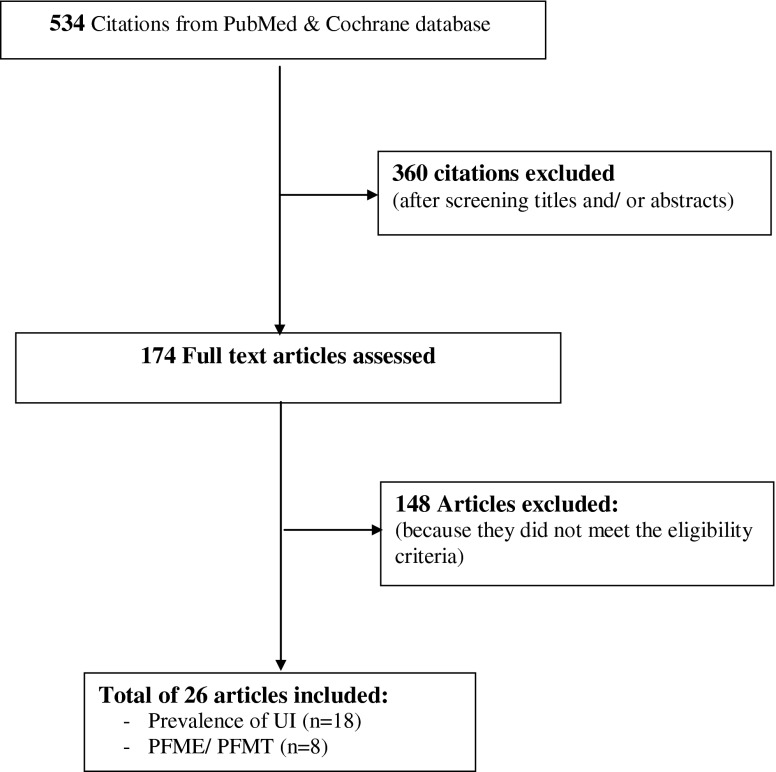
Results: A total of 534 articles were identified; 174 full-text articles were reviewed, and 28 of them met eligibility criteria and are reported on here. The mean prevalence of SUI during pregnancy was 41 % (18.6-60 %) and increased with gestational age. The increasing pressure of the growing uterus and fetal weight on pelvic-floor muscles (PFM) throughout pregnancy, together with pregnancy-related hormonal changes, may lead to reduced PFM strength as well as their supportive and sphincteric function. These cause mobility of the bladder neck and urethra, leading to urethral sphincter incompetence. Pelvic floor muscle exercise (PFME) is a safe and effective treatment for SUI during pregnancy, without significant adverse effects.
Conclusions: Understanding these issues can be useful for health-care professionals when informing and counseling pregnant women to help prevent SUI during pregnancy and the postpartum period.
Figures
References
-
- Haylen BT, de Ridder D, Freeman RM, et al. An International Urogynecological Association (IUGA)/International Continence Society (ICS) joint report on the terminology for female pelvic floor dysfunction. Int Urogynecol J. 2010;21(1):5–26. - PubMed
-
- Dolan LM, Walsh D, Hamilton S, Marshall K, Thompson K, Ashe RG. A study of quality of life in primigravidae with urinary incontinence. Int Urogynecol J Pelvic Floor Dysfunct. 2004;15:160–164. - PubMed
-
- Mascarenhas T, Coelho R, Oliveira M, Patricio B (2003) Impact of urinary incontinence on quality of life during pregnancy and after childbirth. Paper presented at the 33th annual meeting of the International Continence Society, Florence, Italy, October 9, 2003
-
- van Brummen HJ, Bruinse HW, Van de Pol G, Heintz AP, Van der Vaart CH. What is the effect of overactive bladder symptoms on woman’s quality of life during and after first pregnancy? BJU Int. 2006;97(2):296–300. - PubMed
Publication types
MeSH terms
LinkOut - more resources
Full Text Sources
Other Literature Sources
Medical
Miscellaneous
