


Measles outbreak in South Africa: epidemiology of laboratory-confirmed measles cases and assessment of intervention, 2009-2011
- PMID: 23437059
- PMCID: PMC3577838
- DOI: 10.1371/journal.pone.0055682
Measles outbreak in South Africa: epidemiology of laboratory-confirmed measles cases and assessment of intervention, 2009-2011
Abstract
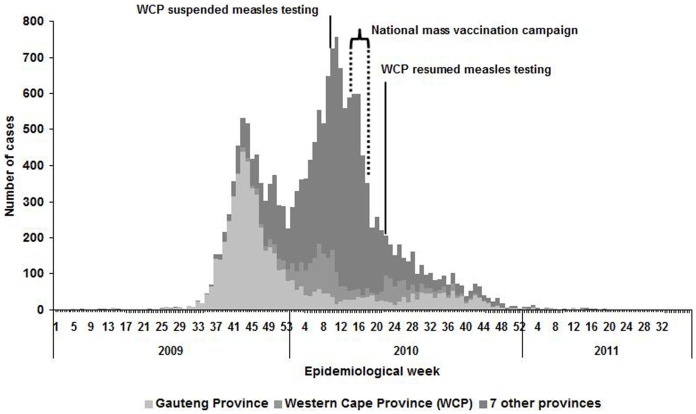
Background: Since 1995, measles vaccination at nine and 18 months has been routine in South Africa; however, coverage seldom reached >95%. We describe the epidemiology of laboratory-confirmed measles case-patients and assess the impact of the nationwide mass vaccination campaign during the 2009 to 2011 measles outbreak in South Africa.
Methods: Serum specimens collected from patients with suspected-measles were tested for measles-specific IgM antibodies using an enzyme-linked immunosorbent assay and genotypes of a subset were determined. To estimate the impact of the nationwide mass vaccination campaign, we compared incidence in the seven months pre- (1 September 2009-11 April 2010) and seven months post-vaccination campaign (24 May 2010-31 December 2010) periods in seven provinces of South Africa.
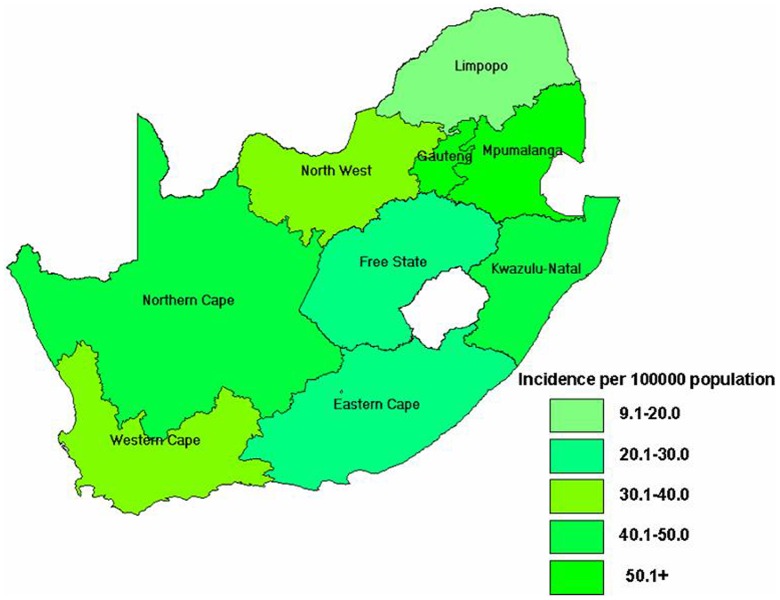
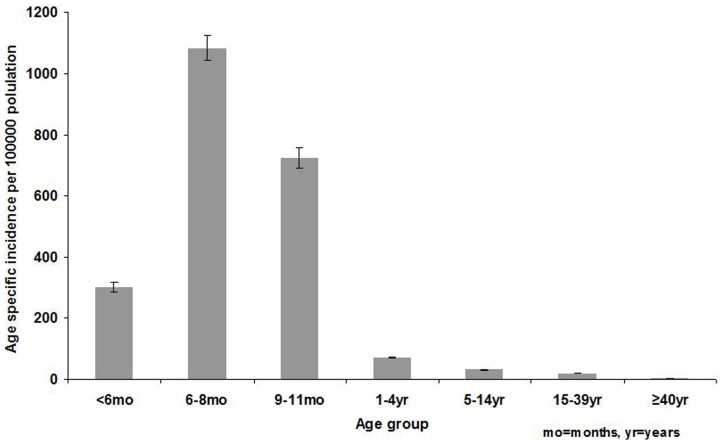
Results: A total of 18,431 laboratory-confirmed measles case-patients were reported from all nine provinces of South Africa (cumulative incidence 37 per 100,000 population). The highest cumulative incidence per 100,000 population was in children aged <1 year (603), distributed as follows: <6 months (302/100,000), 6 to 8 months (1083/100,000) and 9 to 11 months (724/100,000). Forty eight percent of case-patients were ≥ 5 years (cumulative incidence 54/100,000). Cumulative incidence decreased with increasing age to 2/100,000 in persons ≥ 40 years. A single strain of measles virus (genotype B3) circulated throughout the outbreak. Prior to the vaccination campaign, cumulative incidence in the targeted vs. non-targeted age group was 5.9-fold higher, decreasing to 1.7 fold following the campaign (P<0.001) and an estimated 1,380 laboratory-confirmed measles case-patients were prevented.
Conclusion: We observed a reduction in measles incidence following the nationwide mass vaccination campaign even though it was conducted approximately one year after the outbreak started. A booster dose at school entry may be of value given the high incidence in persons >5 years.
Conflict of interest statement
Figures
References
-
- Heymann DL, editor (2004) Control of Communicable Diseases Manual. 18th ed. Washington: American Public Health Association: 347–54.
-
- World Health Organisation Regional Office for Africa. Measles pre-elimination. Available: http://www.afro.who.int/en/clusters-a-programmes/ard/immunisation-and-va.... Accessed 2010 Nov 30.
-
- WHO/UNICEF Joint Statement on Global plan for reducing measles mortality 2006–2010. Available: http://www.who.int/vaccines-documents/DocsPDF06/WHO_IVB_05_11.pdf. Accessed 2010 Nov 30.
-
- World Health Organisation (2009) Measles. Fact sheet No 286. 2009 December. Available: http://www.who.int/mediacentre/factsheets/fs286/en/. Accessed 2010 Nov 30.
-
- World Health Organisation. Expanded Programme on Immunisation, Measles Control in the 1990s: Protocol for analyzing the age distribution and age-specific incidence of measles cases in a given population or region. (WHO/EPI/GEN/94.7).
MeSH terms
Substances
LinkOut - more resources
Full Text Sources
Other Literature Sources
Medical
Miscellaneous
