


Safety of benzathine penicillin for preventing congenital syphilis: a systematic review
- PMID: 23437138
- PMCID: PMC3578834
- DOI: 10.1371/journal.pone.0056463
Safety of benzathine penicillin for preventing congenital syphilis: a systematic review
Abstract
Objective: To estimate the risk of serious adverse reactions to benzathine penicillin in pregnant women for preventing congenital syphilis.
Methods: We searched for clinical trials or cohorts that assessed the incidence of serious adverse reactions to benzathine penicillin in pregnant women and the general population (indirect evidence). MEDLINE, EMBASE, Scopus and other databases were searched up to December 2012. The GRADE approach was used to assess quality of evidence. Absolute risks of each study were calculated along with their 95% confidence intervals (95% CI). We employed the DerSimonian and Laird random effects model in the meta-analyses.
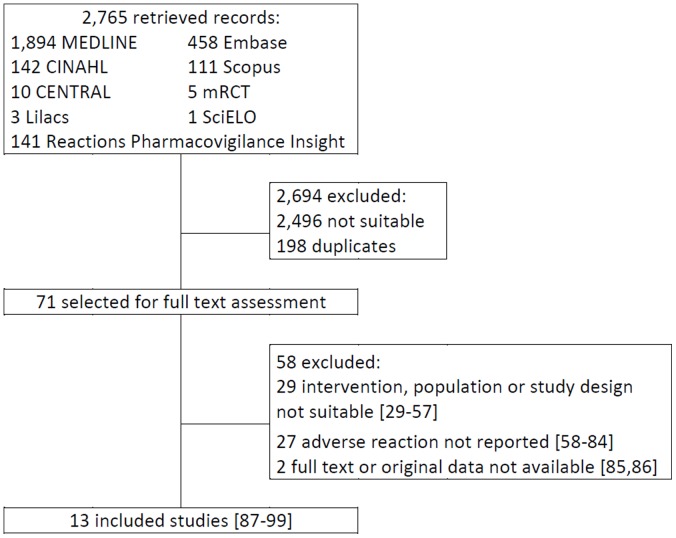
Results: From 2,765 retrieved studies we included 13, representing 3,466,780 patients. The studies that included pregnant women were conducted to demonstrate the effectiveness of benzathine penicillin: no serious adverse reactions were reported among the 1,244 pregnant women included. In the general population, among 2,028,982 patients treated, 4 died from an adverse reaction. The pooled risk of death was virtually zero. Fifty-four cases of anaphylaxis were reported (pooled absolute risk = 0.002%; 95% CI: 0%-0.003% I(2) = 12%). From that estimate, penicillin treatment would be expected to result in an incidence of 0 to 3 cases of anaphylaxis per 100,000 treated. Any adverse reactions were reported in 6,377 patients among 3,465,322 treated with penicillin (pooled absolute risk = 0.169%; 95% CI: 0.073%-0.265% I(2) = 97%). The quality of evidence was very low.
Conclusion: Studies that assessed the risk of serious adverse events due to benzathine penicillin treatment in pregnant women were scarce, but no reports of adverse reactions were found. The incidence of severe adverse outcomes was very low in the general population. The risk of treating pregnant women with benzathine penicillin to prevent congenital syphilis appears very low and does not outweigh its benefits. Further research is needed to improve the quality of evidence.
Conflict of interest statement
Figures
References
-
- WHO (2012) Investment case for eliminating mother-to-child transmission of syphilis: promoting better maternal and child health and stronger health systems. Geneva: World Health Organization.
-
- Workowski KA, Berman S (2010) CDC (2010) Sexually transmitted diseases treatment guidelines, 2010. MMWR Recomm Rep 59: 1–110. - PubMed
-
- WHO (2003) Guidelines for the management of sexually transmitted infections. Geneva: World Health Organization. - PubMed
-
- Douglas JM (2009) Penicillin treatment of syphilis: clearing away the shadow on the land. JAMA 301: 769–771. - PubMed
-
- Wendel GD, Sheffield JS, Hollier LM, Hill JB, Ramsey PS, et al. (2002) Treatment of syphilis in pregnancy and prevention of congenital syphilis. Clin Infect Dis 35: S200–209. - PubMed
Publication types
MeSH terms
Substances
LinkOut - more resources
Full Text Sources
Other Literature Sources
Medical
