


Bystander-initiated chest compression-only CPR is better than standard CPR in out-of-hospital cardiac arrest
- PMID: 23439400
- PMCID: PMC3484593
Bystander-initiated chest compression-only CPR is better than standard CPR in out-of-hospital cardiac arrest
Abstract
Introduction: Out-of-hospital cardiac arrest has a low survival rate to hospital discharge. Recent studies compared a simplified form of CPR, based on chest compression alone versus standard CPR including ventilation. We performed systematic review and meta-analysis of randomized controlled trials, focusing on survival at hospital discharge.
Methods: We extensively searched the published literature on out-of hospital CPR for non traumatic cardiac arrest in different databases.
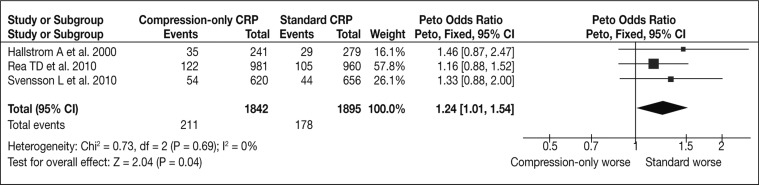
Results: We identified only three randomized trials on this topic, including witnessed and not-witnessed cardiac arrests. When pooling them together with a meta-analytic approach, we found that there is already clinical and statistical evidence to support the superiority of the compression-only CPR in terms of survival at hospital discharge, as 211/1842 (11.5%) patients in the chest compression alone group versus 178/1895 (9.4%) in the standard CPR group were alive at hospital discharge: odds ratio from both Peto and DerSimonian-Laird methods =0.80 (95% confidence interval 0.65-0.99), p for effect =0.04, p for heterogeneity =0.69, inconsistency =0%).
Conclusions: Available evidence strongly support the superiority of bystander compression-only CPR. Reasons for the best efficacy of chest compression-only CPR include a better willingness to start CPR by bystanders, the low quality of mouth-to-mouth ventilation and a detrimental effect of too long interruptions of chest compressions during ventilation. Based on our findings, compression-only CPR should be recommended as the preferred CPR technique performed by untrained bystander.
Keywords: cardiac arrest; cardiopulmonary resuscitation; compression-only; meta-analysis; randomized trials; systematic review.
Conflict of interest statement
Figures
References
-
- Lloyd-Jones D, Adams R, Carnethon M. et al. Heart disease and stroke statistics - 2009 update: a report from the American Heart Association Statistics Committee and Stroke Statistics Subcommittee. circulation. 2009;119:21–181. - PubMed
-
- Sasson C, Rogers M A, Dahl J, Kellermann A L. Predictors of survival from out-of-hospital cardiac arrest: a systematic review and meta-analysis. Circ Cardiovasc Qual Outcomes. 2010;3:63–81. - PubMed
-
- Stiell I, Nichol G H, Wells G. et al. Health-related quality of life is better for cardiac arrest survivors who received citizen cardiopulmonary resuscitation. circulation. 2003;108:1939–1944. - PubMed
-
- Abella B S, Aufderheide T P, Eigel B. et al. Reducing barriers for implementation of bystander-initiated cardiopulmonary resuscitation. A scientific statement from the American Heart Association for healthcare providers policymakers, and community leaders regarding the effectiveness of cardiopulmonary resuscitation. Circulation. 2008;117:704–709. - PubMed
-
- Locke C J, Berg R A, Sanders Ab. et al. Bystander cardiopulmonary resuscitation. Concerns about mouth-to-mouth contact. Arch Intern Med. 1995;155:938–943. - PubMed
LinkOut - more resources
Full Text Sources