Review
. 2013 Apr;21(4):739-49.
doi: 10.1038/mt.2012.286. Epub 2013 Feb 26.

Baculovirus: an insect-derived vector for diverse gene transfer applications

Affiliations
Review

Baculovirus: an insect-derived vector for diverse gene transfer applications

Kari J Airenne et al. Mol Ther. 2013 Apr.

Abstract

Insect-derived baculoviruses have emerged as versatile and safe workhorses of biotechnology. Baculovirus expression vectors (BEVs) have been applied widely for crop and forest protection, as well as safe tools for recombinant protein production in insect cells. However, BEVs ability to efficiently transduce noninsect cells is still relatively poorly recognized despite the fact that efficient baculovirus-mediated in vitro and ex vivo gene delivery into dormant and dividing vertebrate cells of diverse origin has been described convincingly by many authors. Preliminary proof of therapeutic potential has also been established in preclinical studies. This review summarizes the advantages and current status of baculovirus-mediated gene delivery. Stem cell transduction, preclinical animal studies, tissue engineering, vaccination, cancer gene therapy, viral vector production, and drug discovery are covered.


Figures

Figure 1
Figure 1
Life cycle and applications of baculoviruses. Baculoviruses have a biphasic life cycle in which two different forms of the virus spread through vertical and horizontal infection. Infection between hosts is mediated by virions occluded in PIBs late in infection (1). PIBs subsist in nature for years awaiting larva to ingest them (2). PIBs dissolve and release the ODVs only in the unique alkaline environment of the larval midgut (3). ODVs then penetrate the peritrophic membrane and infect epithelial cells by direct fusion of the virion and cell membrane (4). Nucleocapsids travel to the nucleus and initiate replication (5). To evade host defense mechanisms, some nucleocapsids traverse the cell directly to speed up the infection. The infected midgut cells produce the BuV form of the virus which spreads the infection within the larva through the tracheal system and hemolymph (6). The BuV can be used as a versatile tool for a plethora of biotechnological applications (7). BEVS, baculovirus expression vector system; BuV, budded virus; ODV, occlusion-derived virus; PIB, polyhedral inclusion body; PM, peritrophic membrane.
Figure 2
Figure 2
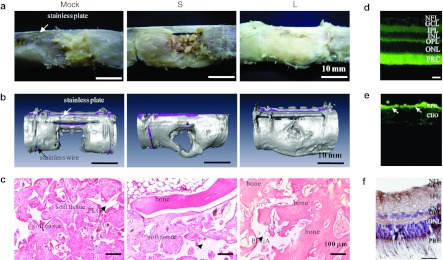
AcMNPV shows a high transduction efficacy ex vivo and in vivo. (ac) ASCs genetically modified by the hybrid baculovirus ameliorate the healing of segmental bone defects in rabbits. The ASCs derived from the subcutaneous fat pad of NZW rabbits were transduced with hybrid baculovirus vectors conferring sustained expression of BMP-2 or VEGF, mixed with cells at a 4:1 ratio, loaded into cylindrical poly(l-lactide-co-glycolide) scaffolds (1.5 × 10⁶ cells/scaffold) and transplanted into the critical-sized segmental defects at the femora of NZW rabbits (two scaffolds/defect, designated L group). The S group comprised PLGA scaffolds and ASCs that were transduced with the conventional baculoviruses transiently expressing BMP-2 or VEGF and transplanted in an identical manner. The mock group consisted of PLGA scaffolds and mock-transduced ASCs as the negative control. After 12 weeks transplantation, (a) gross appearance examination, (b) µCT analyses and hematoxylin & (c) eosin (H&E) staining collectively demonstrated that the L group (persistently expressing BMP-2 and VEGF) gave rise to significant new bone formation and bridging of bone defect in comparison with the S group (transiently expressing BMP-2 and VEGF) and mock group. (df) Intravitreal transduction leads to expression of (d,e) green fluorescent protein and (f) vascular endothelial growth factor D also in the deeper layers of a rabbit eye. The arrows in e indicate RPE layer. ASCs, Adipose-derived stem cells; BMP-2, bone morphogenetic protein-2; CHO, choroidea; GCL, ganglion cell layer; IPL, inner plexiform layer; INL, inner nuclear layer; NFL, nerve fiber layer; NZW, New Zealand White; ONL, outer nuclear layer; OPL, outer plexiform layer; PLGA, poly(l-lactide-co-glycolide); PRC, photoreceptor cells; RPE, retinal pigment epithelium; VEGF, vascular endothelial growth factor. Scale bar = 20 µm. a and b were adapted from Lin et al., c shows C.Y. Lin and Y.-C. Hu; unpublished data, and df were adapted from Kinnunen et al. (2009).
Figure 3
Figure 3
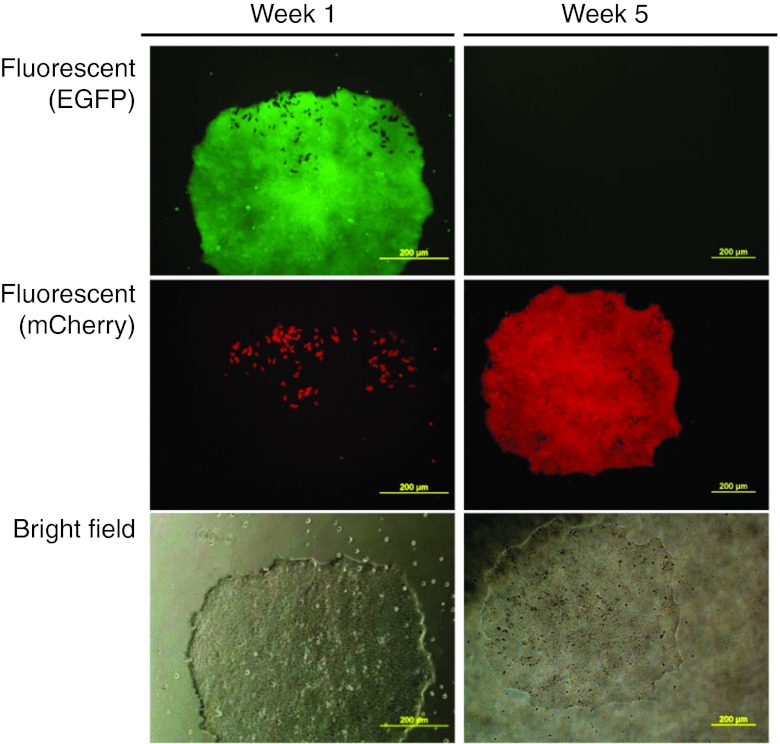
Cre recombinase-mediated cassette exchange in human embryonic stem cells (hESCs) by AcMNPV. Homologous recombination was used to introduce the EGFP gene and heterospecific loxP sites into the AAVS1 locus in hESCs. Two AcMNPV vectors, one to express Cre recombinase and another containing the mCherry gene driven by the EF1α promoter, were used for Cre recombinase-mediated cassette exchange. mCherry-positive cells were visible at week 1 and increased by mechanical selection at the time for normal hESC subculture. After three rounds of selection (week 5), almost the entire hESC colony was mCherry-positive. AcMNPV, Autographa californica multiple nucleopolyhedrovirus; EGFP, enhanced green fluorescent protein; hESCs, human embryonic stem cells; mCherry, red fluorescent protein. Scale bar = 200 µm. (unpublished data).
Figure 4
Figure 4
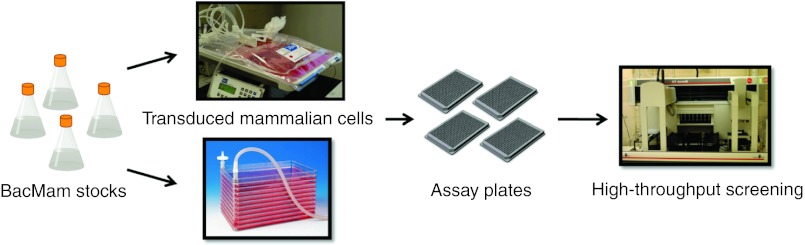
Application of BacMam transduction for assay development and automated high-throughput drug screening. Large quantities of either suspension or anchorage-dependent mammalian cells can be transduced by addition of single or multiple BacMam viruses at various titers. The transduced cells can be either dispensed directly using automated systems into 384 or 1536 well microtiter plates and subsequently incubated for 24–48 hours before assay or incubated for the desired period, harvested and stored frozen in liquid nitrogen for future use. In many instances this eliminates the need to develop stable cell lines for screening assays.
Figure 5
Figure 5
AAV and lentivirus generation by baculoviruses. (a) Schematic diagram of the AAV genome. The prototypical AAV-2 genome is 4.7 kb in length. Two major open reading frames encoded by the rep and cap genes are indicated. The protein coding sequences are flanked at each end of the genome by short (<0.15 kb) ITR elements, which provide cis-acting sequences necessary for replication and packaging of the viral genome. Three separate promoters (at map units 5, 19, and 40) give rise to a nested set of 3′ coterminal transcripts, which share a common polyadenylation signal. The translated portions of the Rep- and Cap-encoding mRNAs are indicated by cylinders. The “V-shape” indicates a differential splicing event. (b) Representation of AAV Rep and Cap coding sequences within a “second-generation” rAAV-producing BEV. (Right) The two major AAV nonstructural proteins, Rep78 and Rep52, are translated from a single species of mRNA via a leaky ribosomal scanning mechanism (see text). Rep78 proteins initiate at a CUG codon, whereas Rep52 proteins initiate at a downstream AUG codon. (Left) The AAV structural proteins, VP1, -2, and -3, are expressed from a single species of mRNA via leaky ribosomal scanning using a combination of AUG and ACG codons as indicated. RNAs are indicated by solid arrows. Expressed polypeptides are indicated by cylinders. VP, virion protein. (c) The constructs for the third generation self inactivating lentivirus production i.e., the transfer construct in which gene of interest is driven by hPKG promoter, the packing construct expressing HIV gag and pol driven by CMV promoter, the envelope construct providing the envelope G glycoprotein of the VSV-G, and HIV Rev under RSV promoter are cloned into AcMNPV genome and baculoviruses are generated in insect cells. Adherent 293T cells or suspension cultures are transduced by hybrid viruses to produce small or larger batches of LV, respectively. High-titer lentiviruses are collected from the medium and purified to homogeneity by ion-exchange chromatography. AcMNPV, Autographa californica multiple nucleopolyhedrovirus; BEV, baculovirus expression vector; BuV, the budded form of baculovirus; CMV, cytomegalovirus; HIV, human immunodeficiency virus; hPKG, human phosphoglycerate kinase; ITR, inverted terminal repeat; LTR, long terminal repeat; LV, Lentiviruses; P10, baculovirus p10 promoter; Ph, baculovirus polyhedrin promoter; RSV, Rous sarcoma virus; UAA, ocher stop codon; VSV-G, vesicular stomatitis virus G; WPRE, Woodchuck hepatitis virus posttranscriptional regulatory element.

References

    1. Boztug K, Schmidt M, Schwarzer A, Banerjee PP, Díez IA, Dewey RA.et al. (2010Stem-cell gene therapy for the Wiskott-Aldrich syndrome N Engl J Med 3631918–1927. - PMC - PubMed
    1. Hacein-Bey-Abina S, Hauer J, Lim A, Picard C, Wang GP, Berry CC.et al. (2010Efficacy of gene therapy for X-linked severe combined immunodeficiency N Engl J Med 363355–364. - PMC - PubMed
    1. Friedrich MJ. Seeing is believing: gene therapy shows promise for ocular disorders. JAMA. 2010;304:1543–1545. - PubMed
    1. Immonen A, Vapalahti M, Tyynelä K, Hurskainen H, Sandmair A, Vanninen R.et al. (2004AdvHSV-tk gene therapy with intravenous ganciclovir improves survival in human malignant glioma: a randomised, controlled study Mol Ther 10967–972. - PubMed
    1. Giacca M., and, Zacchigna S. Virus-mediated gene delivery for human gene therapy. J Control Release. 2012;161:377–388. - PubMed

Publication types