. 2013 Feb 25;14(3):4476-97.
doi: 10.3390/ijms14034476.

From Identification to Characterization of the Multiple Sclerosis Susceptibility Gene CLEC16A

Affiliations

From Identification to Characterization of the Multiple Sclerosis Susceptibility Gene CLEC16A

Tone Berge et al. Int J Mol Sci. .

Abstract

Multiple sclerosis (MS) is an inflammatory, demyelinating disorder of the central nervous system that develops in genetically susceptible individuals, probably triggered by common environmental factors. Human leukocyte antigen (HLA) loci were early shown to confer the strongest genetic associations in MS. Now, more than 50 non-HLA MS susceptibility loci are identified, of which the majority are located in immune-regulatory genes. Single nucleotide polymorphisms (SNPs) in the C-type lectin-like domain family 16A (CLEC16A) gene were among the first non-HLA genetic variants that were confirmed to be associated with MS. Fine-mapping has indicated a primary association in MS and also other autoimmune diseases to intronic CLEC16A SNPs. Here, we review the identification of MS susceptibility variants in the CLEC16A gene region, functional studies of the CLEC16A molecule and the recent progress in understanding the implications thereof for MS development. This may serve as an example of the importance for further molecular investigation of the loci identified in genetic studies, with the aim to translate this knowledge into the clinic.


Figures
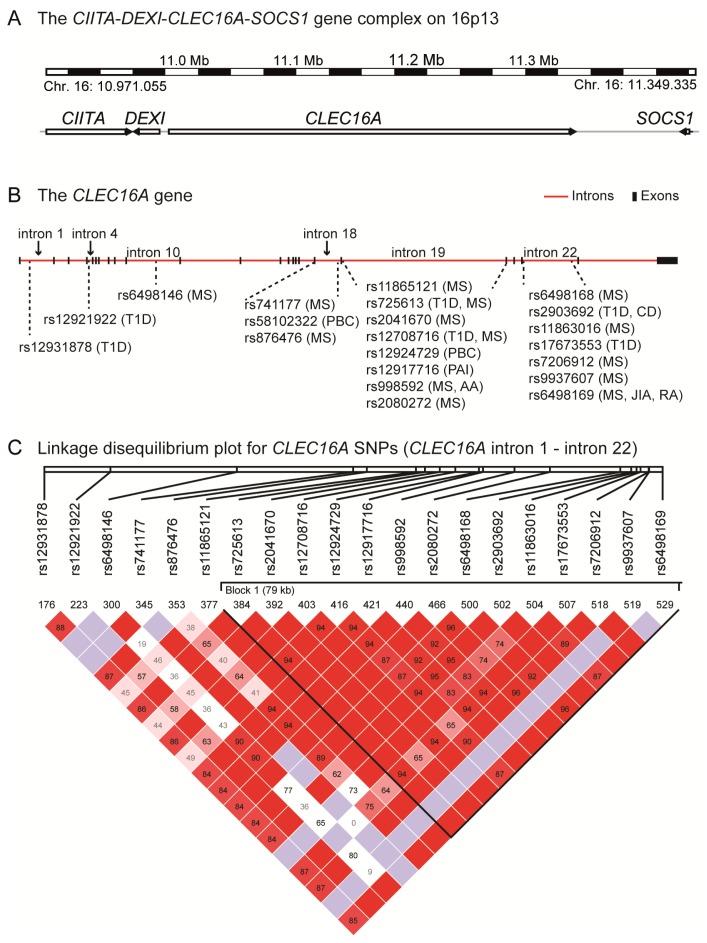
Figure 1
Figure 1
Schematic drawing of (a) the chromosome 16p13 genetic region comprising CIITA, DEXI, CLEC16A and SOCS1 (Genome Reference Consortium Human Build 37 (GRCh37), chromosome 16: 10.971.055–11.349.335) and (b) the 238 kb CLEC16A gene (GRCh37, chromosome 16: 11.038.345–11.276.046), where the autoimmunity-associated single nucleotide polymorphisms (SNPs) and their localization are depicted; (c) Linkage disequilibrium plot (Haploview v. 4.2, CEU-population [46]) for the CLEC16A region (chromosome 16: 11.042.194 (CLEC16A intron 1)–11.249.329 (CLEC16A intron 22), GRCh37) harboring the autoimmune-associated SNPs indicated in (b).
Figure 2
Figure 2
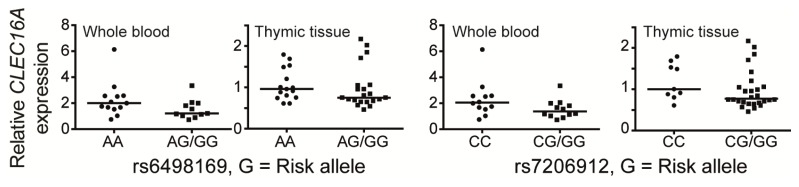
The graphs show relative expression of total CLEC16A (including the two long isoforms) normalized to the TATA-binding protein (TBP) gene in thymic tissue samples from 37 Norwegian children under the age of 13 undergoing corrective cardiac surgery and whole blood samples from 24 healthy, normal controls genotyped for the indicated SNPs in CLEC16A intron 22, as described [70]. Individuals carrying the risk allele were compared with individuals homozygous for the protective allele. Left graphs: rs6498169 (risk allele G): GG/AG: n = 21 (thymus), n = 11 (whole blood), AA: n = 15 (thymus), n = 13 (whole blood); right graphs: rs7206912 (risk allele G): GG/CG: n = 28 (thymus), n = 12 (whole blood), CC: n = 9 (thymus), n = 12 (whole blood). Correlation between gene expression levels and genotypes were assessed by Mann-Whitney U-test (GraphPad Prism 5, GraphPad Software, Inc., San Diego, CA, USA) and were found to be non-significant. Horizontal lines indicate the median values within the groups.
Figure 3
Figure 3
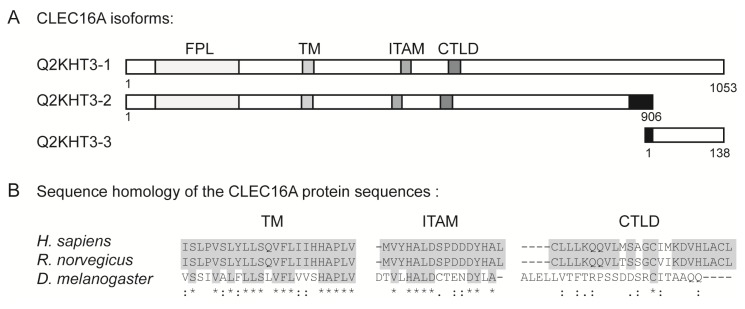
(a) Schematic representation of proposed CLEC16A protein variants (Q2KHT3-1, -2 and -3) highlighting from the N-terminal: a highly conserved uncharacterized protein domain, the FPL motif (amino acid (aa) 51–199 in Q2KHT3-1 and Q2KHT3-2,), a predicted transmembrane (TM) domain (aa 308–330 in Q2KHT3-1), an immunoreceptor-tyrosine based activation motif (ITAM, aa 483–499 in Q2KHT3-1) and the C-type lectin-like domain (CTLD, aa 566–588 in Q2KHT3-1). Black boxes indicate sequences where the amino acid identity differs from the canonical sequence; (b) Protein sequence alignment of the transmembrane region (TM, left), the immunoreceptor tyrosine-based activation motif (ITAM) sequence (middle) and the CTLD (right) of CLEC16A from Homo sapiens, Rattus norwegicus and Drosophila melanogaster. Boxed grey areas highlight fully conserved amino acids between the indicated species. “*” indicates identical amino acids in all three sequences; “:” indicates conserved substitution of amino acids; “.” indicates semi-conserved substitution of amino acids; and open space indicates no conservation of amino acid between the three species.

References

    1. Giovannoni G., Southam E., Waubant E. Systematic review of disease-modifying therapies to assess unmet needs in multiple sclerosis: Tolerability and adherence. Mult. Scler. 2012;18:932–946. - PubMed
    1. Taylor B.V., Pearson J.F., Clarke G., Mason D.F., Abernethy D.A., Willoughby E., Sabel C. MS prevalence in New Zealand, an ethnically and latitudinally diverse country. Mult. Scler. 2010;16:1422–1431. - PubMed
    1. Simpson S., Jr, Blizzard L., Otahal P., van der Mei I., Taylor B. Latitude is significantly associated with the prevalence of multiple sclerosis: A meta-analysis. J. Neurol. Neurosurg. Psychiatry. 2011;82:1132–1141. - PubMed
    1. Alonso A., Hernan M.A. Temporal trends in the incidence of multiple sclerosis: A systematic review. Neurology. 2008;71:129–135. - PMC - PubMed
    1. O’Gorman C., Lucas R., Taylor B. Environmental risk factors for multiple sclerosis: A review with a focus on molecular mechanisms. Int. J. Mol. Sci. 2012;13:11718–11752. - PMC - PubMed