Comparison of intravitreal bevacizumab, intravitreal triamcinolone acetonide, and macular grid augmentation in refractory diffuse diabetic macular edema: A prospective, randomized study
- PMID: 23439853
- PMCID: PMC3574512
- DOI: 10.4103/0974-620X.106100
Comparison of intravitreal bevacizumab, intravitreal triamcinolone acetonide, and macular grid augmentation in refractory diffuse diabetic macular edema: A prospective, randomized study
Abstract
Background: In spite of laser being the gold standard treatment for Diabetic Macular edema (DME), some patients do not respond to laser. Various treatment modalities are being tried in the management of refractory diffuse DME (DDME).
Purpose: To compare the efficacy of intravitreal bevacizumab (IVB), intravitreal triamcinolone acetonide (IVTA), and macular grid augmentation in the management of refractory DDME.
Settings and design: Prospective randomized study in a tertiary eye care center.
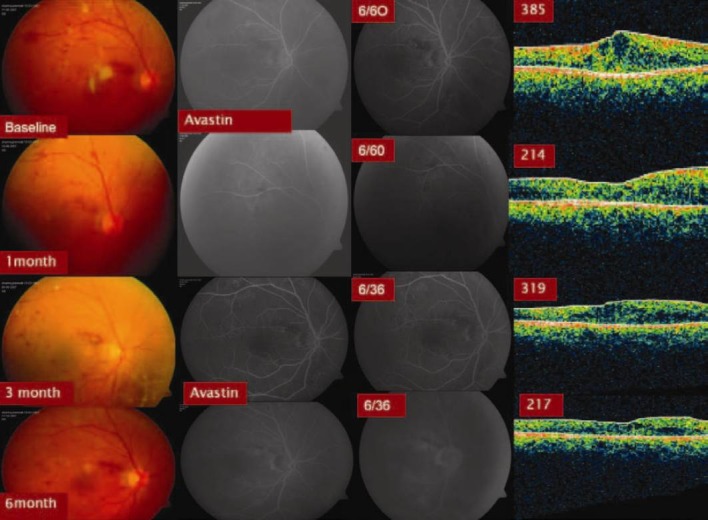
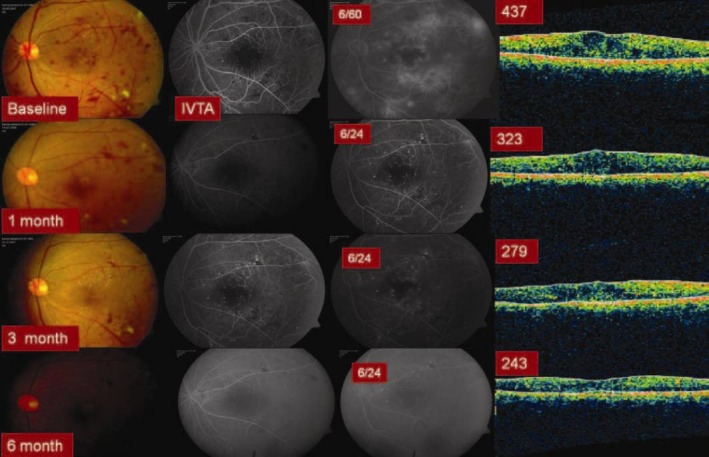
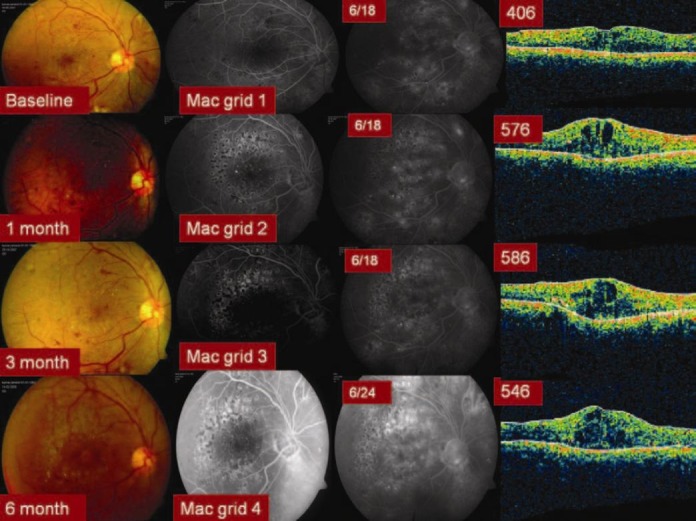
Materials and methods: SIXTY PATIENTS WITH REFRACTORY DDME WERE RANDOMLY ASSIGNED TO THREE GROUPS: Group 1 received IVB (1.25 mg/0.05 ml), Group 2 received IVTA (4 mg/0.1ml), and Group 3 underwent laser augmentation. Primary outcome measures were best corrected visual acuity (BCVA) and central macular thickness (CMT) at the end of 6 months.
Statistics: Analysis was performed using SPSS 14.0
Results: Group 1 and 2 showed significant improvement in mean BCVA from 20/160 at baseline to 20/80 and from 20/125 to 20/63, respectively, at 6 months (P < 0.05). These groups also showed a significant reduction in the mean CMT from 457 ± 151 μ at baseline to 316 ± 136 μ and from 394 ± 61 μ to 261 ± 85 μ, respectively, at 6 months (P < 0.05). Group 3 showed only small improvement in mean BCVA from 20/100 to 20/80 (P = 1.0) while mean CMT increased from 358 ± 89 μ at baseline to 395 ± 127 μ at 6 months (P = 0.191). Eight (40%) eyes in Group 2 had intraocular pressure (IOP) rise and 10 (50%) eyes developed cataract.
Conclusions: Both IVB and IVTA may be effective in the treatment of refractory DDME compared with macular grid augmentation. IVTA may be associated with side effects such as IOP rise and cataract formation.
Keywords: Diabetic macular edema; Intravitreal bevacizumab; Intravitreal triamcinolone; laser photocoagulation.
Conflict of interest statement
Figures
References
-
- Photocoagulation for diabetic macular edema. Early Treatment Diabetic Retinopathy Study report number 1. Early Treatment Diabetic Retinopathy Study research group. Arch Ophthalmol. 1985;103:1796–806. - PubMed
-
- Treatment techniques and clinical guidelines for photocoagulation of diabetic macular edema. Early Treatment Diabetic Retinopathy Study Report Number 2. Early Treatment Diabetic Retinopathy Study Research Group. Ophthalmology. 1987;94:761–74. - PubMed
-
- Akduman L, Olk RJ. Laser photocoagulation of diabetic macular edema. Ophthalmic Surg Lasers. 1997;28:387–408. - PubMed
-
- Lee CM, Olk RJ. Modified grid laser photocoagulation for diffuse macular oedema: Long-term visual results. Ophthalmology. 1991;98:1594–602. - PubMed
-
- Focal photocoagulation treatment of diabetic macular edema. Relationship of treatment effect to fluorescein angiographic and other retinal characteristics at baseline: ETDRS report no. 19. Early Treatment Diabetic Retinopathy Study Research Group. Arch Ophthalmol. 1995;113:1144–55. - PubMed
LinkOut - more resources
Full Text Sources
Research Materials