Endocrine fibroblast growth factor FGF19 promotes prostate cancer progression
- PMID: 23440425
- PMCID: PMC3630260
- DOI: 10.1158/0008-5472.CAN-12-4108
Endocrine fibroblast growth factor FGF19 promotes prostate cancer progression
Abstract
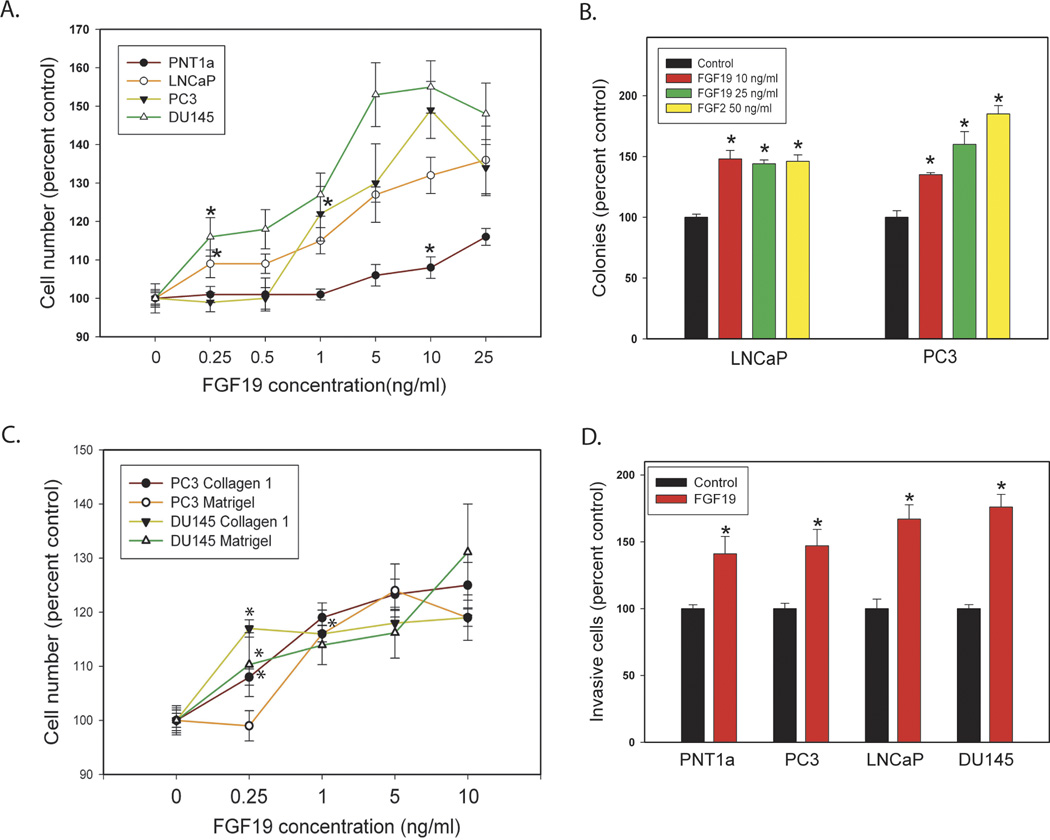
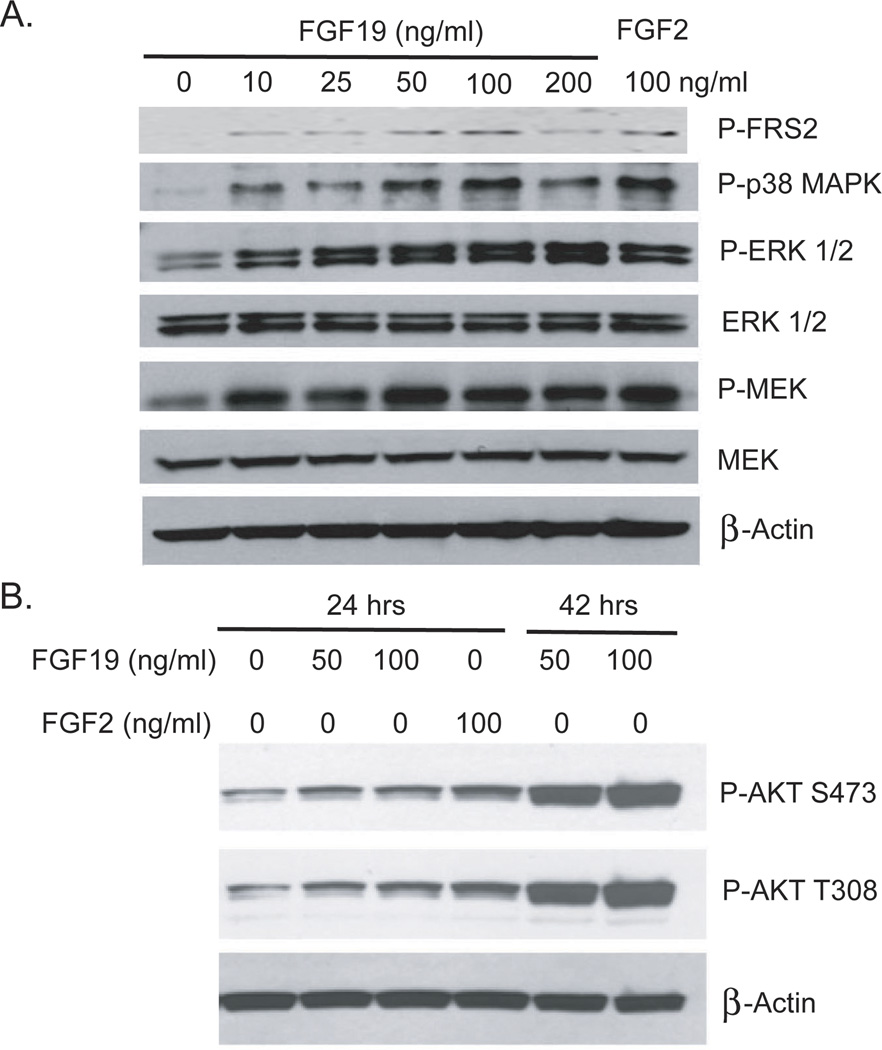
Prostate cancer is the most common visceral malignancy and the second leading cause of cancer deaths in US men. There is broad evidence that fibroblast growth factor (FGF) receptors are important in prostate cancer initiation and progression, but the contribution of particular FGFs in this disease is not fully understood. The FGF family members FGF19, FGF21, and FGF23 comprise a distinct subfamily that circulate in serum and act in an endocrine manner. These endocrine FGFs require α-Klotho (KL) and/or β-Klotho (KLB), two related single-pass transmembrane proteins restricted in their tissue distribution, to act as coreceptors along with classic FGF receptors (FGFR) to mediate potent biologic activity. Here we show that FGF19 is expressed in primary and metastatic prostate cancer tissues, where it functions as an autocrine growth factor. Exogenous FGF19 promoted the growth, invasion, adhesion, and colony formation of prostate cancer cells at low ligand concentrations. FGF19 silencing in prostate cancer cells expressing autocrine FGF19 decreased invasion and proliferation in vitro and tumor growth in vivo. Consistent with these observations, KL and/or KLB were expressed in prostate cancer cells in vitro and in vivo, raising the possibility that additional endocrine FGFs may also exert biologic effects in prostate cancer. Our findings support the concept that therapies targeting FGFR signaling may have efficacy in prostate cancer and highlight FGF19 as a relevant endocrine FGF in this setting.
©2013 AACR.
Conflict of interest statement
The authors disclose no potential conflicts of interest.
Figures



References
-
- Harmer NJ, Pellegrini L, Chirgadze D, Fernandez-Recio J, Blundell TL. The crystal structure of fibroblast growth factor (FGF) 19 reveals novel features of the FGF family and offers a structural basis for its unusual receptor affinity. Biochemistry. 2004;43:629–640. - PubMed
-
- Kurosu H, Kuro OM. The Klotho gene family as a regulator of endocrine fibroblast growth factors. Mol Cell Endocrinol. 2009;299:72–78. - PubMed
-
- Fu L, John LM, Adams SH, Yu XX, Tomlinson E, Renz M, et al. Fibroblast growth factor 19 increases metabolic rate and reverses dietary and leptin-deficient diabetes. Endocrinology. 2004;145:2594–2603. - PubMed
-
- Choi M, Moschetta A, Bookout AL, Peng L, Umetani M, Holmstrom SR, et al. Identification of a hormonal basis for gallbladder filling. Nat Med. 2006;12:1253–1255. - PubMed
Publication types
MeSH terms
Substances
Grants and funding
LinkOut - more resources
Full Text Sources
Other Literature Sources
Medical