


Slum upgrading strategies involving physical environment and infrastructure interventions and their effects on health and socio-economic outcomes
- PMID: 23440845
- PMCID: PMC12423365
- DOI: 10.1002/14651858.CD010067.pub2
Slum upgrading strategies involving physical environment and infrastructure interventions and their effects on health and socio-economic outcomes
Abstract
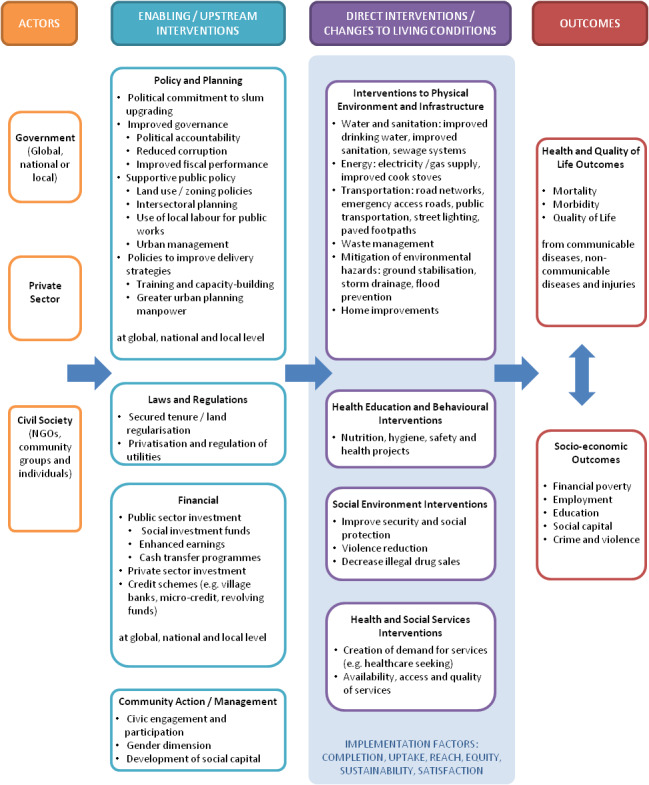
Background: Slums are densely populated, neglected parts of cities where housing and living conditions are exceptionally poor. In situ slum upgrading, at its basic level, involves improving the physical environment of the existing area, such as improving and installing basic infrastructure like water, sanitation, solid waste collection, electricity, storm water drainage, access roads and footpaths, and street lighting, as well as home improvements and securing land tenure.
Objectives: To explore the effects of slum upgrading strategies involving physical environment and infrastructure interventions on the health, quality of life and socio-economic wellbeing of urban slum dwellers in low and middle income countries (LMIC). Where reported, data were collected on the perspectives of slum dwellers regarding their needs, preferences for and satisfaction with interventions received.
Search methods: We searched for published and unpublished studies in 28 bibliographic databases including multidisciplinary (for example Scopus) and specialist databases covering health, social science, urban planning, environment and LMIC topics. Snowballing techniques included searching websites, journal handsearching, contacting authors and reference list checking. Searches were not restricted by language or publication date.
Selection criteria: We included studies examining the impact of slum upgrading strategies involving physical environment or infrastructure improvements (with or without additional co-interventions) on the health, quality of life and socio-economic wellbeing of LMIC urban slum dwellers. Randomised controlled trials (RCTs), controlled before and after studies (CBAs) and interrupted time series (ITS) were eligible for the main analysis. Controlled studies with only post-intervention data (CPI) and uncontrolled before and after (UBA) studies were included in a separate narrative to examine consistency of results and to supplement evidence gaps in the main analysis.
Data collection and analysis: Two authors independently extracted data and assessed risk of bias for each study. Differences between the included study interventions and outcomes precluded meta-analysis so the results were presented in a narrative summary with illustrative harvest plots. The body of evidence for outcomes within the main analysis was assessed according to GRADE as very low, low, moderate or high quality.
Main results: We identified 10,488 unique records, with 323 screened as full text. Five studies were included for the main analysis: one RCT with a low risk, two CBAs with a moderate risk and two CBAs with a high risk of bias. Three CBAs evaluated multicomponent slum upgrading strategies. Road paving only was evaluated in one RCT and water supply in one CBA. A total of 3453 households or observations were included within the four studies reporting sample sizes.Most health outcomes in the main studies related to communicable diseases, for which the body of evidence was judged to be low quality. One CBA with a moderate risk of bias found that diarrhoeal incidence was reduced in households which received water connections from a private water company (risk ratio (RR) 0.53; 95% confidence interval (CI) 0.27 to 1.04) and the severity of diarrhoeal episodes (RR 0.48; 95% CI 0.19 to 1.22). There was no effect for duration of diarrhoea. Road paving did not result in changes in parasitic infections or sickness in one RCT. After multicomponent slum upgrading, claims for a waterborne disease as opposed to a non-waterborne disease reduced (RR 0.64; 95% CI 0.27 to 0.98) in one CBA with a high risk of bias but there was no change in sanitation-related mortality in a CBA with a moderate risk of bias.The majority of socio-economic outcomes reported within the main studies related to financial poverty, for which the body of evidence was of very low quality. Results were mixed amongst the main studies; one RCT and two CBAs reported no effect on the income of slum dwellers following slum upgrading. One further CBA found significant reduction in monthly water expenditure (mean difference (MD) -17.11 pesos; 95% CI -32.6 to -1.62). One RCT also showed mixed results for employment variables, finding no effect on unemployment levels but increased weekly worked hours (MD 4.68; 95% CI -0.46 to 9.82) and lower risk of residents intending to migrate for work (RR 0.78; 95% CI 0.60 to 1.01).There was no evidence available to assess the impact of slum upgrading on non-communicable diseases or social capital. Maternal and perinatal conditions, infant mortality, nutritional deficiencies, injuries, self-reported quality of life, education and crime were evaluated in one study each.Nine supporting studies were included that measured varying outcomes (6794 households or observations within eight studies reporting sample sizes). One CPI evaluated cement flooring only while three UBAs and five CPIs evaluated multicomponent slum upgrading strategies. All studies but one had a high risk of bias.The studies reinforced main study findings for diarrhoea incidence and water-related expenditure. Findings for parasitic infections and financial poverty were inconsistent with the main studies. In addition, supporting studies reported a number of disparate outcomes that were not evaluated in the main studies.Five supporting studies included some limited information on slum dweller perspectives. They indicated the importance of appropriate siting of facilities, preference for private facilities, delivering synergistic interventions together, and ensuring that infrastructure was fit for purpose and systems were provided for cleaning, maintenance and repair.
Authors' conclusions: A high risk of bias within the included studies, heterogeneity and evidence gaps prevent firm conclusions on the effect of slum upgrading strategies on health and socio-economic wellbeing. The most common health and socio-economic outcomes reported were communicable diseases and indicators of financial poverty. There was a limited but consistent body of evidence to suggest that slum upgrading may reduce the incidence of diarrhoeal diseases and water-related expenditure. The information available on slum dwellers' perspectives provided some insight to barriers and facilitators for successful implementation and maintenance of interventions.The availability and use of reliable, comparable outcome measures to determine the effect of slum upgrading on health, quality of life and socio-economic wellbeing would make a useful contribution to new research in this important area. Given the complexity in delivering slum upgrading, evaluations should look to incorporate process and qualitative information alongside quantitative effectiveness data to determine which particular interventions work (or don't work) and for whom.
Conflict of interest statement
None
Figures


Update of
References
References to studies included in this review
Abelson 1996 {published data only}
-
- Abelson P. Evaluation of slum improvements. Case study in Visakhaptnam, India. Cities 13;2:97‐108.
Aiga 2002 {published data only}
-
- Aiga H, Umenai T. Impact of improvement of water supply on household economy in a squatter area of Manila. Social Science and Medicine 2002;55:627‐41. - PubMed
Butala 2010 {published data only}
-
- Butala NM, VanRooyen MJ, Patel RB. Improved health outcomes in urban slums through infrastructure upgrading. Social Science and Medicine 2010;71:935‐40. - PubMed
Cattaneo 2009 {published data only}
-
- Cattaneo MD, Galiani S, Gertler PJ, Martinez S, Titiunik R. Housing, health and happiness. American Economic Journal: Economic Policy 2009;1(1):75‐105.
-
- Cattaneo MD, Galiani S, Gertler PJ, Martinez S, Titiunik R. Housing, health and happiness. American Economic Journal: Economic Policy February 2009;1(1):75‐105.
De Leon 1986 {published data only}
-
- Leon LT. Barrio Escopa. Journal of Architectural and Planning Research 1986;3(2):93‐116.
Galiani 2007 {published data only}
-
- Galiani S, Gonzalez‐Rozada M, Schargrodsky E. Water expansions in Shantytowns: Health and Savings. Water expansions in shantytowns: Health and savings. Washington: Inter‐American Development Bank, 2007.
Gonzalez‐Navarro 2010 {published data only}
-
- Gonzalez‐Navarro M, Quintana‐Domeque C. Roads to Development: Experimental Evidence from Urban Road Pavement. Social Science Research Network Working Paper February 23 2010. [DOI: ; Available at SSRN: http://ssrn.com/abstract=1558631]
-
- Gonzalez‐Navarro M, Quintana‐Domeque C. Slum upgrading: evidence from an urban road pavement experiment in Mexico. Proceedings of the International Conference on Infrastructure Economics and Development February 22 2010;C92, C93, H41, O15, O12:1‐60. [http://www.eea‐esem.com/files/papers/EEA/2010/1819/pavement_experiment.pdf]
-
- Gonzalez‐Navarro M, Quintana‐Domeque C. Urban Infrastructure and economic development: experimental evidence from street pavement. Institute for the Study of Labor (IZA) November 2010;Discussion Paper No. 5346:0‐51. [http://ftp.iza.org/dp5346.pdf]
Joshi 2002 {published data only}
-
- Joshi R. Integrated Slum Development in the slums of of Pravinagar‐Guptanagar, Ahmedabad. In: Amitabh Kundu, Darshini Mahadevia (Eds) editor(s). Poverty and Vulnerability in a Globalising Metropolis. Delhi, India: Manak, 2002. [http://www.ashanet.org/dallas/projects/saath/IntegratedSlumDevelopment.htm]
Milone 1993 {published data only}
-
- Milone P. Kampung improvement in the small and medium sized cities of central Java. Review of Urban and Regional Development Studies 1993;5(1):74‐94.
Moitra 1987 {published data only}
-
- Moitra MK, Samajdar S. Evaluation of the slum improvement program of Calcutta Bustees. In: Skinner RJ, Taylor JL, Wegelin EA editor(s). Shelter upgrading for the urban poor:evaluation of Third World experience. Manila: Island Publishing House, 1987.
Moraes 2004 {published data only}
-
- Moraes LRS, Cairncross S. Environmental interventions and the pattern of geohelminth infections in Salvador, Brazil. Parasitology 2004;129:223‐32. - PubMed
-
- Moraes LRS, Cancio JA, Cairncross S. Impact of drainage and sewerage on intestinal nematode infections in poor urban areas in Salvador, Brazil. Transactions of the Royal Society of Tropical Medicine and Hygiene 2004;98(197):204. - PubMed
-
- Moraes LRS, Cancio JA, Cairncross S, Huttly S. Impact of drainage and sewerage on diarrhoea in poor urban areas in Salvador, Brazil. Transactions of the Royal Society of Tropical Medicine and Hygiene 2003;97:153‐8. - PubMed
Parikh in press {published data only}
-
- Parikh P, McRobie A. Engineering as a tool for improving human habitat. International Journal of Management and Decision Making 2009;10(3/4):270‐81.
-
- Parikh P, Parikh M, McRobie A. The role of infrastructure in improving human settlements. Proceedings of the ICE ‐ Urban Design and Planning 5 June 2012;Paper 1000038:1‐18. [DOI: ]
Soares 2005 {published data only}
-
- Soares F, Soares Y. The socio‐economic impact of Favela‐Bairro: What do the data say?. Office of Evaluation and Oversight. Washington: Inter‐American Development Bank, August 2005.
Taylor 1987 {published data only}
-
- Taylor JL. Evaluation of the Jakarta kampung improvement programme. In: Skinner RJ, Taylor JL, Wegelin EA editor(s). Shelter upgrading for the urban poor:evaluation of Third World experience. Manila: Island Publishing House, 1987.
References to studies excluded from this review
Choudhary 2002 {published data only}
-
- Choudhary R. Building for the future: Influence of housing on intelligence quotients of children in an urban slum. Health Policy and Planning 2002;17(4):420‐4. - PubMed
Chowdhury 2006 {published data only}
-
- Chowdhury FJ, Amin ATMN. Environmental assessment in slum improvement programs: Some evidence from a study on infrastructure projects in two Dhaka slums. Environmental Impact Assessment Review 2006;26(6):530‐52.
Dasgupta 2006 {published data only}
-
- Dasgupta B, Lall SV. Assessing benefits of slum upgrading programs in second‐best settings. World Bank Policy Research Working Paper 3993 August 2006:1‐40. [http://www‐wds.worldbank.org/servlet/WDSContentServer/WDSP/IB/2006/08/09/000016406_...
De Moura 2009 {published data only}
-
- Moura M, Silveira Bueno D, Leony L. How land title affects child labor?. The World Bank, Policy Research Working Paper, 5010 July 2009; Vol. Impact Evaluation Series No.37.
Field 2003 {published data only}
-
- Field E. Fertility Responses to Urban Titling Programs: The Roles of Ownership Security and the Distribution of Household Assets. Harvard University Working Paper 2003.
Field 2007 {published data only}
-
- Field E. Entitled to work: Urban property rights and labor supply in Peru. Quarterly Journal of Economics 2007;122(4):1561‐602.
Galdo 2005 {published data only}
-
- Galdo V, Briceno B. Evaluating the Impact on Child Mortality of a Water Supply Project and Sewerage Expansion in Quito: Is Water Enough?. Inter‐American Development Bank 2005; Vol. 105.
Galiani 2005 {published data only}
-
- Galiani S, Gertler PJ, Schargrodsky E. Water For Life: The impact of the privatization of water services on child mortality. Journal of Political Economy 2005;113(1):83‐120.
Gamper‐Rabindran 2008 {published data only}
-
- Gamper‐Rabindran S, Khan S, Timmins C. The Impact of Piped Water Provision on Infant Mortality in Brazil: A Quantile Panel Data Approach. NBER Working Paper No. 14365. Cambridge, Massachusetts: National Bureau of Economic Research, September 2008:1‐72. [http://www.nber.org/papers/w14365]
Genser 2008 {published data only}
-
- Genser B. Impact of a city‐wide sanitation intervention in a large urban centre on social, environmental and behavioural determinants of childhood diarrhoea: Analysis of two cohort studies. International Journal of Epidemiology 2008;37(4):831‐40. - PubMed
Gross 1989 {published data only}
-
- Gross R. The impact of improvement of water supply and sanitation facilities on diarrhea and intestinal parasites: a Brazilian experience with children in two low‐income urban communities. Revista de Saude Publica 1989;23(3):214‐20. - PubMed
Hanchett 2003 {published data only}
-
- Hanchett S, Akhter S, Khan MH, Mezulianik S, Blagbrough V. Water, sanitation and hygiene in Bangladeshi slums: An evaluation of the Wateraid‐Bangladesh urban programme. Environment and Urbanization 2003;15(2):43‐56.
Hayuma 1979 {published data only}
-
- Hayuma AM. Training‐Program for the Improvement of Slums and Squatter Areas in Tanzania. Habitat International 1979;4(1‐2):119‐29.
Izeogu 1993 {published data only}
-
- Izeogu CV. Public policy and affordable housing for the urban poor in Nigeria. A study of squatter redevelopment programs in Port Harcourt. Habitat International 1993;17(2):21‐38.
Marcano 2008 {published data only}
-
- Marcano L, Ruprah IJ. An Impact Evaluation of Chile's Progressive Housing Program. Inter‐American Development Bank, Office of Evaluation and Oversight (OVE), June 2008; Vol. Working Paper 0608:1‐36. [http://www.iadb.org/intal/intalcdi/PE/2009/03162.pdf]
Mathey 2005 {published data only}
-
- Mathey K. Reduction of urban violence through neighbourhood improvement. A strategy for Khayelitsha Township in Cape Town, South Africa. Trialog 2005;87:17‐24.
Nientied 1987 {published data only}
-
- Nientied P. Evaluation of squatter settlement upgrading in Baldia, Karachi, Shelter Upgrading for the Urban Poor: Evaluation of Third World Experience. Shelter Upgrading for the Urban Poor. Skinner Reinhard, 1987:1‐261.
Parikh 2007 {published data only}
-
- Parikh PH. Health impact of water and sanitation in the low income settlements of India and South Africa. Water management challenges in global change. Taylor & Francis, 2007:659‐66.
Perlman 2008 {published data only}
-
- Perlman JE. Parsing the Urban Poverty Puzzle: A Multi‐generational Panel Study in Rio de Janeiro's Favelas, 1968 ‐ 2008. Working Paper // World Institute for Development Economics Research 2008; Vol. No 2010, 27. [https://www.econstor.eu/dspace/bitstream/10419/54113/1/636508854.pdf]
Rakodi 1988 {published data only}
-
- Rakodi C. Upgrading in Chawama, Lusaka: displacement or differentiation?. Urban Studies 1988;25(4):297‐318.
Ruprah 2008 {published data only}
-
- Ruprah I. An Impact Evaluation of a Neighbourhood Crime Prevention Program: Does Safer Commune Make Chileans Safer?. Inter‐American Development Bank Office of Evaluation and Oversight. Working Paper: OVE/WP‐09/08 November 2008.
Takeuchi 2008 {published data only}
-
- Takeuchi A, Cropper M, Bento A. Measuring the welfare effects of slum improvement programs: The case of Mumbai. Journal of Urban Economics 2008;64(1):65‐84.
Tironi 2009 {published data only}
-
- Tironi M. The lost community? Public housing and social capital in Santiago de Chile, 1985‐2001. International Journal of Urban and Regional Research 2009;33(4):974‐97.
References to ongoing studies
Cooper 2007 {published data only}
-
- Cooper R, Galiani S, Gerter P, Martinez S, Ross A, Undurraga R. Slum Housing Upgrading in El Salvador & Uruguay [in process 2007 ‐]. Poverty Action Lab. Translating Research into Action. [http://www.povertyactionlab.org/evaluation/slum‐housing‐upgrading‐el‐sal...
Additional references
Cadavid 2010
-
- Cadavid PR. Moving in ‐ selling out: the outcomes of slum rehabilitation in Mumbai. CERNA Working Paper Series, April 2010.
CIDG 2011
-
- Campbell International Development Coordinating Group. Protocol and Review Guidelines. The Campbell Collaboration, December 2011.
Cities Alliance 2011
-
- Cities Alliance. What is upgrading?. http://www.citiesalliance.org/ca/About‐slum‐upgrading (accessed July 2012).
Clasen 2006
Clasen 2010
CPHG 2011
-
- Cochrane Public Health Group. Guide for developing a Cochrane protocol. Melbourne, Australia: Cochrane Public Health Group, November 2011. [http://ph.cochrane.org/sites/ph.cochrane.org/files/uploads/Guide%20for%2...
Craig 2012
-
- Craig P, Cooper C, Gunnell D, Haw S, Lawson K, Macintyre S, et al. Using natural experiments to evaluate population health interventions: new Medical Research Council guidance. Journal of Epidemiology and Community Health 10 May 2012;(online first):1‐5. [DOI: 10.1136/jech-2011-200375] - DOI - PMC - PubMed
Feiken 2010
Field 2005
-
- Field E. Property rights and investment in urban slums. Journal of the European Economic Association 2005;3(2‐3):279‐90.
Field 2006
-
- Field EM, Kremer M. Impact evaluation for slum upgrading interventions. Washington D.C.: World Bank, Poverty Reduction and Economic Management, Thematic Group on Poverty Analysis, 2006.
Galea 2005
Gruen 2004
Guyatt 2008
Higgins 2002
-
- Higgins JP, Thomson SG. Quantifying heterogeneity in a meta‐analysis. Statistics in Medicine 2002;21(11):1539‐8. - PubMed
Higgins 2011
-
- Higgins JPT, Green S (editors). Cochrane Handbook for Systematic Reviews of Effectiveness. Oxford: The Cochrane Collaboration, Version 5.1.0 [updated March 2011].
Hutton 2004
-
- Hutton G, Haller L. Evaluation of the costs and benefits of water and sanitation improvements at the global level. World Health Organization, 2004. - PubMed
Jackson 2006
-
- Jackson R, Ameratunga S, Broad Jetal. The GATE frame: critical appraisal with pictures. Evidence Based Medicine 2006;11(2):35‐8. - PubMed
Keef 2004
-
- Keef S, Roberts L. The meta‐analysis of partial effect sizes. British Journal of Mathematical and Statistical Psychology 2004;57(97):129. - PubMed
Kellet 1992
-
- Kellett P. Residential mobility and consolidation processes in spontaneous settlements: the case of Santa Marta, Colombia. Third World Planning Review 1992;14(4):355‐69.
Kyobutngi 2008
NICE 2009
-
- National Institute for Health and Clinical Excellence. Methods for the development of NICE public health guidance. Methods for the development of NICE public health guidance. 2. London: NICE, April 2009.
Northridge 2003
Noyes 2011
-
- Noyes J, Booth A, Hannes K, Harden A, Harris J, Lewin S, Lockwood C (eds). Supplementary guidance for inclusion of qualitative research in Cochrane systematic reviews of interventions. Cochrane Collaboration Qualitative Methods Group, August 2011.
Ogilvie 2008
Riley 2007
Sclar 2005
-
- Sclar ED, Garau P, Carolini G. The 21st century health challenge of slums and cities. Lancet 2005;365:901‐3. - PubMed
UN HABITAT 2003a
-
- UN HABITAT. The Challenge of Slums. London: Earthscan, 2003.
UN HABITAT 2003b
-
- UN HABITAT. Guide to Monitoring Target 11: Improving the lives of 100 million slum dwellers. Progress towards the Millennium Development Goals. Nairobi: UN Habitat, Global Urban Observatory, May 2003. [DOI: ]
Unger 2007
United Nations 2007a
-
- United Nations. State of world population 2007. Unleashing the Potential of Urban Growth. New York: United Nations Population Fund (UNFPA), 2007.
United Nations 2007b
-
- United Nations. Human Settlements Programme GUO. Report on Progress on the MDGs Target 7. Nairobi, Kenya: United Nations, 2007.
United Nations 2010
-
- United Nations. The Millennium Development Goals Report. New York: United Nations, 2010.
United Nations 2012
-
- United Nations. The Millenium Development Goals Report 2012. The Millenium Development Goals Report 2012. New York: United Nations, 2012. [http://mdgs.un.org/unsd/mdg/Resources/Static/Products/Progress2012/Engli...
Vaessen 2010
-
- Vaessen J. Challenges in impact evaluation of development interventions: opportunities and limitations for randomized experiments. Institute of Development Policy and Management, 2010.
Verma 2000
-
- Verma GD. Indore’s Habitat Improvement Project: success or failure?. Habitat International 2000;24:91‐117.
Waddington 2009
-
- Waddington H, Snilsveit B. Effectiveness and sustainability of water, sanitation and hygiene interventions in combating diarrhoea. Journal of Development Effectiveness August 2009;1(3):295‐335.
Wekesa 2011
-
- Wekesa BW, Steyn GS, Otieno FAO. A review of physical and socio‐economic characteristics and intervention approaches of informal settlements. Habitat International 2011;25:238‐45.
WHO 2005
-
- WHO Kobe Centre. A billion voices: listening and responding to the health needs of slum dwellers and informal settlers in new urban settings. An analytical and strategic review paper for the Knowledge Network on Urban Settings, WHO Commission on Social Determinants of Health. WHO Kobe Centre Japan, 2005. [http://www.who.int/social_determinants/resources/urban_settings.pdf]
World Bank
-
- World Bank. Country and Lending Groups. http://data.worldbank.org/about/country‐classifications/country‐and‐lend... Last accessed: 19 September 2011.
Publication types
MeSH terms
LinkOut - more resources
Full Text Sources
Other Literature Sources
