. 2013 Feb;15(2):156-68.
doi: 10.1593/neo.121398.

The roles of telomerase in the generation of polyploidy during neoplastic cell growth

Affiliations

The roles of telomerase in the generation of polyploidy during neoplastic cell growth

Agni Christodoulidou et al. Neoplasia. 2013 Feb.

Abstract

Polyploidy contributes to extensive intratumor genomic heterogeneity that characterizes advanced malignancies and is thought to limit the efficiency of current cancer therapies. It has been shown that telomere deprotection in p53-deficient mouse embryonic fibroblasts leads to high rates of polyploidization. We now show that tumor genome evolution through whole-genome duplication occurs in ∼15% of the karyotyped human neoplasms and correlates with disease progression. In a panel of human cancer and transformed cell lines representing the two known types of genomic instability (chromosomal and microsatellite), as well as the two known pathways of telomere maintenance in cancer (telomerase activity and alternative lengthening of telomeres), telomere dysfunction-driven polyploidization occurred independently of the mutational status of p53. Depending on the preexisting context of telomere maintenance, telomerase activity and its major components, human telomerase reverse transcriptase (hTERT) and human telomerase RNA component (hTERC), exert both reverse transcriptase-related (canonical) and noncanonical functions to affect tumor genome evolution through suppression or induction of polyploidization. These new findings provide a more complete mechanistic understanding of cancer progression that may, in the future, lead to novel therapeutic interventions.


Figures
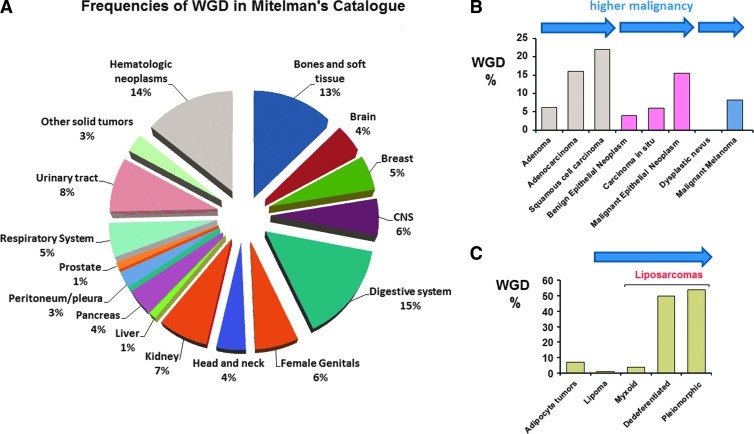
Figure 1
Figure 1
Frequencies of polyploidization in Mitelman Catalog of Chromosome Abnormalities in Cancer: Data mining in a total of 59,772 karyotyped samples of human neoplasms included in Mitelman Database at the time of our analysis reveals that polyploidization through WGD occurs in virtually all types of human neoplasia, affecting about 15% of all cases. The percentages of WGD between different histopathologic entities varied between 1% and 15% (A). In several types of solid tumors, the frequencies of recorded WGD were found accelerated in cases representing disease progress or higher grades of malignancy: Note a three-fold to four-fold increase in the rates of WGD when adenomas are compared to adenocarcinomas, or squamous cell carcinomas, as well as between benign epithelial neoplasms or carcinomas in situ and malignant epithelial neoplasms. In melanocytic tumors, identification of WGD might be an indication of malignancy because benign dysplastic nevi do not exert WGD (B). Only 5% to 6% of total adipose tumors display evidence of WGD; however, the presence of WGD is strongly associated to disease progression from the benign lipomas and well-differentiated myxoid liposarcomas to the more malignant dedifferentiated or pleiomorphic liposarcomas (C).
Figure 2
Figure 2
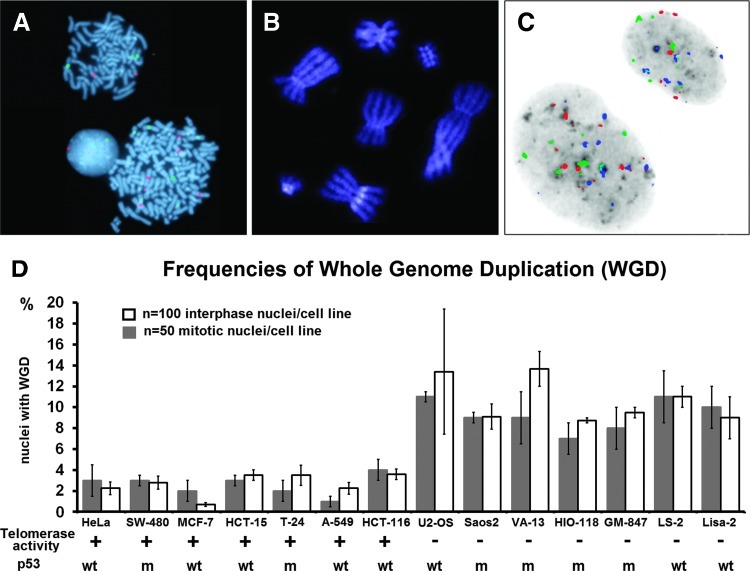
Mitotic and interphase polyploidies in a panel of human cancer and immortalized cell lines: WGD in cytogenetic preparations of SW-480 cells stained by DAPI (blue) and centromere-specific probes for chromosomes 3 (red, Texas Red) and 9 (green, fluorescein isothiocyanate) (A). Mitotic presence of diplochromosomes reveals endoreduplication-driven WGD in SW-480 cells lentivirally transduced with shRNA against hTERT (B). Interphase WGD in U2-OS nuclei labeled with inverted DAPI (gray) and centromeric probes specific for human centromeres 3 (red, Texas Red), 7 (green, fluorescein isothiocyanate), and 18 (blue, spectrum aqua) (630x) (C). Comparison of the rates of mitotic and interphase WGDs in 14 continuous human cell lines: Telomerase activity is indicated as (+) or (-) by TRAP. Status of p53 is indicated as wild type (WT) or mutated (M) (Table W1). HCT-15 and HCT-116 cell lines display MIN [45,53]. The remaining 12 cell lines can be categorized as CIN. The ALT cell lines that are characterized by extreme rates of telomere dysfunction display a significantly higher propensity for both interphase and mitotic WGDs (P < .0001 by analysis of variance) (D).
Figure 3
Figure 3
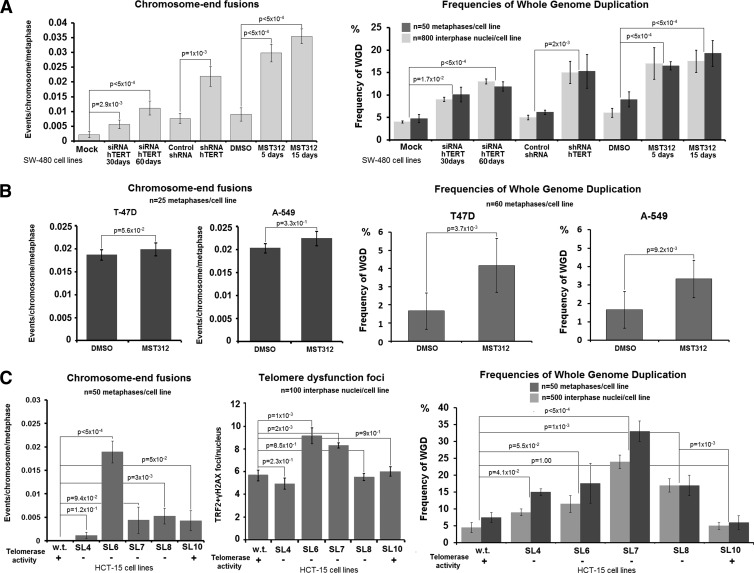
Inducible telomere dysfunction in CIN and MIN cell lines is associated with increased frequencies of WGD: Depletion of hTERT by serial transient siRNA transfections, lentiviral transduction with an shRNA against hTERT, or exposure to the telomerase inhibitor MST312 in the CIN SW-480 cells is associated with increased telomere dysfunction and significantly elevated levels of mitotic and interphase WGDs (A). Telomerase inhibition through MST312 for 10 days results to insignificant increase in end-to-end fusions but still leads to significant induction of WGD in two additional CIN cell lines with extremely low rates of endogenous polyploidization (A-549 and T47D) (B). Robust hTERT knockdown in different sublines of the MIN HCT-15 colon adenocarcinoma cell line, representing consequent PDs after retroviral introduction of an antimorph against hTERT. After PD180, telomerase activity is spontaneously restored (SL10) [45]. In this setting, telomerase knockdown leads to increase in telomere dysfunction and WGD, whereas restoration of telomerase activity suppresses WGD (C). Statistics by paired t test or chi-square test.
Figure 4
Figure 4
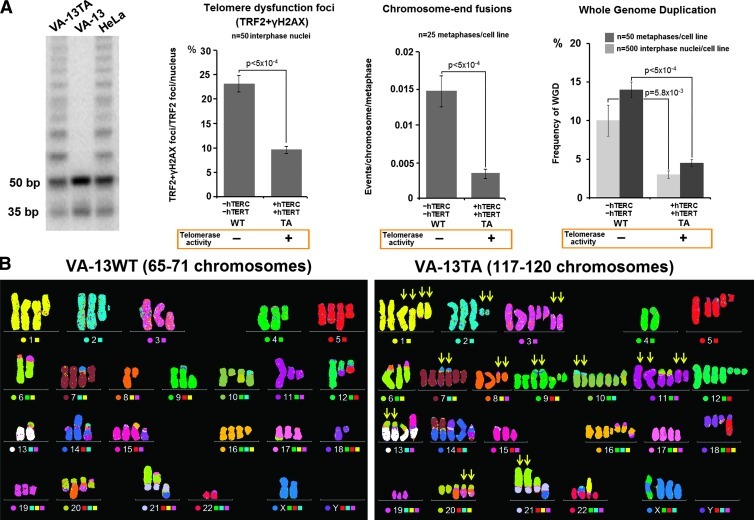
Constitutive telomerase activity in ALT cells reduces telomere dysfunction but is related to high prevalence of polyploidy: Long-term stable reconstitution of telomerase activity in the VA-13TA cell line through exogenous introduction of hTERC and hTERT (indicated by TRAP) reduces significantly endogenous telomere dysfunction, as indicated by the rates of chromosome end-to-end fusions and TIFs, and suppresses the rates of WGD (A). Prolonged exposure to telomerase activity in VA-13TA is accompanied by high prevalence of polyploid nuclei composed from 117 to 120 chromosomes (98%). Multicolor FISH indicates that the representative VA-13TA karyotype contains duplicated copies of several structurally altered chromosomes of the parental ALT VA-13 cells (arrows) (630x) (B). Statistics by paired t test or chi-square test.
Figure 5
Figure 5
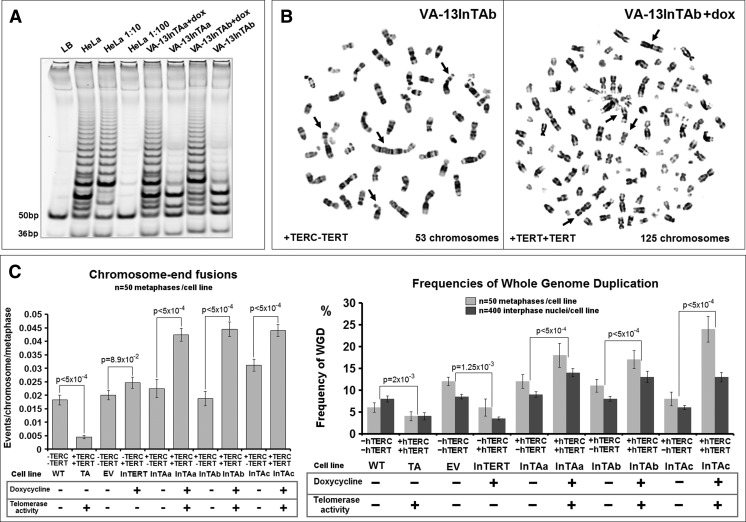
Inducible reconstitution of telomerase activity in ALT cells increases telomere dysfunction and polyploidy through WGD: TRAP assay shows inducible telomerase activity in the VA-13 derivative multiclonal cell lines InTAa and InTAb, after 5 days in doxycycline (A). Reconstitution of telomerase activity in InTAb cells increases frequencies of chromosome end-to-end fusions (arrows) and WGD (inverted DAPI, 630x) (B). Constitutive expression of hTERC in the three InTA (a, b, and c) cell lines is related to a significant increase in telomere dysfunction-driven chromosome terminal fusions as compared to parental WT cells and the TA cell line that stably expresses telomerase activity. The rates of telomere dysfunction after 5 days in doxycycline and activation of the telomerase holoenzyme are highly accelerated. Elevated frequencies of WGD in mitotic and interphase nuclei of different VA-13 cell lines correspond to the rates of telomere dysfunction (C). Statistics by paired t test or chi-square test.
Figure 6
Figure 6
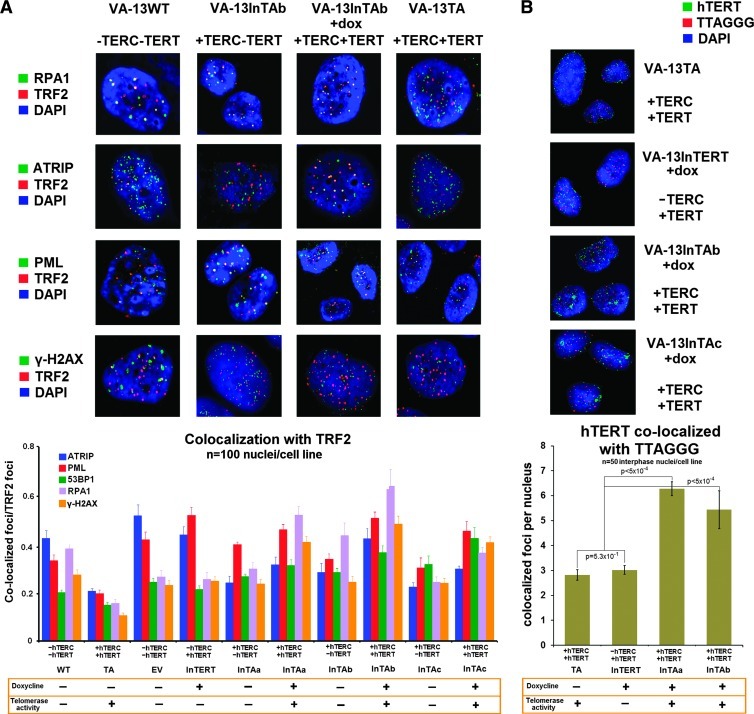
Nuclear association of telomeric binding TRF2 with DDR proteins and of hTERT with telomeric repeats in VA-13 cells. Examples of nuclear co-localization of TRF2-specific antibodies, with the DDR proteins RPA1, ATRIP, PML, and γ-H2AX, by immunofluorescence, in parental ALT VA-13 (WT), in InTAb (constitutive expression of hTERC), in InTAb + doxycycline cells (inducible expression of hTERT and telomerase activity after 5 days of doxycycline in culture), and in VA-13TA cells that constitutively express both holoenzyme components and display telomerase activity for more than 200 PDs (630x). The graph depicts frequencies of spatial interaction of TRF2 with ATRIP, PML, 53BP1, RPA1, and γ-H2AX by dual-color IF in 100 nuclei/cell line. Constitutive overexpression of hTERC in the three independent InTA (a, b, and c) cell lines is associated with significantly reduced co-localization rates of TRF2 with PML (P = .001, P = .002, and P = .001) and ATRIP (P = .007, P = .003, and P = .002), whereas rates of classic TIFs (co-localization of TRF2 with γ-H2AX) remain unaffected. Doxycycline-induced reconstitution of telomerase activity in these cell lines restored levels of co-localization between TRF2 and PML (P = .012, P = .000, and P = .012, respectively) or ATRIP (P = .007, P = .001, and P = .001, respectively), increasing in parallel frequencies of classic TIFs and the rates of spatial association of TRF2 with 53BP1 (P = .045, P = .018, and P = .034, respectively) and RPA1 (P < .0001, P = .001, and P < .0001). Inducible expression of hTERT alone, in the InTERT cells, did not exert any effects in spatial association of TRF2 with DDR components (ATRIP, P = .192; PML, P = .060; 53BP1, P = .139; RPA1, P = .786; γ-H2AX, P = .123) (A). Immuno-FISH depicts nuclear localization of an antibody specific for hTERT and TTAGGG telomeric repeats (630x). Compared to the stable +hTERC+hTERT TA cells, the rates of spatial association of telomerase with the telomeres are significantly elevated after 5 days of the interphase between the sole action of ALT and the introduction of telomerase activity (InTAc + doxycycline, P = .529; InTAa and InTAb, P < .0001) (B) (all statistics by paired t test).
Figure 7
Figure 7
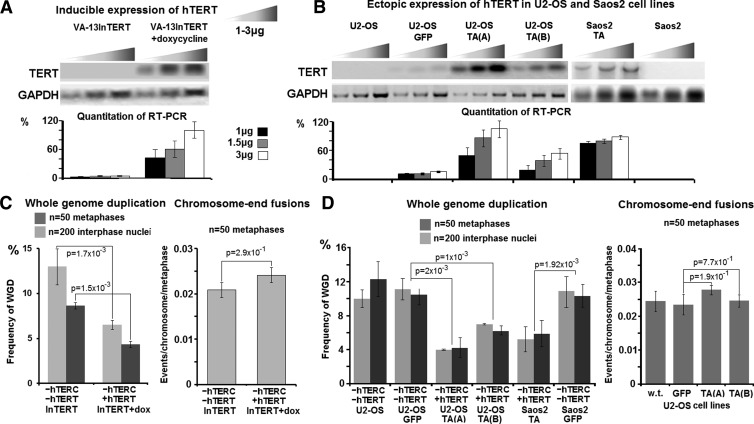
Ectopic expression of hTERT in the absence of telomerase activity suppresses endogenous polyploidization in ALT cells: Semiquantitative RT-PCR indicates inducible and stable expression of hTERT, in three ALT human cell lines (A, B). In the absence of telomerase activity, the inducible introduction of hTERT in the VA-13 derivative InTERT cell line for 30 days did not affect telomeric integrity, as indicated by the frequencies of terminal chromosome fusions, but reduced significantly the rates of endogenous mitotic and interphase WGDs (C). Similarly, the lentiviral transduction of U2-OS cells with particles carrying GFP or hTERT + GFP had insignificant effects on telomere functionality but significantly suppressed WGD. Suppression of WGD upon ectopic expression of hTERT was also observed in Saos2 cells. Transduction rates for U2-OS TA(A) and U2-OS GFP reached 90% to 95%, 50% to 60% for U2-OS TA(B), and 60% to 75% for Saos2TA and Saos2 GFP (D). Statistics by paired t test or chi-square test.

References

    1. Rajagopalan H, Jallepalli PV, Rago C, Velculescu VE, Kinzler KW, Vogelstein B, Lengauer C. Inactivation of hCDC4 can cause chromosomal instability. Nature. 2004;428:77–81. - PubMed
    1. Rajagopalan H, Lengauer C. Aneuploidy and cancer. Nature. 2004;432:338–341. - PubMed
    1. Bayani J, Selvarajah S, Maire G, Vukovic B, Al-Romaih K, Zielenska M, Squire JA. Genomic mechanisms and measurement of structural and numerical instability in cancer cells. Semin Cancer Biol. 2007;17:5–18. - PubMed
    1. Gorgoulis VG, Vassiliou LV, Karakaidos P, Zacharatos P, Kotsinas A, Liloglou T, Venere M, Ditullio RA, Jr, Kastrinakis NG, Levy B, et al. Activation of the DNA damage checkpoint and genomic instability in human precancerous lesions. Nature. 2005;434:907–913. - PubMed
    1. Nowell PC. The clonal evolution of tumor cell populations. Science. 1976;4260:23–28. - PubMed

Publication types