


Identification of a novel nonsense mutation p.Tyr1957Ter of CACNA1A in a Chinese family with episodic ataxia 2
- PMID: 23441182
- PMCID: PMC3575407
- DOI: 10.1371/journal.pone.0056362
Identification of a novel nonsense mutation p.Tyr1957Ter of CACNA1A in a Chinese family with episodic ataxia 2
Abstract
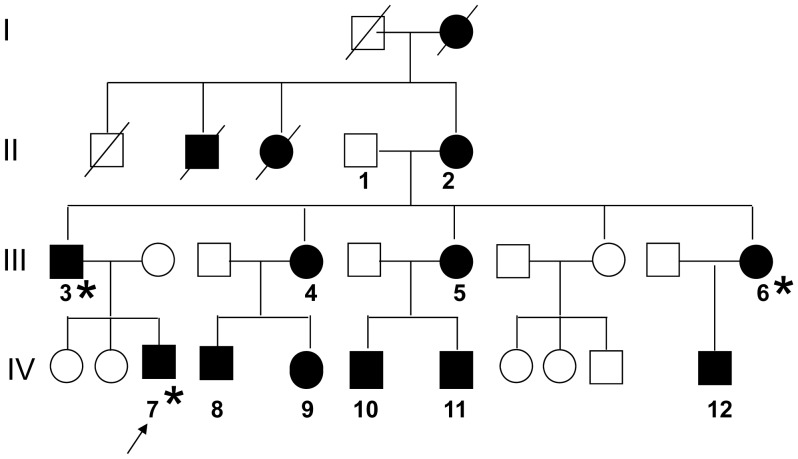
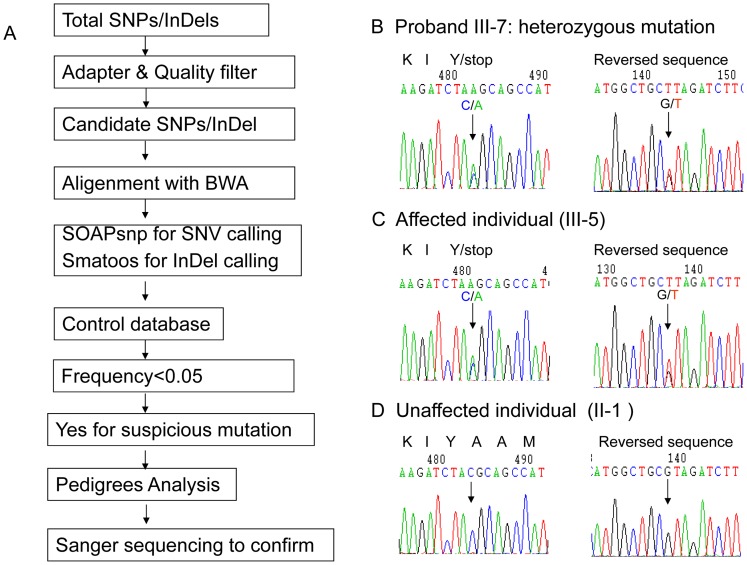
Type 2 episodic ataxia (EA2) is the most common subtype among a group of rare hereditary syndromes characterized by recurrent attacks of ataxia. More than 60 mutations and several gene rearrangements due to large deletions in CACNA1A gene have been reported so far for the cause of EA2. Because CACNA1A gene is a large gene containing 47 exons and there is no hot spot mutation, direct sequencing will be a challenge in clinical genetic testing. In this study, we used next generation sequencing technology to identify a novel nonsense mutation of CACNA1A (p.Tyr1957Ter, NP_001120693.1) resulting in truncated protein without 305 amino acids in the c-terminus. Sanger sequencing confirmed the heterozygous mutation of CACNA1A in a Chinese family with 11 affected individuals. Affected individuals experienced recurrent attacks with or without nystagmus, dysarthria, seizure, myokymia, dystonia, weakness, blurred vision, visual field defects, diplopia, migraine, dizziness, nausea and vomiting, sweating and abdominal pain. This is the first report of EA2 in a Chinese family that carries a novel mutation in CACNA1A gene and had abdominal pain as a novel phenotype associated with EA2.
Conflict of interest statement
Figures
References
-
- Jen JC, Graves TD, Hess EJ, Hanna MG, Griggs RC, et al. (2007) Primary episodic ataxias: diagnosis, pathogenesis and treatment. Brain 130: 2484–2493. - PubMed
-
- Browne DL, Gancher ST, Nutt JG, Brunt ER, Smith EA, et al. (1994) Episodic ataxia/myokymia syndrome is associated with point mutations in the human potassium channel gene, KCNA1. Nat Genet 8: 136–40. - PubMed
-
- Ophoff RA, Terwindt GM, Vergouwe MN, van Eijk R, Oefner PJ, et al. (1996) Familial hemiplegic migraine and episodic ataxia type-2 are caused by mutations in the Ca2þ channel gene CACNL1A4. Cell 87: 543–52. - PubMed
-
- Jen JC, Wan J, Palos TP, Howard BD, Baloh RW (2005) Mutation in the glutamate transporter EAAT1 causes episodic ataxia, hemiplegia, and seizures. Neurology 65: 529–34. - PubMed
Publication types
MeSH terms
Substances
Supplementary concepts
LinkOut - more resources
Full Text Sources
Other Literature Sources
Miscellaneous
