


A review of breast cancer care and outcomes in Latin America
- PMID: 23442305
- PMCID: PMC3607519
- DOI: 10.1634/theoncologist.2012-0373
A review of breast cancer care and outcomes in Latin America
Abstract
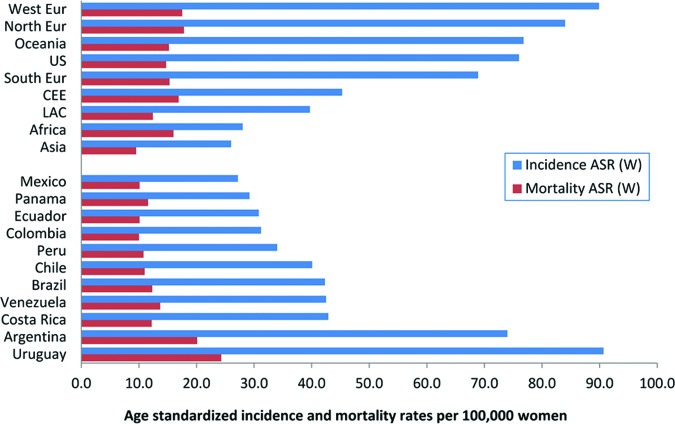
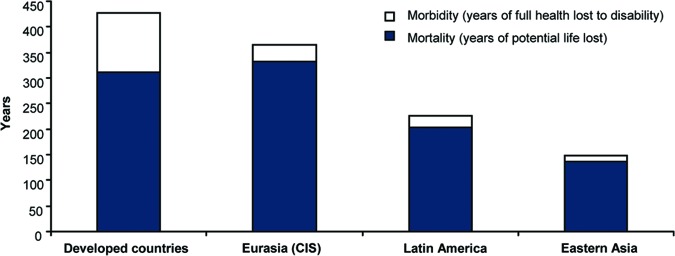
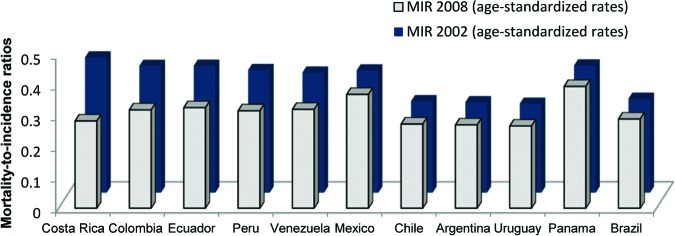
This review presents an overview of breast cancer care, burden, and outcomes in Latin America, as well as the challenges and opportunities for improvement. Information was gleaned through a review of the literature, public databases, and conference presentations, in addition to a survey of clinical experts and patient organizations from the region. Breast cancer annual incidence (114,900 cases) and mortality (37,000 deaths) are the highest of all women's cancers in Latin America, and they are increasing. Twice as many breast cancer deaths are expected by 2030. In Peru, Mexico, Colombia, and Brazil, diagnosis and death at younger ages deprives society of numerous productive years, as does high disease occurrence in Argentina and Uruguay. Approximately 30%-40% of diagnoses are metastatic disease. High mortality-to-incidence ratios (MIRs) in Latin America indicate poor survival, partly because of the late stage at diagnosis and poorer access to treatment. Between 2002 and 2008, MIRs decreased in all countries, albeit unevenly. Costa Rica's change in MIR outpaced incidence growth, indicating impressive progress in breast cancer survival. The situation is similar, although to a lesser extent, in Colombia and Ecuador. The marginal drops of MIRs in Brazil and Mexico mainly reflect incidence growth rather than progress in outcomes. Panama's MIR is still high. Epidemiological data are scattered and of varying quality in Latin America. However, one could ascertain that the burden of breast cancer in the region is considerable and growing due to demographic changes, particularly the aging population, and socioeconomic development. Early diagnosis and population-wide access to evidence-based treatment remain unresolved problems, despite progress achieved by some countries.
Conflict of interest statement
Disclosures of potential conflicts of interest may be found at the end of this article.
Figures
References
-
- Wilking N, Kasteng F. A review of breast cancer care and outcomes in 18 countries in Europe, Asia and Latin America. [Accessed December 10, 2012]. Available at http://www.comparatorreports.se/A_review_of_breast_cancer_care_and_outco....
-
- Ferlay J, Shin H, Bray F, et al. GLOBOCAN 2008 v1.2: Cancer incidence and mortality worldwide. Lyon, France: International Agency for Research on Cancer; 2010.
-
- Tirona MT, Sehgal R, Ballester O. Prevention of breast cancer (part I): Epidemiology, risk factors, and risk assessment tools. Cancer Invest. 2010;28:743–750. - PubMed
-
- Lozano-Ascencio R, Gómez-Dantés H, Lewis S, et al. Breast cancer trends in Latin America and the Caribbean. Salud Publica Mex. 2009;51(suppl 2):S147–S156. - PubMed
Publication types
MeSH terms
LinkOut - more resources
Full Text Sources
Other Literature Sources
Medical
