Review
. 2013 May;56(5):949-64.
doi: 10.1007/s00125-013-2869-1. Epub 2013 Feb 27.

Insulin signalling mechanisms for triacylglycerol storage

Affiliations
Review

Insulin signalling mechanisms for triacylglycerol storage

M P Czech et al. Diabetologia. 2013 May.

Abstract

Insulin signalling is uniquely required for storing energy as fat in humans. While de novo synthesis of fatty acids and triacylglycerol occurs mostly in liver, adipose tissue is the primary site for triacylglycerol storage. Insulin signalling mechanisms in adipose tissue that stimulate hydrolysis of circulating triacylglycerol, uptake of the released fatty acids and their conversion to triacylglycerol are poorly understood. New findings include (1) activation of DNA-dependent protein kinase to stimulate upstream stimulatory factor (USF)1/USF2 heterodimers, enhancing the lipogenic transcription factor sterol regulatory element binding protein 1c (SREBP1c); (2) stimulation of fatty acid synthase through AMP kinase modulation; (3) mobilisation of lipid droplet proteins to promote retention of triacylglycerol; and (4) upregulation of a novel carbohydrate response element binding protein β isoform that potently stimulates transcription of lipogenic enzymes. Additionally, insulin signalling through mammalian target of rapamycin to activate transcription and processing of SREBP1c described in liver may apply to adipose tissue. Paradoxically, insulin resistance in obesity and type 2 diabetes is associated with increased triacylglycerol synthesis in liver, while it is decreased in adipose tissue. This and other mysteries about insulin signalling and insulin resistance in adipose tissue make this topic especially fertile for future research.


Figures

Fig. 1
Fig. 1
Insulin signalling attenuates cAMP-mediated lipolysis at multiple steps in adipocytes. (a) NPs signal through NP receptor A to increase cGMP levels and activate PKG. (b) Stimulation of the β-adrenergic receptor increases cAMP levels, which activates PKA. (c) The lipolytic actions of PKA and PKG converge through phosphorylating perilipin-1 (Plin1), releasing CGI-58 to bind and activate ATGL, thereby stimulating hydrolysis of triacylglycerol to DAG. (d) Both PKA and PKG also phosphorylate HSL, inducing its translocation to lipid droplets, where it interacts with phosphorylated perilipin and acts primarily to convert DAG to MAG. (e) Activation of the insulin receptor–IRS signalling pathway inhibits lipolysis through activation of adipose-specific phospholipase A2 (AdPLA2), which inhibits adenylate cyclase via prostaglandin E2 synthesis, while activation of Akt leads to phosphodiesterase 3B (PDE-3B) activation to lower cAMP levels. Lipid droplet protein FSP27 is also upregulated by insulin signalling. (f) mTORC1 acts as a critical node in the control of adipocyte lipid metabolism, through reducing Atgl mRNA levels and (g) stimulating lipogenesis via SREBP1-c. Alternatively, mTORC1 stimulates a negative feedback loop through activation of (h) S6K and growth factor receptor-bound protein 10 (GRB10). (i) PKA can also regulate adipocyte lipid handling by modulating its own activity by phosphorylating and activating PDE-3B, while PKA has also been shown to (j) inhibit mTORC1
Fig. 2
Fig. 2
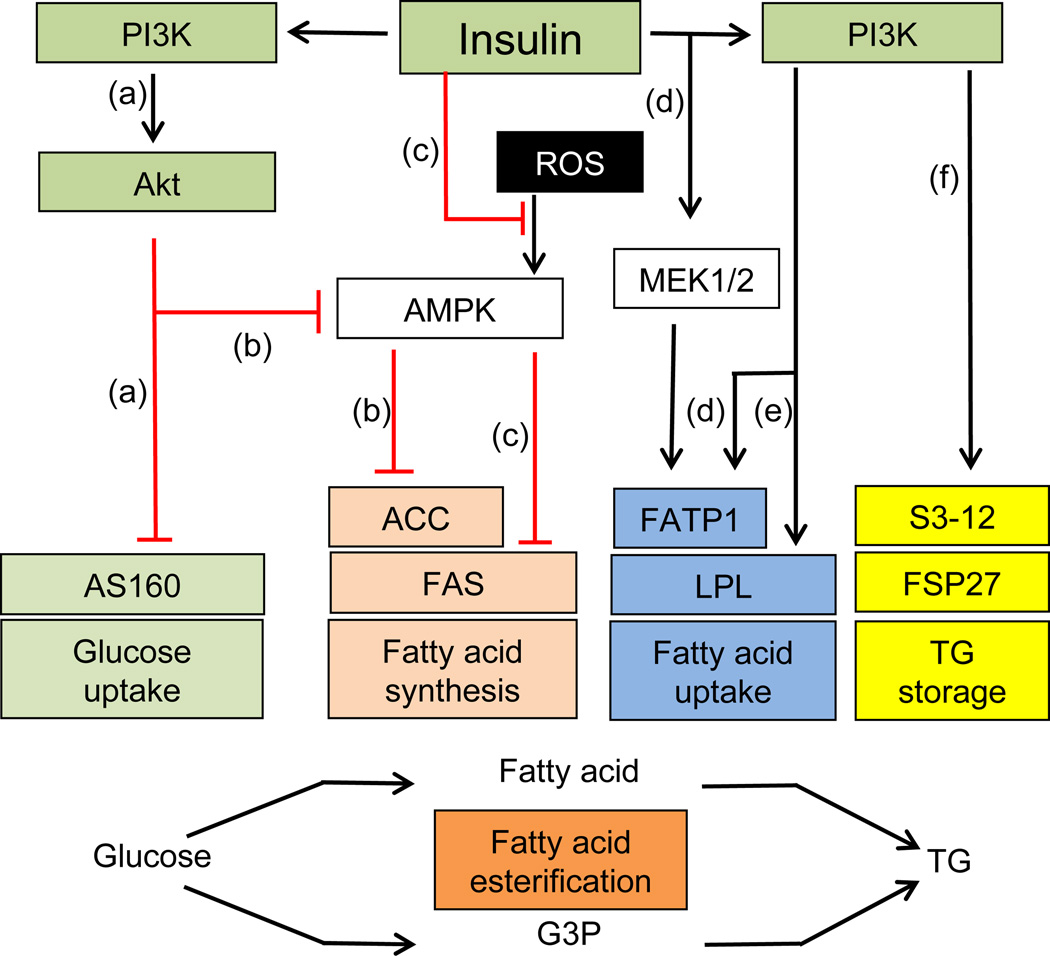
Insulin signalling exerts rapid stimulation of glucose transport as well as fatty acid uptake, synthesis and esterification to triacylglycerol (TG). (a) Stimulation of the PI3K/Akt pathway by insulin leads to inhibition of AS160 and GLUT4 translocation. Glucose is converted to glycerol 3-phosphaate and fatty acids. (b) Insulin-stimulated Akt may inhibit AMPK by phosphorylation. This in turn would lead to dephosphorylation and activation of ACC, increasing malonyl CoA production and de novo lipogenesis. (c) Reactive oxygen species (ROS) are reported to activate AMPK, which then phosphorylates and inhibits FAS. Insulin treatment decreases the inhibition of FAS induced by ROS. (d) Insulin increases fatty acid uptake by stimulating the translocation of FATP1 from intracellular vesicles to the plasma membrane mediated by PI3K or the MAPK pathway. (e) Insulin increases fatty acid uptake by stimulating LPL levels and activity through PI3K. (f) Insulin triacylglycerol synthesis or retention in adipocytes can be altered through regulation of lipid droplet protein S3-12 redistribution or FSP27 levels
Fig. 3
Fig. 3
Transcriptional regulation of lipogenic enzymes by insulin and glucose studied in hepatocytes (orange background) and adipocytes (yellow background). The degree to which the mechanisms discovered in liver apply to adipocytes is likely to be high, but this has not yet been established. (a) Insulin may increase the levels of active SREBP-1c through the atypical PKC PKCλ/ζ and (b) PI3K. (c) Activation of PI3K by insulin leads to increased SREBP-1c levels through mTORC1. (d) Insulin stimulates processing of SREBP-1c through the mTORC1 substrate S6K. (e) Insulin negatively regulates levels of Insig-2a, which inhibits SREBP processing. (f) Lipin-1 is a direct substrate of mTORC1 and a negative regulator of nuclear SREBP activity. Once active, SREBP can induce the transcription of lipogenic genes. (g) Insulin-stimulated protein phosphatase-1 (PP1) dephosphorylates and activates DNA-PK, which in turn phosphorylates USF1/2. By interacting with SREBP, USF1/2 increases expression of Fas and de novo lipogenesis. (h) Insulin-stimulated glucose uptake in adipocytes activates ChREBP-α, which stimulates production of its isoform ChREBP-β. The target genes of SREBP1c and ChREBP-α and ChREBP-β are involved in adipogenesis, glucose uptake, glycolysis, lipogenesis, and triacylglycerol storage. FA, fatty acid; SCAP, SREBP cleavage-activating protein
Fig. 4
Fig. 4
PPARγ as a key regulator of lipogenesis in adipocytes and hypothetical major target for inhibitors of insulin-stimulated lipogenesis in obesity. Adipocytes from obese rodents and humans display decreased levels of lipogenic transcription factors (SREBP1c and ChREBP) and lipogenic enzymes (FAS, SCD1, ELOVL, DGAT) compared with lean controls. (a) Attenuation of PPARγ by candidate inhibitors generated in obesity would explain the downregulation of all of these proteins. Direct inhibition of the lipogenic transcription factors and enzymes by such inhibitors is also possible. (b) Inhibition of early steps in insulin signalling is also evident in adipocytes in obesity, through attenuation of IRS tyrosine phosphorylation and other inhibitory mechanisms, as shown in Fig. 1. While the factors listed as candidate inhibitors in the top box can be shown in vitro to exert such effects, the extent to which they contribute to insulin resistance in adipocytes in vivo remains to be fully elucidated. It should be noted that PPARγ also stimulates production of the enzyme phosphoenolpyruvate carboxykinase (not shown in the Figure), which in turn stimulates lipogenesis through the pathway of glyceroneogenesis [55]. Thus PPARγ disruption will also lead to attenuation of this pathway. DGAT, Diglyceride acyltransferase; ELOVL, Elongation of long-chain fatty acids; SCD1, stearoyl-CoA desaturase

References

    1. Tattersall RB. A force of magical activity: the introduction of insulin treatment in Britain 1922–1926. Diabet Med. 1995;12:739–755. - PubMed
    1. Dentin R, Girard J, Postic C. Carbohydrate responsive element binding protein (ChREBP) and sterol regulatory element binding protein-1c (SREBP-1c): two key regulators of glucose metabolism and lipid synthesis in liver. Biochimie. 2005;87:81–86. - PubMed
    1. Frayn KN. Regulation of fatty acid delivery in vivo. Adv Exp Med Biol. 1998;441:171–179. - PubMed
    1. Frayn KN. Adipose tissue and the insulin resistance syndrome. Proc Nutr Soc. 2001;60:375–380. - PubMed
    1. Boden G. Free fatty acids-the link between obesity and insulin resistance. Endocr Pract. 2001;7:44–51. - PubMed

Publication types

LinkOut - more resources