Tympanic border cells are Wnt-responsive and can act as progenitors for postnatal mouse cochlear cells
- PMID: 23444352
- PMCID: PMC3585657
- DOI: 10.1242/dev.087528
Tympanic border cells are Wnt-responsive and can act as progenitors for postnatal mouse cochlear cells
Abstract
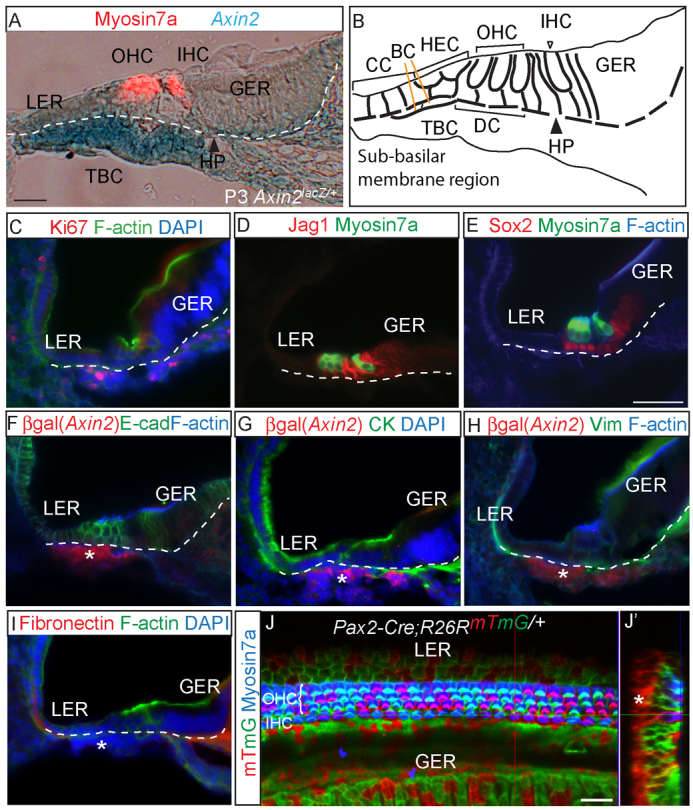
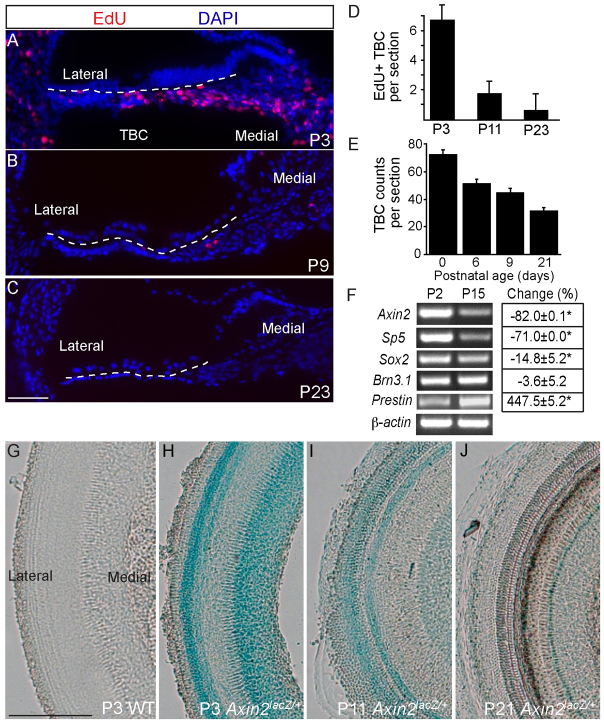
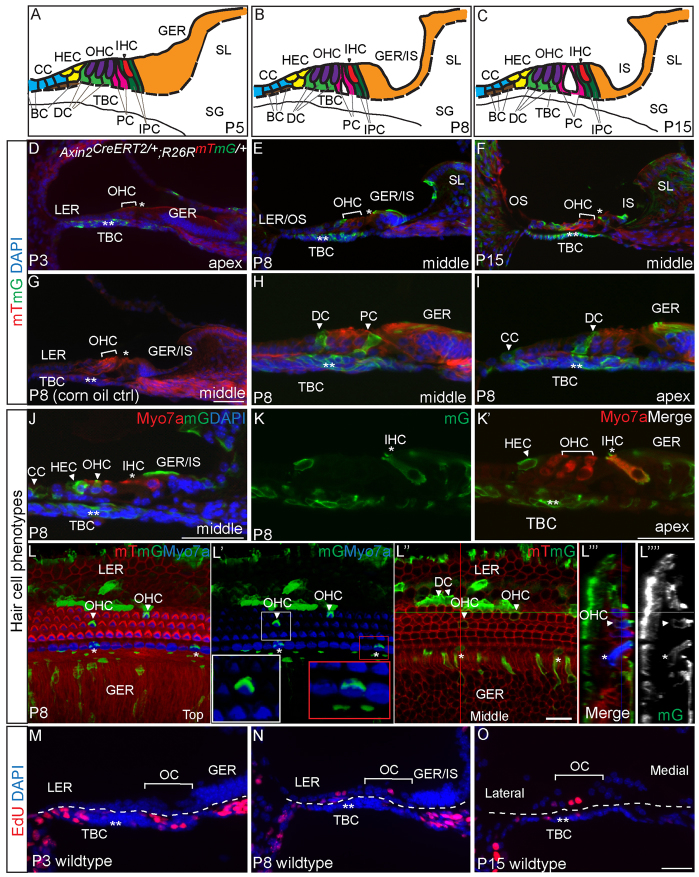
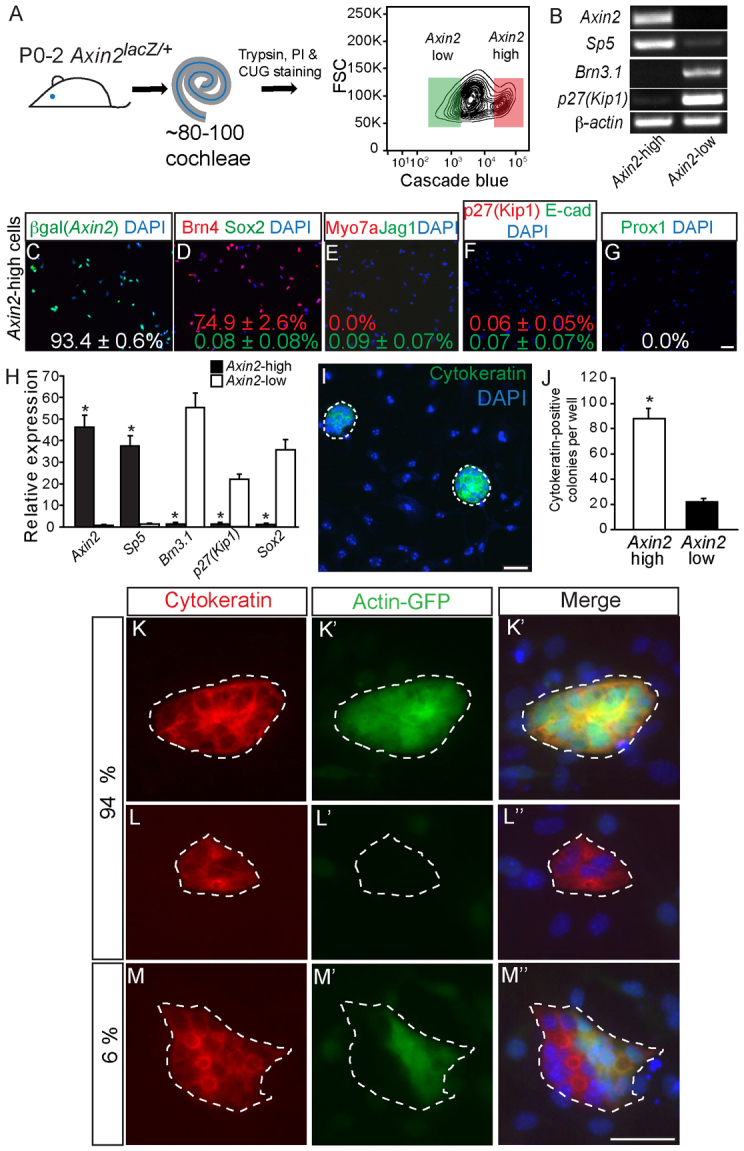
Permanent hearing loss is caused by the irreversible damage of cochlear sensory hair cells and nonsensory supporting cells. In the postnatal cochlea, the sensory epithelium is terminally differentiated, whereas tympanic border cells (TBCs) beneath the sensory epithelium are proliferative. The functions of TBCs are poorly characterized. Using an Axin2(lacZ) Wnt reporter mouse, we found transient but robust Wnt signaling and proliferation in TBCs during the first 3 postnatal weeks, when the number of TBCs decreases. In vivo lineage tracing shows that a subset of hair cells and supporting cells is derived postnatally from Axin2-expressing TBCs. In cochlear explants, Wnt agonists stimulated the proliferation of TBCs, whereas Wnt inhibitors suppressed it. In addition, purified Axin2(lacZ) cells were clonogenic and self-renewing in culture in a Wnt-dependent manner, and were able to differentiate into hair cell-like and supporting cell-like cells. Taken together, our data indicate that Axin2-positive TBCs are Wnt responsive and can act as precursors to sensory epithelial cells in the postnatal cochlea.
Figures
References
-
- Ahn K. J., Passero F., Jr, Crenshaw E. B., 3rd (2009). Otic mesenchyme expression of Cre recombinase directed by the inner ear enhancer of the Brn4/Pou3f4 gene. Genesis 47, 137–141 - PubMed
-
- Amma L. L., Goodyear R., Faris J. S., Jones I., Ng L., Richardson G., Forrest D. (2003). An emilin family extracellular matrix protein identified in the cochlear basilar membrane. Mol. Cell. Neurosci. 23, 460–472 - PubMed
-
- Barker N., van Es J. H., Kuipers J., Kujala P., van den Born M., Cozijnsen M., Haegebarth A., Korving J., Begthel H., Peters P. J., et al. (2007). Identification of stem cells in small intestine and colon by marker gene Lgr5. Nature 449, 1003–1007 - PubMed
-
- Barker N., Huch M., Kujala P., van de Wetering M., Snippert H. J., van Es J. H., Sato T., Stange D. E., Begthel H., van den Born M., et al. (2010). Lgr5(+ve) stem cells drive self-renewal in the stomach and build long-lived gastric units in vitro. Cell Stem Cell 6, 25–36 - PubMed
Publication types
MeSH terms
Substances
Grants and funding
LinkOut - more resources
Full Text Sources
Other Literature Sources
Medical
Molecular Biology Databases