


Analysis of ventilatory ratio as a novel method to monitor ventilatory adequacy at the bedside
- PMID: 23445563
- PMCID: PMC4057449
- DOI: 10.1186/cc12541
Analysis of ventilatory ratio as a novel method to monitor ventilatory adequacy at the bedside
Abstract
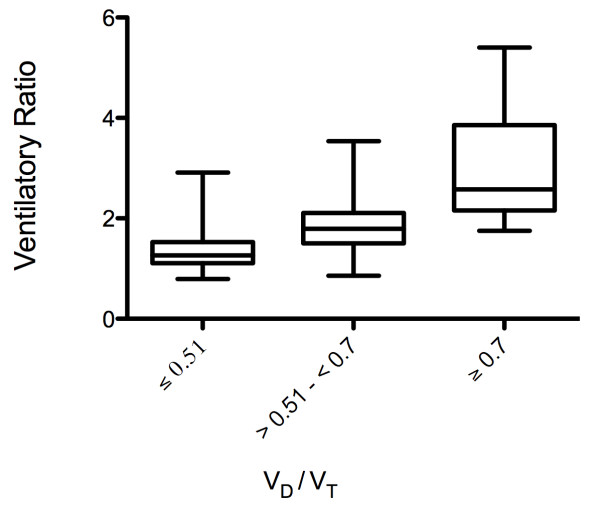
Introduction: Due to complexities in its measurement, adequacy of ventilation is seldom used to categorize disease severity and guide ventilatory strategies. Ventilatory ratio (VR) is a novel index to monitor ventilatory adequacy at the bedside. VR=(VEmeasured × PaCO₂measured)/(VEpredicted × PaCO₂ideal). VEpredicted is 100 mL.Kg-1.min-1 and PaCO₂ideal is 5 kPa. Physiological analysis shows that VR is influenced by dead space (VD/VT) and CO₂ production (VCO₂). Two studies were conducted to explore the physiological properties of VR and assess its use in clinical practice.
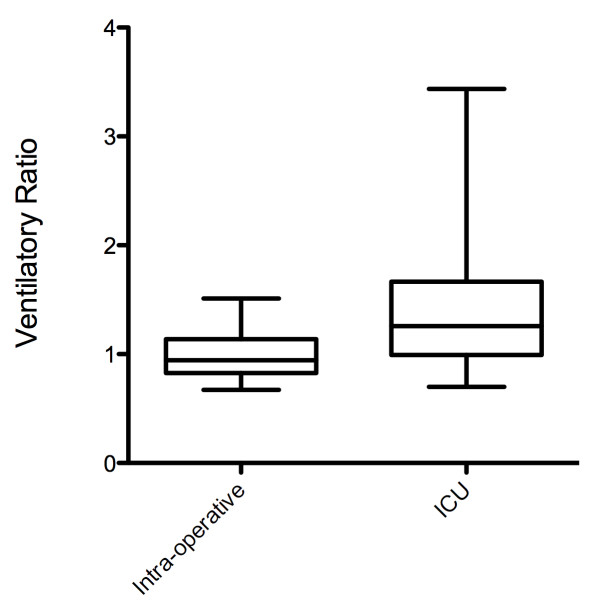
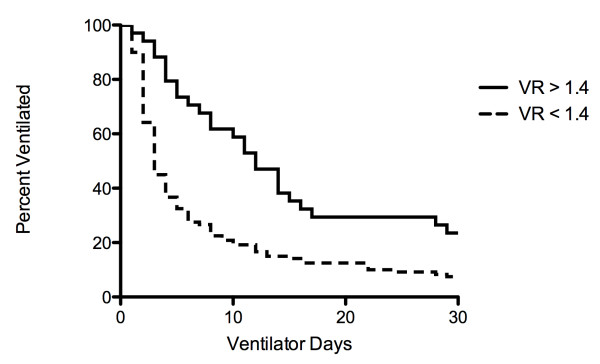
Methods: Both studies were conducted in adult mechanically ventilated ICU patients. In Study 1, volumetric capnography was used to estimate daily VD/VT and measure VCO₂ in 48 patients. Simultaneously, ventilatory ratio was calculated using arterial blood gas measurements alongside respiratory and ventilatory variables. This data was used to explore the physiological properties of VR. In Study 2, 224 ventilated patients had daily VR and other respiratory variables, baseline characteristics, and outcome recorded. The database was used to examine the prognostic value of VR.
Results: Study 1 showed that there was significant positive correlation between VR and VD/VT (modified r = 0.71) and VCO₂ (r = 0.14). The correlation between VR and VD/VT was stronger in mandatory ventilation compared to spontaneous ventilation. Linear regression analysis showed that VD/VT had a greater influence on VR than VCO₂ (standardized regression coefficient 1/1-VD/VT: 0.78, VCO₂: 0.44). Study 2 showed that VR was significantly higher in non-survivors compared to survivors (1.55 vs. 1.32; P < 0.01). Univariate logistic regression showed that higher VR was associated with mortality (OR 2.3, P < 0.01), this remained the case after adjusting for confounding variables (OR 2.34, P = 0.04).
Conclusions: VR is an easy to calculate bedside index of ventilatory adequacy and appears to yield clinically useful information.
Figures
References
-
- Kallet RH, Alonso JA, Pittet JF, Matthay MA. Prognostic value of the pulmonary dead-space fraction during the first 6 days of acute respiratory distress syndrome. Respir Care. 2004;17:1008–1014. - PubMed
MeSH terms
LinkOut - more resources
Full Text Sources
Other Literature Sources
Miscellaneous
