SD-OCT analysis of regional epithelial thickness profiles in keratoconus, postoperative corneal ectasia, and normal eyes
- PMID: 23446013
- PMCID: PMC4123636
- DOI: 10.3928/1081597X-20130129-08
SD-OCT analysis of regional epithelial thickness profiles in keratoconus, postoperative corneal ectasia, and normal eyes
Erratum in
- J Refract Surg. 2013 Apr;29(4):234. Perez-Straziota, E [corrected to Perez-Straziota, Claudia E]
Abstract
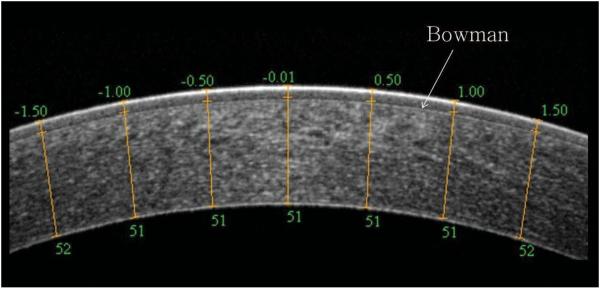
Purpose: To assess corneal microarchitecture and regional epithelial thickness profile in eyes with keratoconus, postoperative corneal ectasia (ectasia), and normal unoperated eyes (controls) using spectral-domain optical coherence tomography (SD-OCT).
Methods: Regional corneal epithelial thickness profiles were measured with anterior segment SD-OCT (Optovue RTVue-100, Optovue Inc., Fremont, CA). Epithelial thickness was assessed at 21 points, 0.5 mm apart, across the central 6-mm of the corneal apex in the horizontal and vertical meridians.
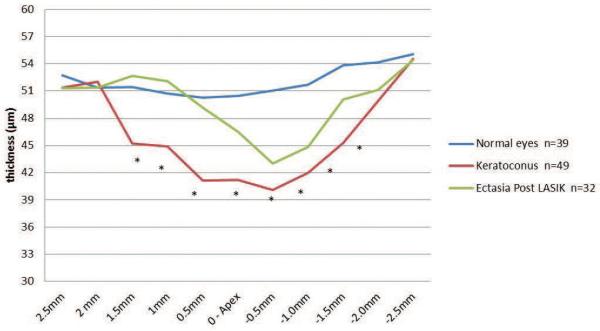
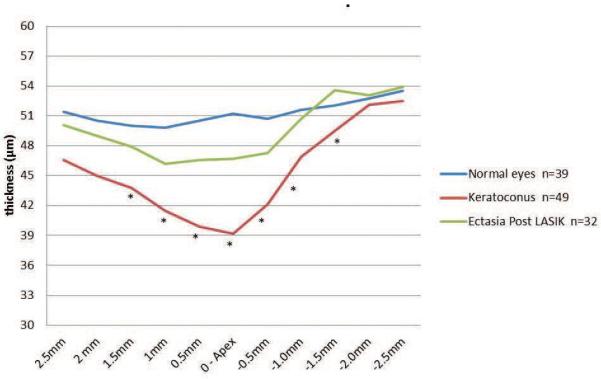
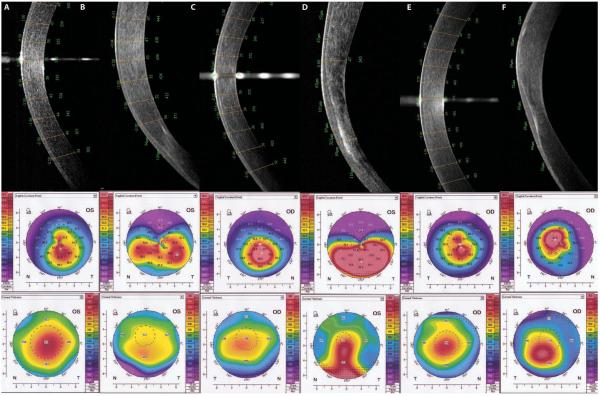
Results: One hundred twenty eyes were evaluated, including 49 eyes from 29 patients with keratoconus, 32 eyes from 16 patients with ectasia, and 39 eyes from 21 control patients. Average epithelial thickness at the corneal apex was 41.18 ± 6.47 μm (range: 30 to 51 μm) for keratoconus, 46.5 ± 6.72 μm for ectasia (range: 34 to 60 μm), and 50.45 ± 3.92 μm for controls (range: 42 to 55 μm). Apical epithelial thickness was significantly thinner in eyes with keratoconus (P < .0001) and ectasia (P = .0007) than in controls. Epithelial thickness ranges in all other areas varied widely for keratoconus (range: 21 to 101 μm) and ectasia (range: 30 to 82 μm) compared to controls (range: 43 to 64) (P = .0063).
Conclusion: SD-OCT demonstrated significant central and regional epithelial thickness profile differences between keratoconus, ectasia, and control eyes, with significant variability and unpredictability in ectatic eyes. This regional irregularity may necessitate direct epithelial thickness measurement for treatments where underlying stromal variations may be clinically relevant, including corneal collagen cross-linking or topography-guided ablations.
Copyright 2013, SLACK Incorporated.
Figures
References
-
- Raiskup-Wolf F, Hoyer A, Spoerl E, Pillunat LE. Collagen crosslinking with riboflavin and ultraviolet-A light in keratoconus: long-term results. J Cataract Refract Surg. 2008;34(5):796–801. - PubMed
-
- Alió JL, Toffaha BT, Piñero DP, Klonowski P, Javaloy J. Cross-linking in progressive keratoconus using an epithelial debridement or intrastromal pocket technique after previous corneal ring segment implantation. J Refract Surg. 2011;27(10):737–743. - PubMed
-
- Greenstein SA, Fry KL, Hersh PS. Corneal topography indices after corneal collagen crosslinking for keratoconus and corneal ectasia: one-year results. J Cataract Refract Surg. 2011;37(7):1282–1290. - PubMed
-
- Kymionis GD, Portaliou DM, Kounis GA, Limnopoulou AN, Kontadakis GA, Grentzelos MA. Simultaneous topography-guided photorefractive keratectomy followed by corneal collagen cross-linking for keratoconus. Am J Ophthalmol. 2011;152(5):748–55. - PubMed
Publication types
MeSH terms
Grants and funding
LinkOut - more resources
Full Text Sources
Other Literature Sources
Miscellaneous