


Hydrogen sulfide reduces neutrophil recruitment in hind-limb ischemia-reperfusion injury in an L-selectin and ADAM-17-dependent manner
- PMID: 23446563
- PMCID: PMC3587315
- DOI: 10.1097/PRS.0b013e31827c6e9c
Hydrogen sulfide reduces neutrophil recruitment in hind-limb ischemia-reperfusion injury in an L-selectin and ADAM-17-dependent manner
Abstract
Background: Reperfusion following ischemia leads to neutrophil recruitment into injured tissue. Selectins and β2-integrins regulate neutrophil interaction with the endothelium during neutrophil rolling and firm adhesion. Excessive neutrophil infiltration into tissue is thought to contribute to ischemia-reperfusion injury damage. Hydrogen sulfide mitigates the damage caused by ischemia-reperfusion injury. This study's objective was to determine the effect of hydrogen sulfide on neutrophil adhesion receptor expression.
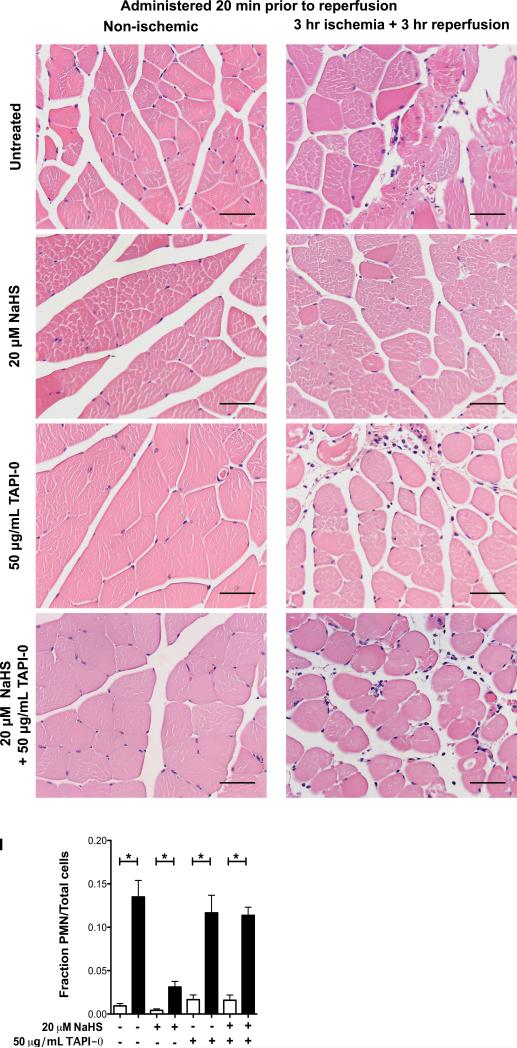
Methods: Human neutrophils were either left untreated or incubated in 20 μM hydrogen sulfide and/or 50 μg/ml pharmacologic ADAM-17 inhibitor TAPI-0; activated by interleukin-8, fMLP, or TNF-α; and labeled against P-selectin glycoprotein ligand-1, leukocyte function associated antigen-1, Mac-1 α, L-selectin, and β2-integrin epitopes CBRM1/5 or KIM127 for flow cytometry. Cohorts of three C57BL/6 mice received an intravenous dose of saline vehicle or 20 μM hydrogen sulfide with or without 50 μg/ml TAPI-0 before unilateral tourniquet-induced hind-limb ischemia for 3 hours followed by 3 hours of reperfusion. Bilateral gastrocnemius muscles were processed for histology before neutrophil infiltration quantification.
Results: Hydrogen sulfide treatment significantly increased L-selectin shedding from human neutrophils following activation by fMLP and interleukin-8 in an ADAM-17-dependent manner. Mice treated with hydrogen sulfide to raise bloodstream concentration by 20 μM before ischemia or reperfusion showed a significant reduction in neutrophil recruitment into skeletal muscle tissue following tourniquet-induced hind-limb ischemia-reperfusion injury.
Conclusions: Hydrogen sulfide administration results in the down-regulation of L-selectin expression in activated human neutrophils. This leads to a reduction in neutrophil extravasation and tissue infiltration and may partially account for the protective effects of hydrogen sulfide seen in the setting of ischemia-reperfusion injury.
Figures


References
-
- McCord JM. Oxygen-derived free radicals in postischemic tissue injury. N Engl J Med. 1985;312:159–163. - PubMed
-
- Yan HD, Zhang F, Kochevar AJ, et al. The Effect of Postconditioning on the Muscle Flap Survival After Ischemia-Reperfusion Injury in Rats. J Invest Surg. 2010;23:249–256. - PubMed
-
- Ergun Y, Darendeli S, Imrek S, et al. The comparison of the effects of anesthetic doses of ketamine, propofol, and etomidate on ischemia-reperfusion injury in skeletal muscle. Fundam Clin Pharmacol. 2010;24:215–222. - PubMed
-
- Cowled PA, Khanna A, Laws PE, et al. Simvastatin plus nitric oxide synthase inhibition modulates remote organ damage following skeletal muscle ischemia-reperfusion injury. J Invest Surg. 2008;21:119–126. - PubMed
Publication types
MeSH terms
Substances
Grants and funding
LinkOut - more resources
Full Text Sources
Other Literature Sources
Research Materials
Miscellaneous
