


Program director opinions of core competencies in hand surgery training: analysis of differences between plastic and orthopedic surgery accredited programs
- PMID: 23446569
- PMCID: PMC4804718
- DOI: 10.1097/PRS.0b013e31827c6f54
Program director opinions of core competencies in hand surgery training: analysis of differences between plastic and orthopedic surgery accredited programs
Abstract
Background: The authors' aim was to conduct a national survey of hand surgery fellowship program directors to determine differences of opinions of essential components of hand surgery training between program directors from plastic and orthopedic surgery programs.
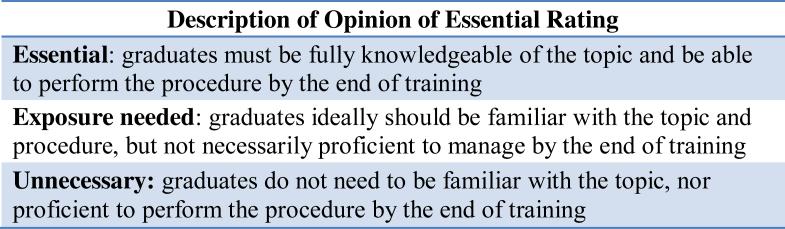
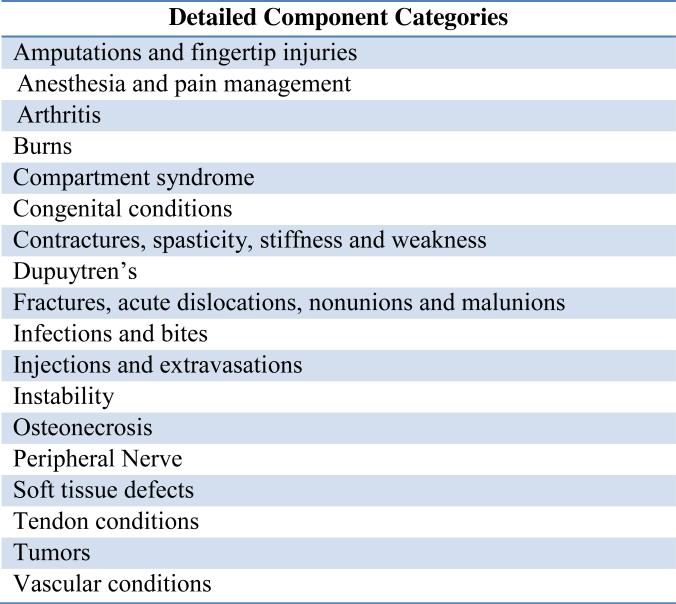
Methods: The authors performed a Web-based survey of 74 program directors from all Accreditation Council for Graduate Medical Education-accredited hand surgery fellowship programs to determine components that are essential for hand surgery training. The survey included assessment of nine general areas of practice, 97 knowledge topics, and 172 procedures. Twenty-seven scales of related survey items were created to determine differences between specialty groups based on clinical themes.
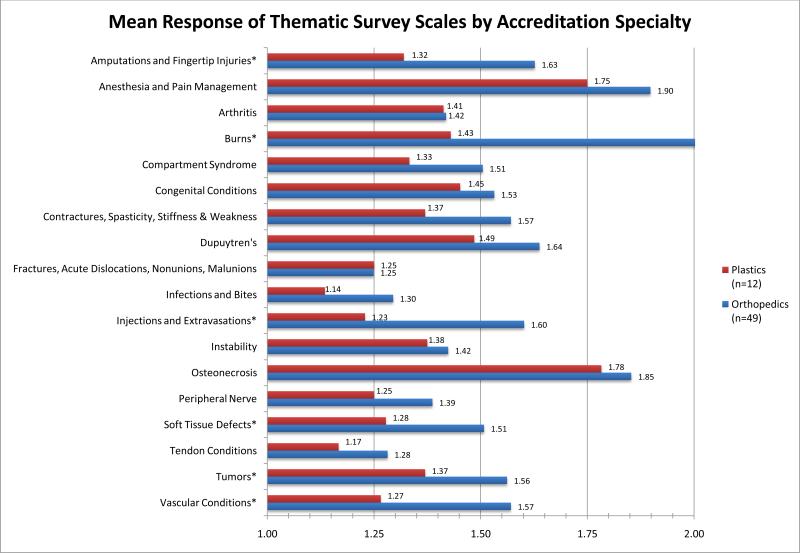
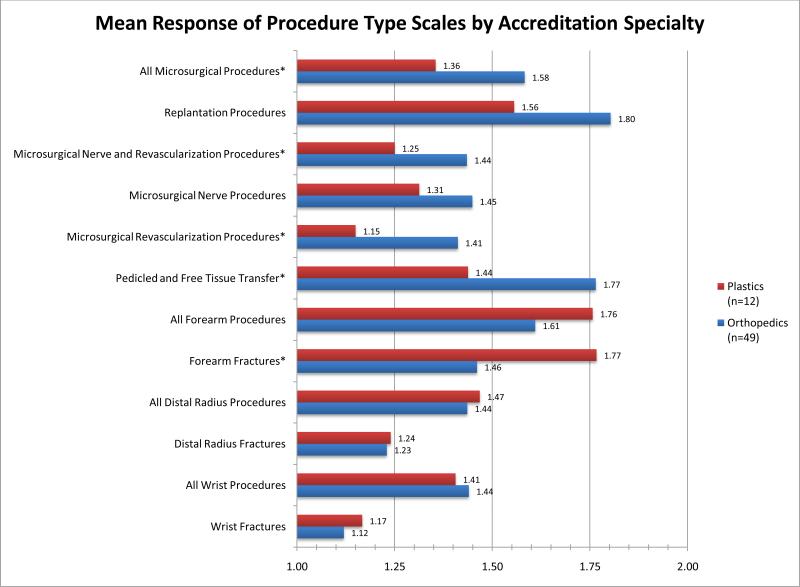
Results: An 84 percent response rate was achieved, including 49 orthopedic and 12 plastic surgery program directors. There were significant differences in mean responses between the specialty groups in 11 of 27 scales. Only one scale, forearm fractures, contained items with a significantly stronger preference for essential rating among orthopedic surgeons. The other 10 scales contained items with a significantly higher preference for essential rating among plastic surgeons, most of which related to soft-tissue injury and reconstruction. The burn scale had the greatest discrepancy in opinion of essential ratings between the groups, followed by pedicled and free tissue transfer, and amputation and fingertip injuries.
Conclusions: Despite being united under the subspecialty of hand surgery, program directors tend to emphasize clinical areas that are stressed in their respective primary disciplines. These differences promote the advantage of programs that provide exposure to both plastic surgery-trained and orthopedic surgery-trained hand surgeons.
Figures
Comment in
-
Discussion: Program director opinions of core competencies in hand surgery training: analysis of differences between plastic and orthopedic surgery accredited programs.Plast Reconstr Surg. 2013 Mar;131(3):591-592. doi: 10.1097/PRS.0b013e31828012ee. Plast Reconstr Surg. 2013. PMID: 23446570 No abstract available.
References
-
- Accreditation Council for Graduate Medical Education [February 23, 2012];Common program requirements, effective. 2011 Jul 1; http://www.acgme.org/acWebsite/dutyhours/dh_dutyhourscommonpr07012007.pdf.
-
- Accreditation Council for Graduate Medical Education [February 23, 2012];History of medical education accreditation. http://www.acgme.org/acWebsite/GME_info/historyGME.pdf.
-
- Swing SR. The ACGME outcome project: retrospective and prospective. Med Teach. 2007;29:648–654. - PubMed
-
- Bell RH. National curricula, certification and credentialing. Surgeon. 2011;9(Suppl 1):S10–S11. - PubMed
-
- Davis Sears E, Larson BP, Chung KC. A national survey of program director opinions of core competencies and structure of hand surgery fellowship training. J Hand Surg Am. 2012 Jun; In Press. - PubMed
Publication types
MeSH terms
Grants and funding
LinkOut - more resources
Full Text Sources
Other Literature Sources
Medical
