


Novel diagnostic assays for heparin-induced thrombocytopenia
- PMID: 23446735
- PMCID: PMC3643769
- DOI: 10.1182/blood-2013-01-479576
Novel diagnostic assays for heparin-induced thrombocytopenia
Abstract
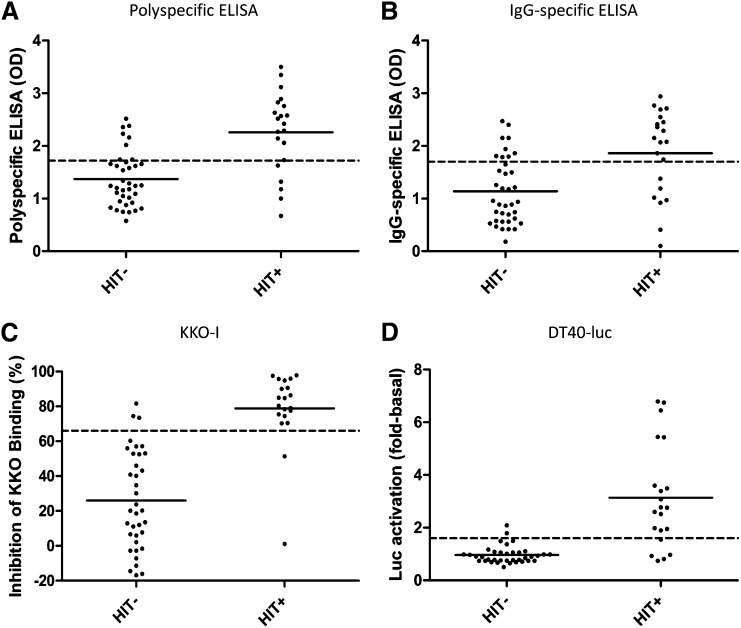
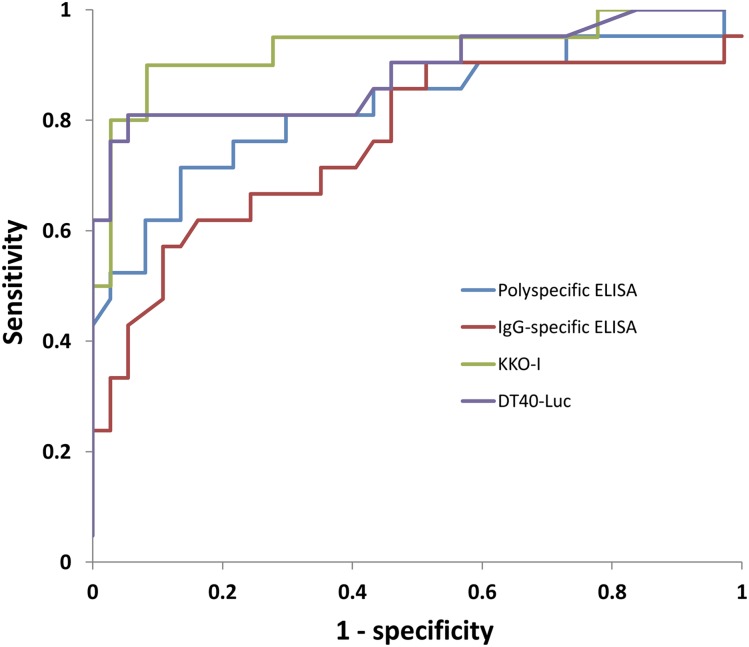
Laboratory testing for heparin-induced thrombocytopenia (HIT) has important shortcomings. Immunoassays fail to discriminate platelet-activating from nonpathogenic antibodies. Specific functional assays are impracticable due to the need for platelets and radioisotope. We describe 2 assays that may overcome these limitations. The KKO-inhibition test (KKO-I) measures the effect of plasma on binding of the HIT-like monoclonal antibody KKO to platelet factor 4 (PF4)/heparin. DT40-luciferase (DT40-luc) is a functional test comprised of a B-cell line expressing FcγRIIa coupled to a luciferase reporter. We compared these assays to polyspecific and immunoglobulin (Ig)G-specific PF4/heparin enzyme-linked immunosorbent assays (ELISAs) in samples from 58 patients with suspected HIT and circulating anti-PF4/heparin antibodies. HIT was defined as a 4Ts score ≥ 4 and positive (14)C-serotonin release assay. HIT-positive plasma demonstrated greater mean inhibition of KKO binding than HIT-negative plasma (78.9% vs 26.0%; P < .0001) and induced greater luciferase activity (3.14-fold basal vs 0.96-fold basal; P < .0001). The area under the receiver-operating characteristic curve was greater for KKO-I (0.93) than for the polyspecific (0.82; P = .020) and IgG-specific ELISA (0.76; P = .0044) and for DT40-luc (0.89) than for the IgG-specific ELISA (P = .046). KKO-I and DT40-luc showed better discrimination than 2 commercially available immunoassays, are simple to perform, and hold promise for improving the specificity and feasibility of HIT laboratory testing.
Figures
References
-
- Amiral J, Bridey F, Dreyfus M, Vissoc AM, Fressinaud E, Wolf M, Meyer D. Platelet factor 4 complexed to heparin is the target for antibodies generated in heparin-induced thrombocytopenia. Thromb Haemost. 1992;68(1):95–96. - PubMed
-
- Rauova L, Poncz M, McKenzie SE, et al. Ultralarge complexes of PF4 and heparin are central to the pathogenesis of heparin-induced thrombocytopenia. Blood. 2005;105(1):131–138. - PubMed
-
- Cuker A, Cines DB. How I treat heparin-induced thrombocytopenia. Blood. 2012;119(10):2209–2218. - PubMed
-
- Arepally GM, Kamei S, Park KS, et al. Characterization of a murine monoclonal antibody that mimics heparin-induced thrombocytopenia antibodies. Blood. 2000;95(5):1533–1540. - PubMed
Publication types
MeSH terms
Substances
Grants and funding
- R03 AI101992/AI/NIAID NIH HHS/United States
- HL110860/HL/NHLBI NIH HHS/United States
- BHF_/British Heart Foundation/United Kingdom
- HL078726-S1/HL/NHLBI NIH HHS/United States
- AI101992/AI/NIAID NIH HHS/United States
- R01 HL078726/HL/NHLBI NIH HHS/United States
- HL112903/HL/NHLBI NIH HHS/United States
- RC1 HL099973/HL/NHLBI NIH HHS/United States
- K23 HL112903/HL/NHLBI NIH HHS/United States
- HL078726/HL/NHLBI NIH HHS/United States
- HL099973/HL/NHLBI NIH HHS/United States
- P01 HL110860/HL/NHLBI NIH HHS/United States
- R21 HL109825/HL/NHLBI NIH HHS/United States
- HL109825/HL/NHLBI NIH HHS/United States
- P30 CA016520/CA/NCI NIH HHS/United States
LinkOut - more resources
Full Text Sources
Other Literature Sources
Medical
Miscellaneous
