. 2013 Jul;74(1):119-27.
doi: 10.1002/ana.23872. Epub 2013 Aug 6.

Plasma apolipoprotein A1 as a biomarker for Parkinson disease

Affiliations

Plasma apolipoprotein A1 as a biomarker for Parkinson disease

Judy K Qiang et al. Ann Neurol. 2013 Jul.

Abstract

Objective: To identify plasma-based biomarkers for Parkinson disease (PD) risk.

Methods: In a discovery cohort of 152 PD patients, plasma levels of 96 proteins were measured by multiplex immunoassay; proteins associated with age at PD onset were identified by linear regression. Findings from discovery screening were then assessed in a second cohort of 187 PD patients, using a different technique. Finally, in a third cohort of at-risk, asymptomatic individuals enrolled in the Parkinson's Associated Risk Study (PARS, n = 134), plasma levels of the top candidate biomarker were measured, and dopamine transporter (DAT) imaging was performed, to evaluate the association of plasma protein levels with dopaminergic system integrity.

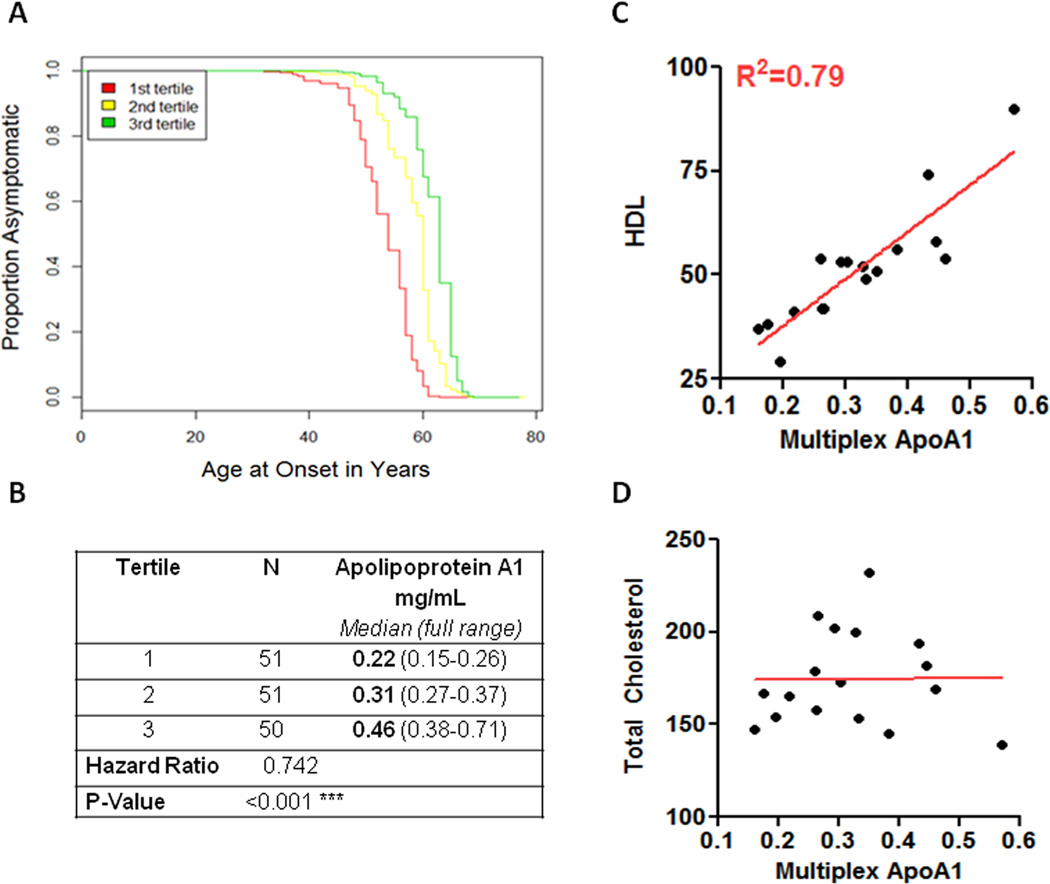
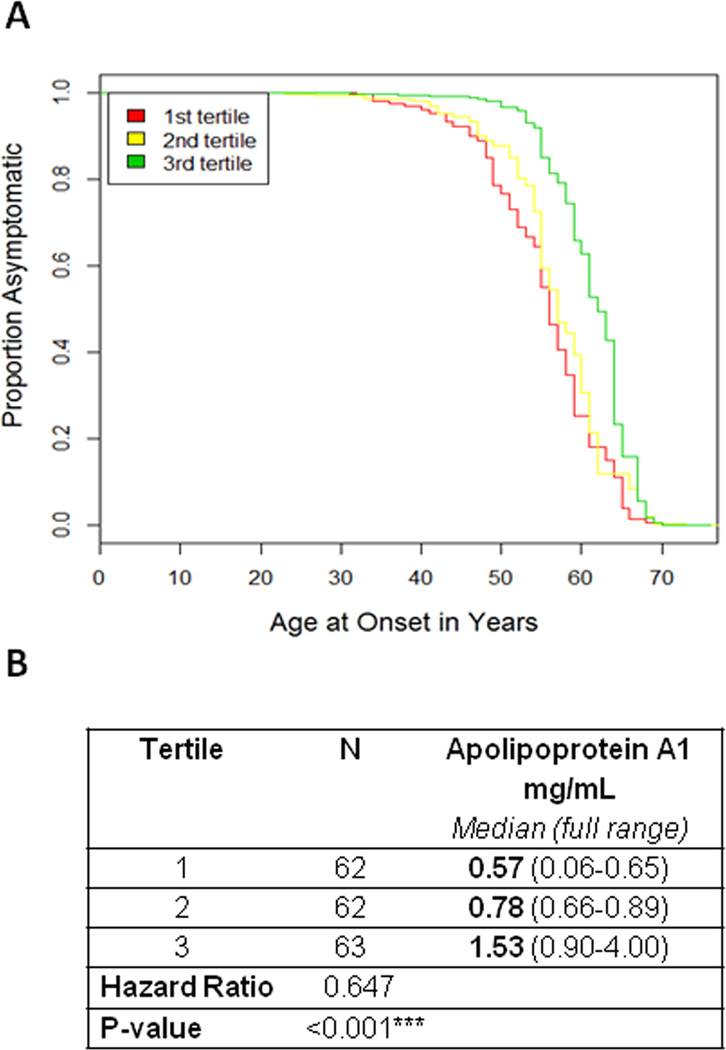
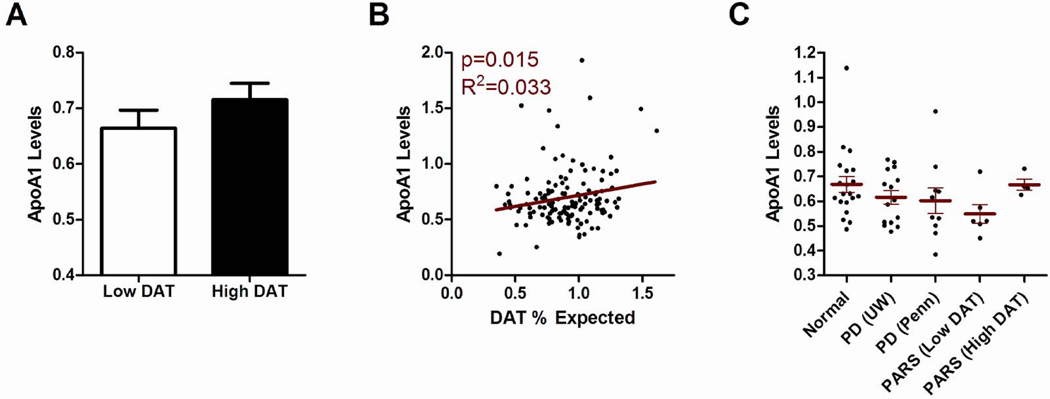
Results: One of the best candidate protein biomarkers to emerge from discovery screening was apolipoprotein A1 (ApoA1; p = 0.001). Low levels of ApoA1 correlated with earlier PD onset, with a 26% decrease in risk of developing PD associated with each tertile increase in ApoA1 (Cox proportional hazards, p < 0.001, hazard ratio = 0.742). The association between plasma ApoA1 levels and age at PD onset was replicated in an independent cohort of PD patients (p < 0.001). Finally, in the PARS cohort of high-risk, asymptomatic subjects, lower plasma levels of ApoA1 were associated with greater putaminal DAT deficit (p = 0.037).

Interpretation: Lower ApoA1 levels correlate with dopaminergic system vulnerability in symptomatic PD patients and in asymptomatic individuals with physiological reductions in dopamine transporter density consistent with prodromal PD. Plasma ApoA1 may be a new biomarker for PD risk.


Figures

Figure 1
Figure 1. Apolipoprotein A1 as a biomarker for age at PD onset
(A) Low Apolipoprotein A1 levels are predictive of early age at PD onset in the discovery cohort. Survival curves of time to PD onset are shown here for the lowest tertile of Apolipoprotein A1 plasma levels (red line), middle tertile (yellow line) and highest tertile (green line), as measured by multiplex immunoassay. Outcomes for age at PD onset between the different tertiles were significantly different (p<0.001, hazard ratio 0.742, 95% CI 0.606–0.909), after adjustment for age at plasma draw and gender. (B) Number of individuals (N), Apolipoprotein A1 plasma values (median, full range in mg/mL) for each tertile are listed. (C) HDL levels (mg/dL) are shown on the y axis (HDL); ApoA1 levels (mg/mL) are shown on the x axis (Multiplex ApoA1). High density lipoprotein levels correlate well with immunoassay ApoA1 values, as reflected by an R2 of 0.79. (D) In contrast to HDL levels, total cholesterol levels do not correlate with ApoA1 levels. Total cholesterol levels (mg/dL) are shown on the y axis; ApoA1 levels (mg/mL) are shown on the x axis.
Figure 2
Figure 2. Association between plasma ApoA1 levels and age at PD onset replicates in an independent cohort
(A) Survival curves of time to PD onset are shown here for the lowest tertile of Apolipoprotein A1 plasma levels (red line), middle tertile (yellow line) and highest tertile (green line), as measured by ELISA, in the replication cohort. Outcomes for age at PD onset between the different tertiles were significantly different (log rank p<0.001, hazard ratio 0.647, 95% CI 0.536–0.781), after adjustment for age at plasma draw and gender. (B) Number of individuals (N), Apolipoprotein A1 plasma values (median, full range in mg/mL) for each tertile are listed.
Figure 3
Figure 3. High plasma ApoA1 levels predict greater putaminal dopaminergic system integrity
(A) Plasma ApoA1 levels in mg/mL (y axis) are shown for both abnormal putaminal DAT uptake (Low DAT = DAT uptake ≤80% expected for age) and normal putaminal DAT uptake (High DAT = DAT uptake >80% expected for age) groups. (B) Plasma ApoA1 levels in mg/mL are shown on the y axis; percent putaminal DAT uptake relative to age-matched healthy controls is shown on the x axis. Correlation between plasma ApoA1 levels and degree of putaminal DAT uptake was significant (p=0.015). Adjusting for age and gender did not affect this association (p=0.037). (C) Plasma ApoA1 levels in mg/mL (with means +/− SEM, y axis) are shown for normal individuals not at increased risk for PD (n=20), a subset of PD patients from the discovery cohort (n=10), a subset of PD patients from the replication cohort (n=15), and a subset of PARS cohort subjects (n=10). Discovery, replication, and PARS cohort subjects were age- and gender-matched to the normal control subjects, and individuals were drawn evenly from each tertile of ApoA1 values for each cohort. Normal vs. PD, p=0.098 by Mann-Whitney. Normal vs. Low DAT, p=0.036 by Mann-Whitney. Low DAT = DAT uptake ≤80% expected for age. High DAT = DAT uptake >80% expected for age.
Figure 4
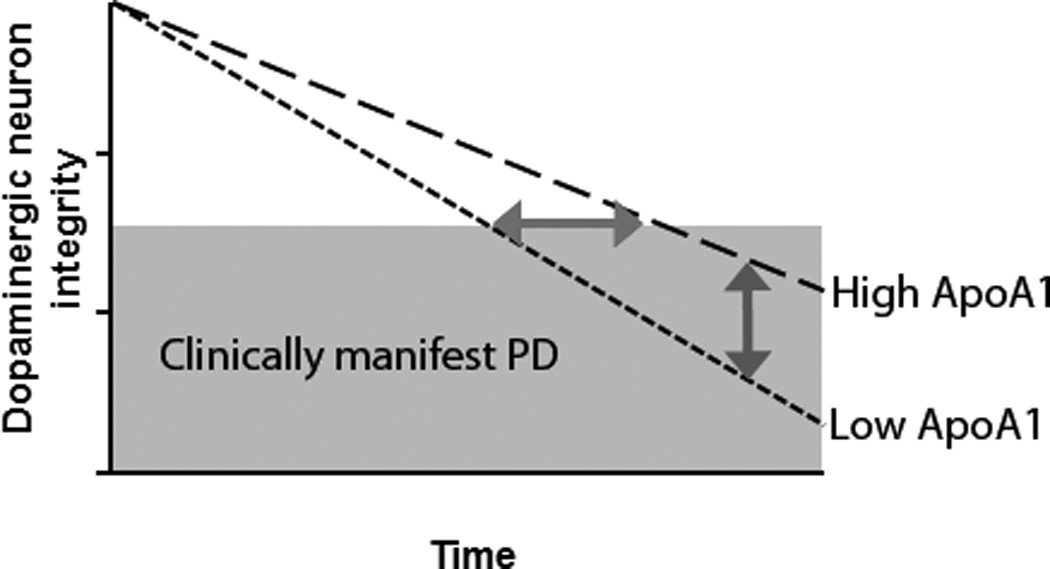
Figure 4. Model of the relationship of plasma ApoA1 levels with age at PD onset, degree of motor impairment in PD, and dopaminergic system integrity
Our results are compatible with a hypothetical model in which high plasma ApoA1 levels influence the rate of dopaminergic neuron loss. The horizontal arrow indicates the difference in age at clinical PD onset for high- vs. low-ApoA1 groups. The vertical arrow indicates the difference in disease severity for high- vs. low-ApoA1 groups.

References

    1. Inzelberg R, Schechtman E, Paleacu D. Onset age of Parkinson disease. Am J Med Genet. 2002;111(4):459–460. author reply 461. - PubMed
    1. Fearnley JM, Lees AJ. Ageing and Parkinson's disease: Substantia nigra regional selectivity. Brain. 1991;114(Pt 5):2283–2301. (Pt 5) - PubMed
    1. Shaw LM, Vanderstichele H, Knapik-Czajka M, et al. Cerebrospinal fluid biomarker signature in Alzheimer's disease neuroimaging initiative subjects. Ann Neurol. 2009;65(4):403–413. - PMC - PubMed
    1. Payami H, Kaye J, Heston LL, et al. Apolipoprotein E genotype and Alzheimer's disease. Lancet. 1993;342(8873):738. - PubMed
    1. Parkinson Progression Marker Initiative. The Parkinson Progression Marker Initiative (PPMI) Prog Neurobiol. 2011;95(4):629–635. - PMC - PubMed

Publication types

MeSH terms

Substances