


Clinical study reports of randomised controlled trials: an exploratory review of previously confidential industry reports
- PMID: 23447465
- PMCID: PMC3586134
- DOI: 10.1136/bmjopen-2012-002496
Clinical study reports of randomised controlled trials: an exploratory review of previously confidential industry reports
Abstract
Objective: To explore the structure and content of a non-random sample of clinical study reports (CSRs) to guide clinicians and systematic reviewers.
Search strategy: We searched public sources and lodged Freedom of Information requests for previously confidential CSRs primarily written by the industry for regulators.
Selection criteria: CSRs reporting sufficient information for extraction ('adequate').
Primary outcome measures: Presence and length of essential elements of trial design and reporting and compression factor (ratio of page length for CSRs compared to its published counterpart in a scientific journal).
Data extraction: Data were extracted on standard forms and crosschecked for accuracy.
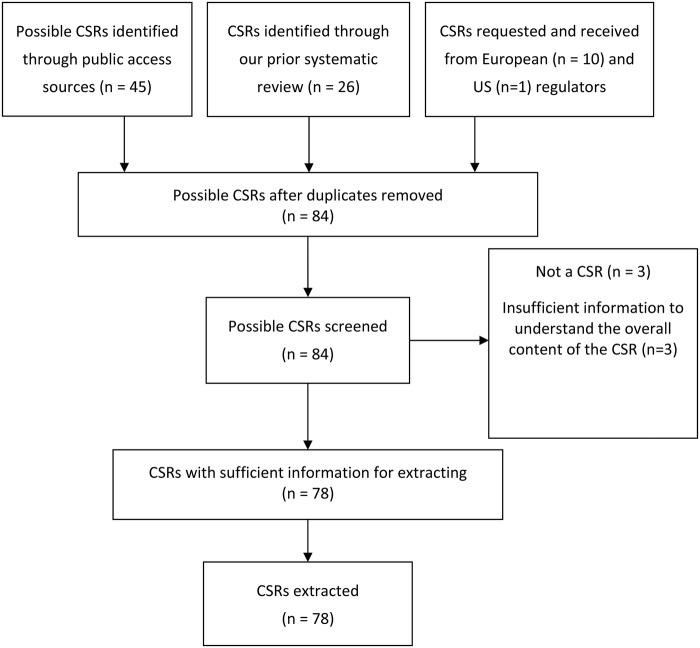
Results: We assembled a population of 78 CSRs (covering 90 randomised controlled trials; 144 610 pages total) dated 1991-2011 of 14 pharmaceuticals. Report synopses had a median length of 5 pages, efficacy evaluation 13.5 pages, safety evaluation 17 pages, attached tables 337 pages, trial protocol 62 pages, statistical analysis plan 15 pages and individual efficacy and safety listings had a median length of 447 and 109.5 pages, respectively. While 16 (21%) of CSRs contained completed case report forms, these were accessible to us in only one case (765 pages representing 16 individuals). Compression factors ranged between 1 and 8805.
Conclusions: Clinical study reports represent a hitherto mostly hidden and untapped source of detailed and exhaustive data on each trial. They should be consulted by independent parties interested in a detailed record of a clinical trial, and should form the basic unit for evidence synthesis as their use is likely to minimise the problem of reporting bias. We cannot say whether our sample is representative and whether our conclusions are generalisable to an undefined and undefinable population of CSRs.
Figures
References
-
- Doshi P, Jones M, Jefferson T. Rethinking credible evidence synthesis. BMJ 2012;344:d7898. - PubMed
-
- Chan A-W, Hróbjartsson A, Haahr MT, et al. Empirical evidence for selective reporting of outcomes in randomized trials: comparison of protocols to published articles. JAMA 2004;291:2457–65 - PubMed
-
- Turner EH, Matthews AM, Linardatos E, et al. Selective publication of antidepressant trials and its influence on apparent efficacy. N Engl J Med 2008;358:252–60 - PubMed
Grants and funding
LinkOut - more resources
Full Text Sources
Other Literature Sources
