Guidelines for Field Triage of Injured Patients: In conjunction with the Morbidity and Mortality Weekly Report published by the Center for Disease Control and Prevention
- PMID: 23447758
- PMCID: PMC3582524
- DOI: 10.5811/westjem.2013.1.15981
Guidelines for Field Triage of Injured Patients: In conjunction with the Morbidity and Mortality Weekly Report published by the Center for Disease Control and Prevention
Abstract
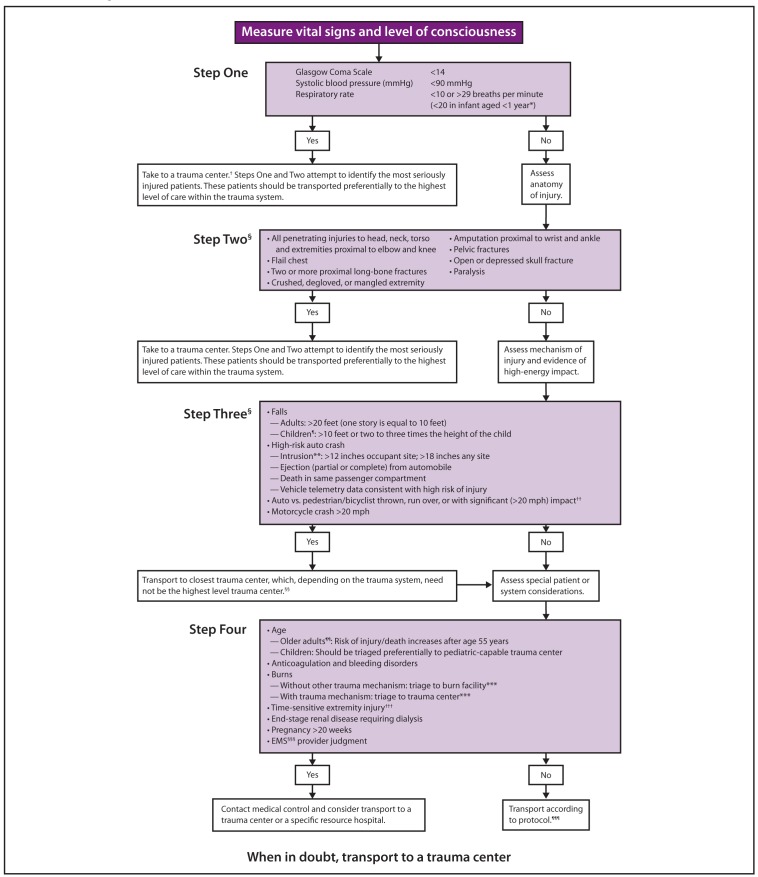
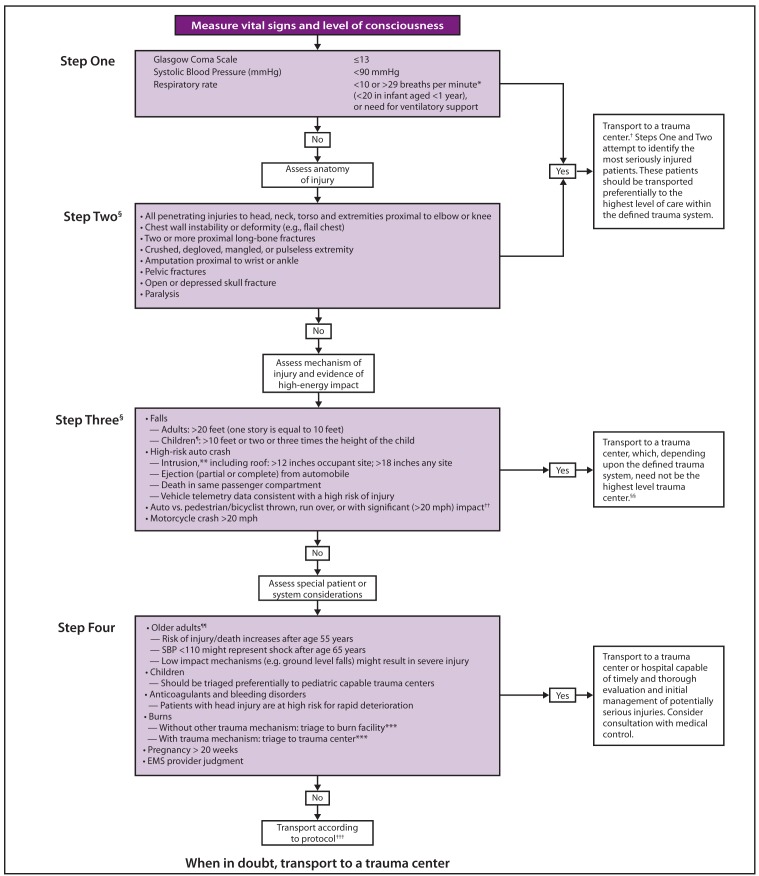
The Centers for Disease Control and Prevention (CDC) has published significant data and trends related to the national public health burden associated with trauma and injury. In the United States (U.S.), injury is the leading cause of death for persons aged 1-44 years. In 2008, approximately 30 million injuries resulted in an emergency department (ED) evaluation; 5.4 million (18%) of these patients were transported by Emergency Medical Services (EMS).1 EMS providers determine the severity of injury and begin initial management at the scene. The decisions to transport injured patients to the appropriate hospital are made through a process known as "field triage." Since 1986, the American College of Surgeons Committee on Trauma (ACS-COT) has provided guidance for the field triage process though its "Field Triage Decision Scheme." In 2005, the CDC, with financial support from the National Highway Traffic Safety Administration (NHTSA), collaborated with ASC-COT to convene the initial meeting of the National Expert Panel on Field Triage (the Panel) to revise the decision scheme. This revised version was published in 2006 by ASC-COT, and in 2009 the CDC published a detailed description of the scientific rational for revising the field triage criteria entitled, "Guidelines for Field Triage of Injured Patients."2-3 In 2011, the CDC reconvened the Panel to review the 2006 Guidelines and recommend any needed changes. We present the methodology, findings and updated guidelines from the Morbidity & Mortality Weekly Report (MMWR) from the 2011 Panel along with commentary on the burden of injury in the U.S., and the role emergency physicians have in impacting morbidity and mortality at the population level.
Figures
References
-
- Centers for Disease Control and Prevention (CDC) Guidelines for Field Triage of Injured Patients. Recommendations of the National Expert Panel on Field Triage, 2011. MMWR Morbidity and Mortality Weekly Report. 2012;61(1):1–21. - PubMed
-
- American College of Surgeons . Resources for the optimal care of the injured patient. Chicago, IL: American College of Surgeons; 2006. 2006.
-
- Centers for Disease Control and Prevention (CDC) Guidelines for Field Triage of Injured Patients. Recommendations of the National Expert Panel on Field Triage, 2009. MMWR Morbidity and Mortality Weekly Report. 2009;58 (No. RR-1) - PubMed
-
- CDC WISQARS: web-based injury statistics query and reporting system. Available at www.cdc.gov/injury/wisqars/LeadingCauses.html. Accessed October 5, 2012. - PMC - PubMed
-
- DCD WISQARS: web-based injury statistics query and reporting system: injury mortality reports, 2008, United States. Available at http://www.cdc.gov/injury/wisqars/fatal.html. Accessed October 5, 2012.
LinkOut - more resources
Full Text Sources
Other Literature Sources
Miscellaneous