


Comparison of enrollment rates of African-American families into a school-based tobacco prevention trial using two recruitment strategies in urban and rural settings
- PMID: 23448420
- PMCID: PMC3703455
- DOI: 10.4278/ajhp.110204-QUAN-53
Comparison of enrollment rates of African-American families into a school-based tobacco prevention trial using two recruitment strategies in urban and rural settings
Abstract
Purpose: This study evaluated similarities and differences of enrollment rates using two different recruitment strategies for a tobacco control trial in rural and urban African-American (AA) elementary school families.
Design: A comparative study, nested within a larger randomized controlled trial, was used to test the effectiveness of two recruitment approaches on enrollment rates in rural and urban AA families.
Setting: The study was conducted in 14 Title 1 elementary schools in the southeastern United States: 7 rural and 7 urban.
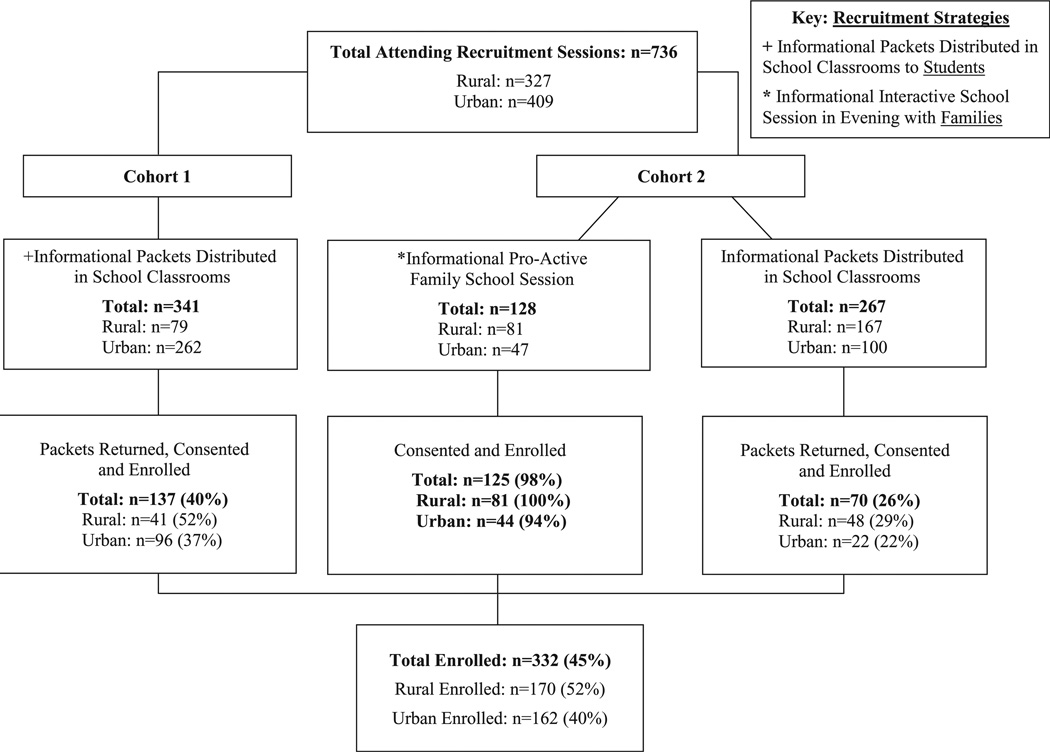
Subjects: There were 736 eligible AA families, and 332 (45%) completed informed consent and were enrolled into the study.
Intervention: The Facilitate, Open and transparent communication, Shared benefits, Team and tailored, Educate bilaterally, and Relationships, realistic and rewards (FOSTER) approach guided the two recruitment strategies: (1) written informational packets provided to fourth graders to take home to parents; and (2) proactive, face-to-face family information sessions held at schools.
Measures: Enrollment rates were based on responsiveness to the two recruitment strategies and completion of the informed consent process.
Analysis: Chi-square, Cochran-Mantel-Haenszel, and Breslow-Day tests were performed.
Results: Higher enrollment rates occurred during the family session for both rural and urban families (100% rural, 93.6% urban; p = .0475) than informational packets alone (28.7% rural, 22% urban; p < .0001). Rural family enrollment rates were overall higher than urban rates regardless of recruitment strategy (52.0% rural vs. 39.6% urban; p = .0008).
Conclusion: The findings suggest the FOSTER approach, although effective in both rural and urban settings, was more successful in recruiting rural families.
Figures
References
-
- National Institute of Health. NIH Guidelines on the inclusion of women and minorities as subjects in clinical research. NIH Guide Grants Contracts. 1994;23(11):2–20.
-
- Minkler M, Wallerstein N. Community-Based Participatory Research for Health. San Francisco, Calif: Jossey-Bass; 2003.
-
- Israel BA, Schulz AJ, Parker EA, Becker AB. Review of community-based research: assessing partnership approaches to improve public health. Annu Rev Public Health. 1998;19:173–202. - PubMed
Publication types
MeSH terms
Grants and funding
LinkOut - more resources
Full Text Sources
Other Literature Sources
Medical
