


Impact of prolonged cannabinoid excretion in chronic daily cannabis smokers' blood on per se drugged driving laws
- PMID: 23449702
- PMCID: PMC3717350
- DOI: 10.1373/clinchem.2012.195503
Impact of prolonged cannabinoid excretion in chronic daily cannabis smokers' blood on per se drugged driving laws
Abstract
Background: Cannabis is the illicit drug most frequently reported with impaired driving and motor vehicle accidents. Some "per se" laws make it illegal to drive with any amount of drug in the body, while others establish blood, saliva, or urine concentrations above which it is illegal to drive. The persistence of Δ(9)-tetrahydrocannabinol (THC) in chronic daily cannabis smokers' blood is unknown.
Methods: Thirty male chronic daily cannabis smokers resided on a secure research unit for up to 33 days, with daily blood collection. Samples were processed in an ice bath during sample preparation to minimize cannabinoid adsorption onto precipitant material. We quantified THC by 2-dimensional GC-MS.
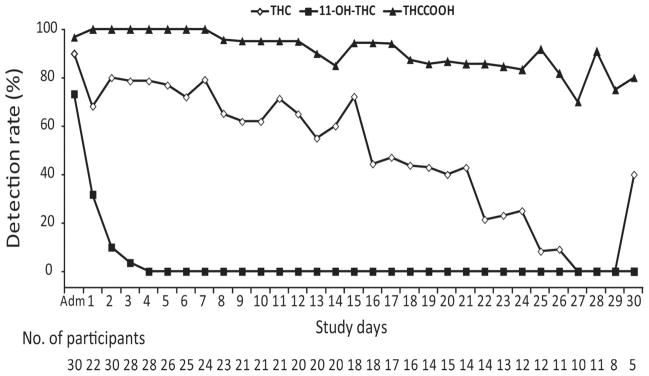
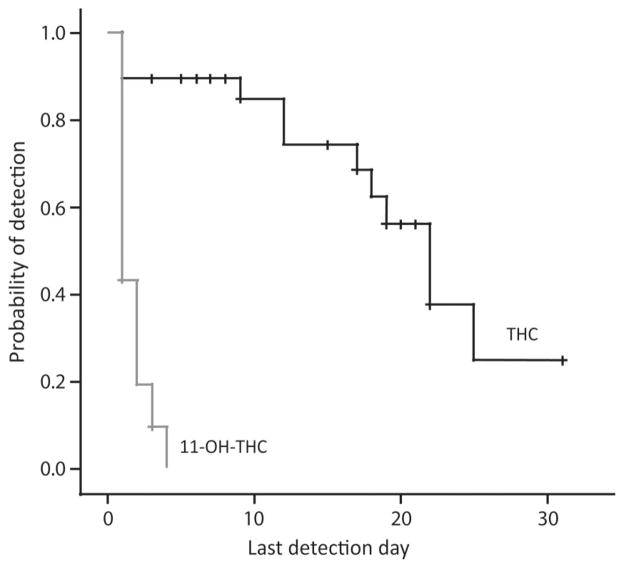
Results: Of the 30 participants, 27 were THC-positive on admission, with a median (range) concentration of 1.4 μg/L (0.3-6.3). THC decreased gradually; only 1 of 11 participants was negative at 26 days, 2 of 5 remained THC-positive (0.3 μg/L) for 30 days, and 5.0% of participants had THC ≥ 1.0 μg/L for 12 days. Median 11-hydroxy-THC concentrations were 1.1 μg/L on admission, with no results ≥ 1.0 μg/L 24 h later. 11-Nor-9-carboxy-THC (THCCOOH) detection rates were 96.7% on admission, decreasing slowly to 95.7% and 85.7% on days 8 and 22, respectively; 4 of 5 participants remained THCCOOH positive (0.6-2.7 μg/L) after 30 days, and 1 remained positive on discharge at 33 days.
Conclusions: Cannabinoids can be detected in blood of chronic daily cannabis smokers during a month of sustained abstinence. This is consistent with the time course of persisting neurocognitive impairment reported in recent studies.
Conflict of interest statement
Figures
References
-
- United Nations Office on Drugs and Crime (UNODC) World Drug Report 2011. New York: 2011. p. 272.
-
- Substance Abuse and Mental Health Services Administration (SAMHSA) Results from the 2010 National Survey on Drug Use and Health: summary of national findings. Rockville (MD): SAMHSA; 2011. NSDUH Series H-41, HHS publ. no. (SMA) 11-4658.
-
- Ramaekers J, Kauert G, Theunissen E, Toennes S, Moeller M. Neurocognitive performance during acute THC intoxication in heavy and occasional cannabis users. J Psychopharmacol. 2009;23:266–77. - PubMed
-
- Lane SD, Cherek DR, Tcheremissine OV, Lieving LM, Pietras CJ. Acute marijuana effects on human risk taking. Neuropsychopharmacology. 2005;30:800–9. - PubMed
Publication types
MeSH terms
Substances
Grants and funding
LinkOut - more resources
Full Text Sources
Other Literature Sources
Medical
Miscellaneous
