. 2013 May;87(9):5193-204.
doi: 10.1128/JVI.02743-12. Epub 2013 Feb 28.

Mother-offspring transmission and age-dependent accumulation of simian foamy virus in wild chimpanzees

Affiliations

Mother-offspring transmission and age-dependent accumulation of simian foamy virus in wild chimpanzees

Anja Blasse et al. J Virol. 2013 May.

Abstract

Simian foamy viruses (SFVs) are thought to infect virtually any adult nonhuman primate (NHP). While many data have accumulated about patterns of codivergence with their hosts and cross-species transmission events, little is known about the modalities of SFV transmission within NHP species, especially in the wild. Here we provide a detailed investigation of the dynamics of SFV circulation in a wild community of Western chimpanzees (Pan troglodytes verus). We demonstrate that mother-offspring (vertical) SFV transmission is common and hypothesize that it accounts for a number of primary infections. We also show that multiple infections with several chimpanzee-specific SFV strains (i.e., superinfection) commonly happen in adult chimpanzees, which might point to adult-specific aggressive behaviors as a lifelong source of SFV infection. Our data give evidence for complex SFV dynamics in wild chimpanzees, even at a single community scale, and show that linking wild NHP social interactions and their microorganisms' dynamics is feasible.


Figures
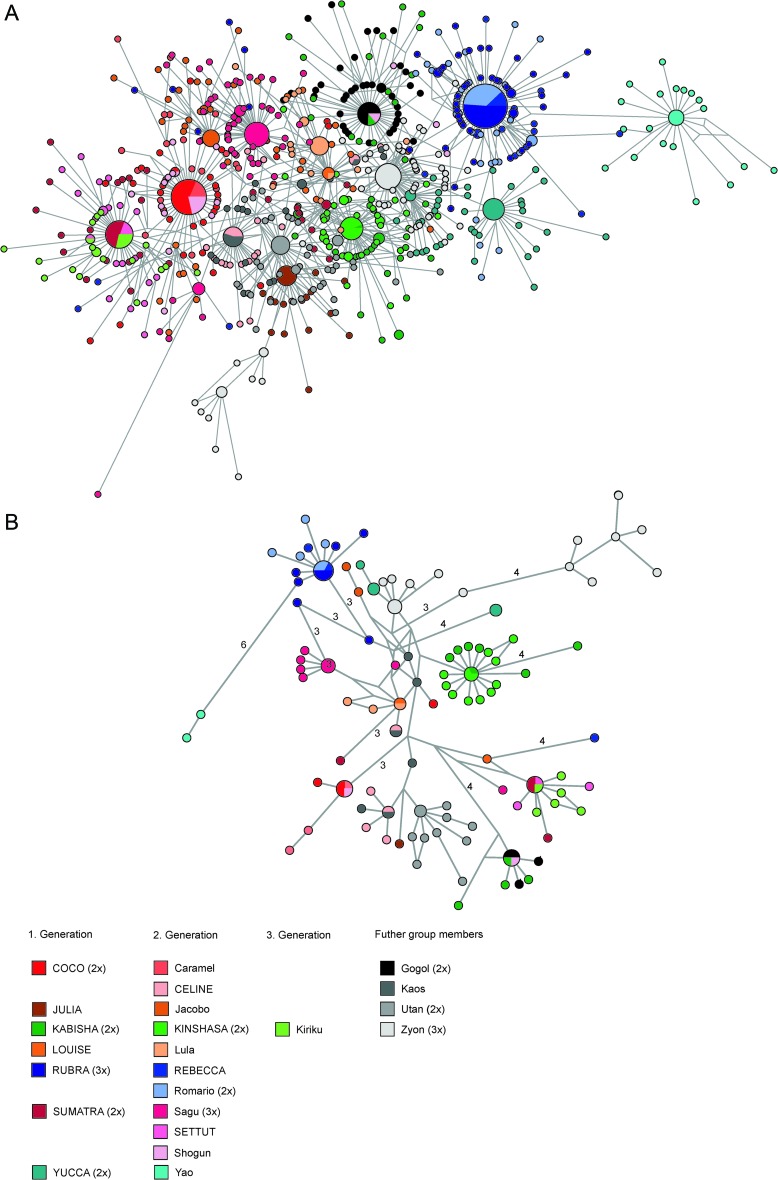
Fig 1
Fig 1
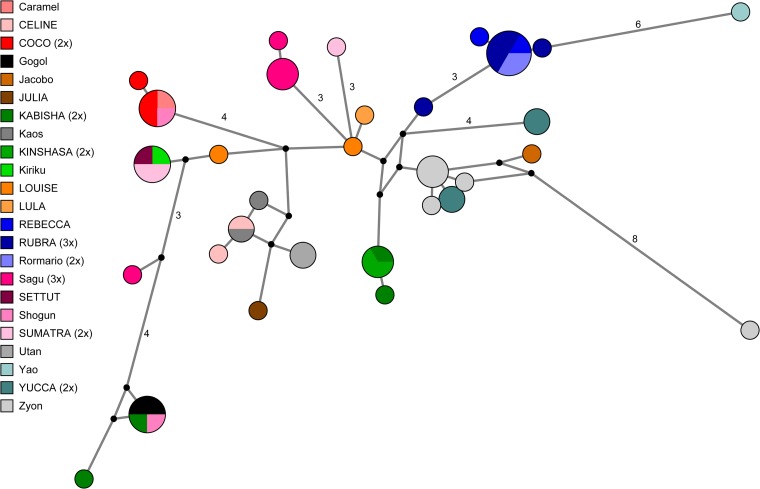
Networks of all SFV sequences generated for this study. (A) Comprehensive version. (B) Streamlined version. Only those SFV sequences less likely to comprise “noise,” Taq-induced mutations, were included. The legend illustrates matrilineal lines included in this study. Females' names are in capital letters. When individuals were repeatedly sampled, number of samples is given between brackets in the legend. Within the networks, node size is proportional to the frequency of sequence occurrence. Branch lengths are directly related to the number of mutations between sequences (total length of aligned sequences: 432 bp [A], 426 bp [B]). Please note that the streamlined network still comprise all but two of the shared SFV sequences, the two exceptions consisting of sequences closely related to other shared sequences (1 bp difference). Data set reduction therefore did not result in any loss of information about SFV transmission.
Fig 2
Fig 2
Network of founder sequences. Node size is proportional to the frequency of sequence occurrence in the data set. Branch lengths are directly related to the number of mutations between sequences, with values noted for differences greater than two base pairs. Legend conventions are the same as in Fig. 1.
Fig 3
Fig 3
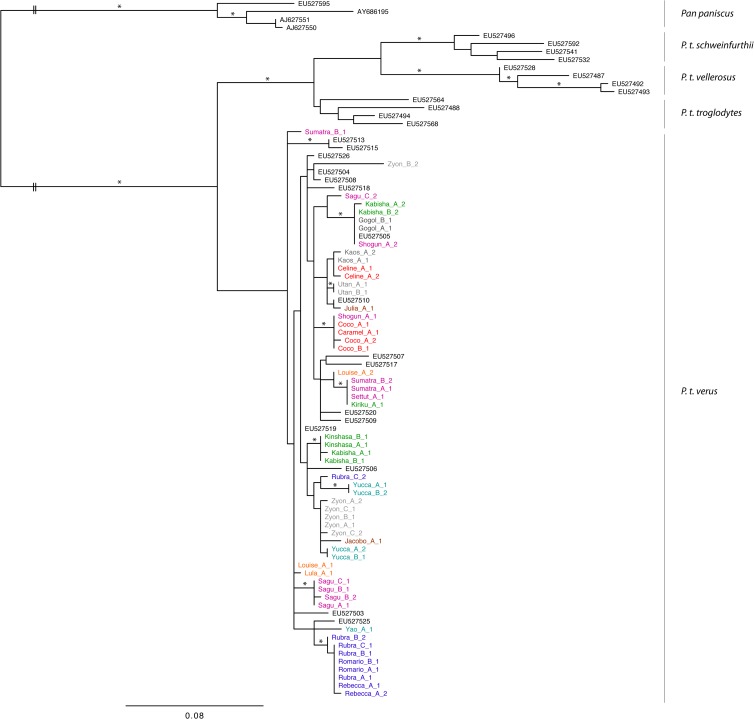
Maximum likelihood tree of founder sequences. Asterisks mark branches with bootstrap support of >70. Please note that most inner branches are not statistically supported. Legend conventions are the same as in Fig. 1.
Fig 4
Fig 4
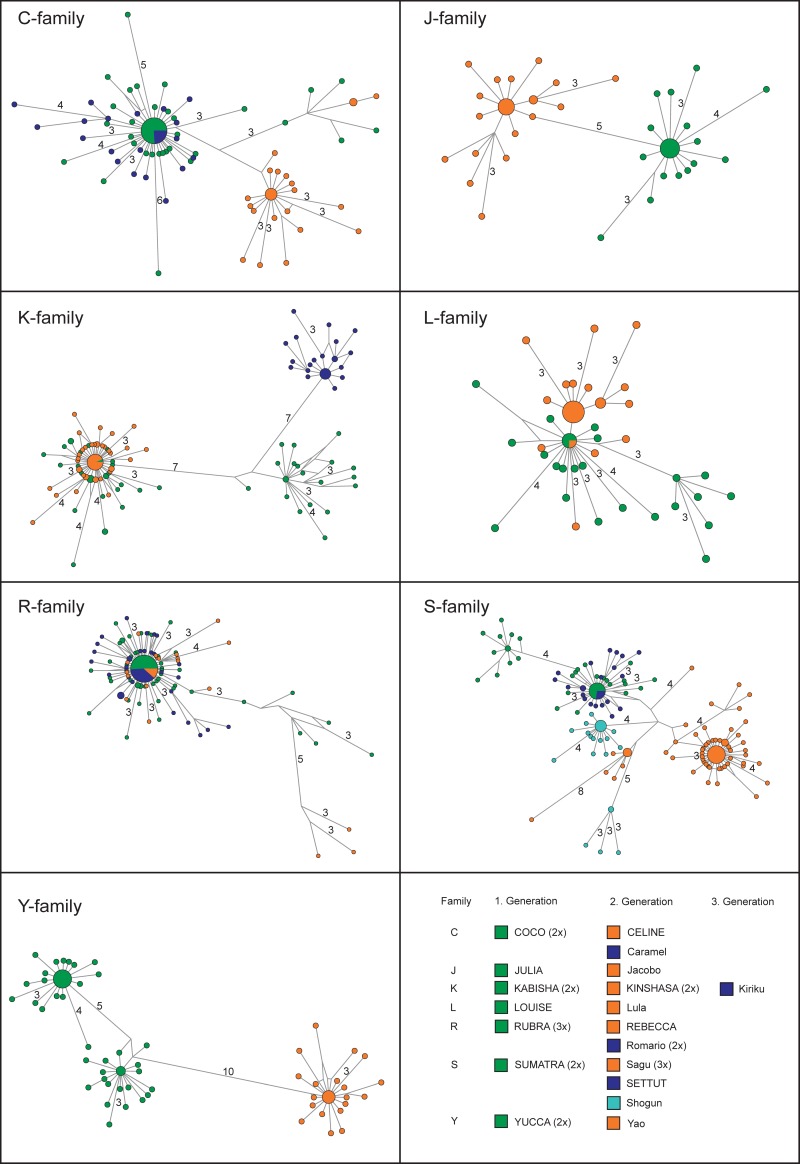
Networks for all mother-offspring pairs. The bottom right illustrates matrilineal lines included in this study. The column family marks the individuals belonging to the family with the same initial (letter), followed by mothers to the left of their offspring (starting with the first generation). Females' names are in capital letters. When individuals were repeatedly sampled, the number of samples is given between brackets. Within each network, node size is proportional to the frequency of sequence occurrence. Branch lengths are directly related to the number of mutations between sequences, with values noted for differences greater than two base pairs (total length of aligned sequences: C, L, Y family, 425 bp; J, K family, 426 bp; R, S family, 428bp).
Fig 5
Fig 5
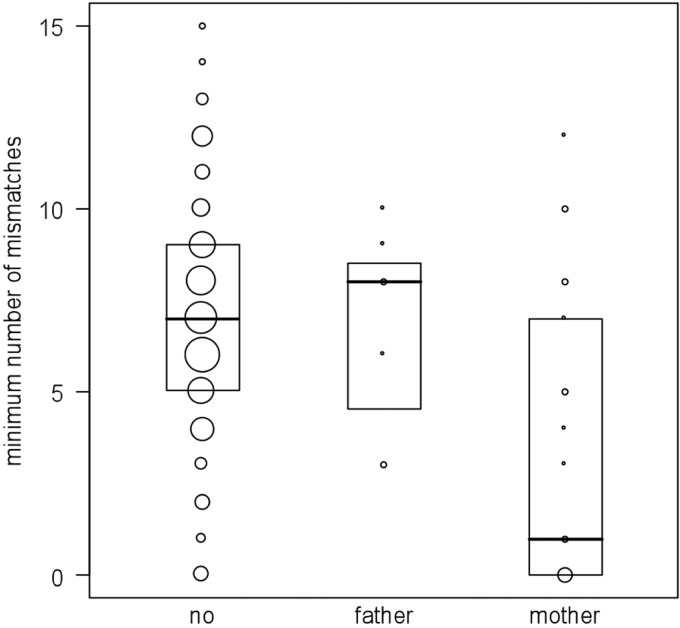
SFV similarity as a function of host relatedness. Circle size represents the number of dyads exhibiting the corresponding relationship with the offspring.
Fig 6
Fig 6
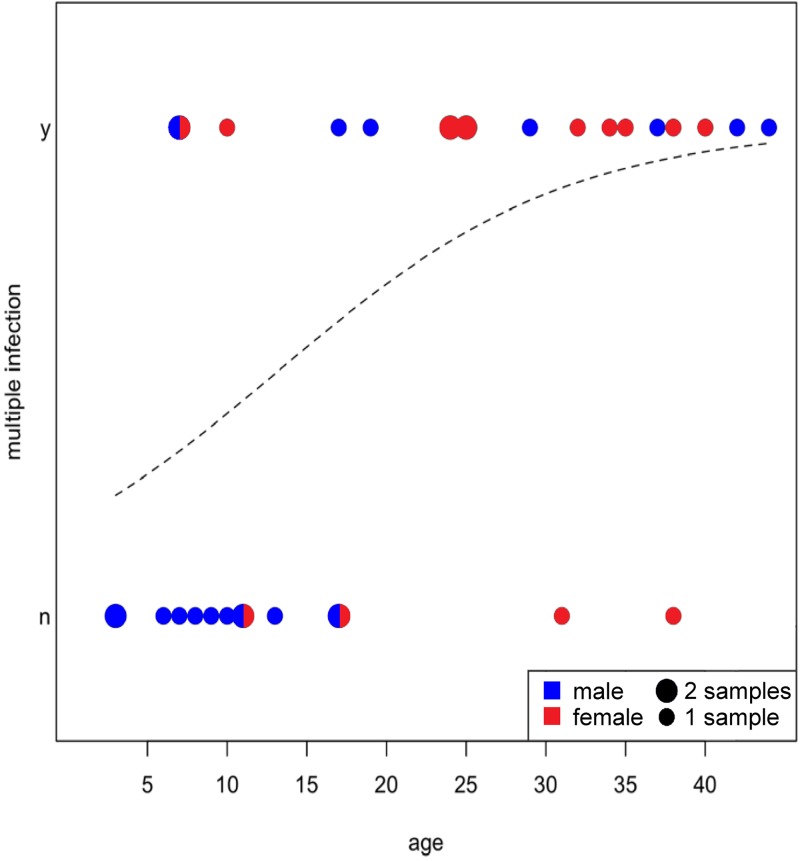
SFV accumulation dynamics in wild chimpanzees from Taï (P. troglodytes verus). Superinfection status (no/yes) is shown as a function of age. Circle size represents the number of samples at the corresponding combination of age and infection status; colors indicate the sex of the individuals. The dashed line indicates the fitted model's prediction.
Fig 7
Fig 7
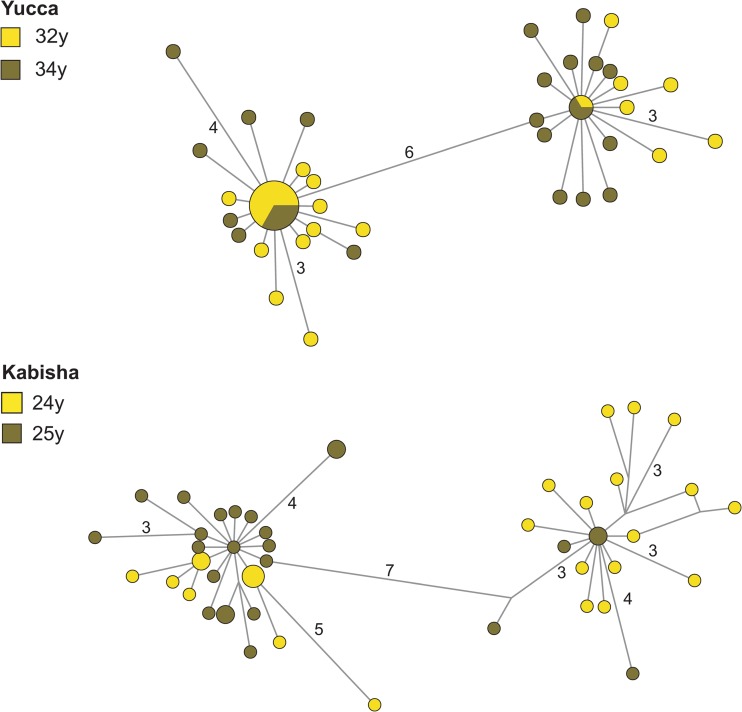
In-host SFV population dynamics. Chimpanzees Yucca and Kabisha were sampled at different time points (y, years of age). Within the networks, node size is proportional to the frequency of sequence occurrence. Branch lengths are directly related to the number of mutations between sequences, with values noted for differences greater than two base pairs (total length of aligned sequences: 425 bp).

References

    1. Locatelli S, Peeters M. 2012. Cross-species transmission of simian retroviruses: how and why they could lead to the emergence of new diseases in the human population. AIDS 26:659–673 - PubMed
    1. Leendertz SA, Junglen S, Hedemann C, Goffe A, Calvignac S, Boesch C, Leendertz FH. 2010. High prevalence, coinfection rate, and genetic diversity of retroviruses in wild red colobus monkeys (Piliocolobus badius badius) in Tai National Park, Cote d'Ivoire. J. Virol. 84:7427–7436 - PMC - PubMed
    1. Liu W, Worobey M, Li Y, Keele BF, Bibollet-Ruche F, Guo Y, Goepfert PA, Santiago ML, Ndjango JB, Neel C, Clifford SL, Sanz C, Kamenya S, Wilson ML, Pusey AE, Gross-Camp N, Boesch C, Smith V, Zamma K, Huffman MA, Mitani JC, Watts DP, Peeters M, Shaw GM, Switzer WM, Sharp PM, Hahn BH. 2008. Molecular ecology and natural history of simian foamy virus infection in wild-living chimpanzees. PLoS Pathog. 4:e1000097 doi:10.1371/journal.ppat.1000097 - DOI - PMC - PubMed
    1. Morozov VA, Leendertz FH, Junglen S, Boesch C, Pauli G, Ellerbrok H. 2009. Frequent foamy virus infection in free-living chimpanzees of the Tai National Park (Cote d'Ivoire). J. Gen. Virol. 90:500–506 - PubMed
    1. Switzer WM, Salemi M, Shanmugam V, Gao F, Cong ME, Kuiken C, Bhullar V, Beer BE, Vallet D, Gautier-Hion A, Tooze Z, Villinger F, Holmes EC, Heneine W. 2005. Ancient co-speciation of simian foamy viruses and primates. Nature 434:376–380 - PubMed

Publication types

LinkOut - more resources