


Decreased erythrocyte deformability after transfusion and the effects of erythrocyte storage duration
- PMID: 23449853
- PMCID: PMC3744176
- DOI: 10.1213/ANE.0b013e31828843e6
Decreased erythrocyte deformability after transfusion and the effects of erythrocyte storage duration
Abstract
Background: Erythrocyte cell membranes undergo morphologic changes during storage, but it is unclear whether these changes are reversible. We assessed erythrocyte cell membrane deformability in patients before and after transfusion to determine the effects of storage duration and whether changes in deformability are reversible after transfusion.
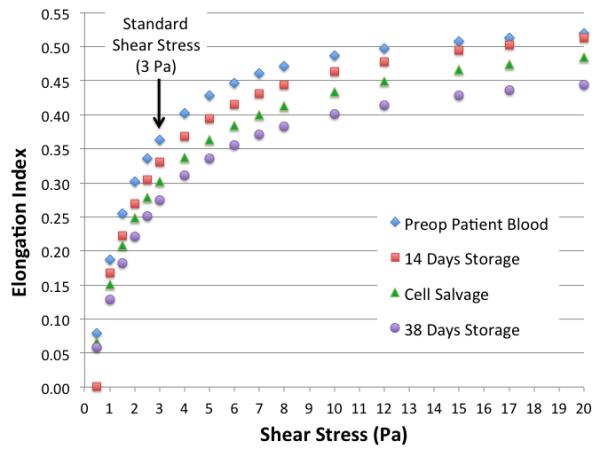
Methods: Sixteen patients undergoing posterior spinal fusion surgery were studied. Erythrocyte deformability was compared between those who required moderate transfusion (≥ 5 units erythrocytes) and those who received minimal transfusion (0-4 units erythrocytes). Deformability was measured in samples drawn directly from the blood storage bags before transfusion and in samples drawn from patients before and after transfusion (over 3 postoperative days). In samples taken from the blood storage bags, we compared deformability of erythrocytes stored for a long duration (≥ 21 days), those stored for a shorter duration (<21 days), and cell-salvaged erythrocytes. Deformability was assessed quantitatively using the elongation index (EI) measured by ektacytometry, a method that determines the ability for the cell to elongate when exposed to shear stress.
Results: Erythrocyte deformability was significantly decreased from the preoperative baseline in patients after moderate transfusion (EI decreased by 12% ± 4% to 20% ± 6%; P = 0.03) but not after minimal transfusion (EI decreased by 3% ± 1% to 4% ± 1%; P = 0.68). These changes did not reverse over 3 postoperative days. Deformability was significantly less in erythrocytes stored for ≥ 21 days (EI = 0.28 ± 0.02) than in those stored for <21 days (EI = 0.33 ± 0.02; P = 0.001) or those drawn from patients preoperatively (EI = 0.33 ± 0.02; P = 0.001). Cell-salvaged erythrocytes had intermediate deformability (EI = 0.30 ± 0.03) that was greater than that of erythrocytes stored ≥ 21 days (P = 0.047), but less than that of erythrocytes stored <21 days (P = 0.03).
Conclusions: The findings demonstrate that increased duration of erythrocyte storage is associated with decreased cell membrane deformability and that these changes are not readily reversible after transfusion.
Figures


Comment in
-
Oxygen transport rate and erythrocyte deformability.Anesth Analg. 2013 Nov;117(5):1260. doi: 10.1213/ANE.0b013e3182a4f106. Anesth Analg. 2013. PMID: 24149504 No abstract available.
-
In response.Anesth Analg. 2013 Nov;117(5):1260-1. doi: 10.1213/ANE.0b013e3182a4f11b. Anesth Analg. 2013. PMID: 24149505 No abstract available.
References
-
- Fitzgerald RD, Martin CM, Dietz GE, Doig GS, Potter RF, Sibbald WJ. Transfusing red blood cells stored in citrate phosphate dextrose adenine-1 for 28 days fails to improve tissue oxygenation in rats. Crit Care Med. 1997;25:726–32. - PubMed
-
- van Bommel J, de Korte D, Lind A, Siegemund M, Trouwborst A, Verhoeven AJ, Ince C, Henny CP. The effect of the transfusion of stored RBCs on intestinal microvascular oxygenation in the rat. Transfusion. 2001;41:1515–23. - PubMed
-
- Tinmouth A, Fergusson D, Yee IC, Hebert PC. Clinical consequences of red cell storage in the critically ill. Transfusion. 2006;46:2014–27. - PubMed
-
- Berezina TL, Zaets SB, Morgan C, Spillert CR, Kamiyama M, Spolarics Z, Deitch EA, Machiedo GW. Influence of storage on red blood cell rheological properties. J Surg Res. 2002;102:6–12. - PubMed
Publication types
MeSH terms
Grants and funding
LinkOut - more resources
Full Text Sources
Other Literature Sources
Medical
Molecular Biology Databases
