


Personalised risk communication for informed decision making about taking screening tests
- PMID: 23450534
- PMCID: PMC6464864
- DOI: 10.1002/14651858.CD001865.pub3
Personalised risk communication for informed decision making about taking screening tests
Abstract
Background: There is a trend towards greater patient involvement in healthcare decisions. Although screening is usually perceived as good for the health of the population, there are risks associated with the tests involved. Achieving both adequate involvement of consumers and informed decision making are now seen as important goals for screening programmes. Personalised risk estimates have been shown to be effective methods of risk communication.
Objectives: To assess the effects of personalised risk communication on informed decision making by individuals taking screening tests. We also assess individual components that constitute informed decisions.
Search methods: Two authors searched the Cochrane Central Register of Controlled Trials (CENTRAL, The Cochrane Library, Issue 3, 2012), MEDLINE (OvidSP), EMBASE (OvidSP), CINAHL (EbscoHOST) and PsycINFO (OvidSP) without language restrictions. We searched from 2006 to March 2012. The date ranges for the previous searches were from 1989 to December 2005 for PsycINFO and from 1985 to December 2005 for other databases. For the original version of this review, we also searched CancerLit and Science Citation Index (March 2001). We also reviewed the reference lists and conducted citation searches of included studies and other systematic reviews in the field, to identify any studies missed during the initial search.
Selection criteria: Randomised controlled trials incorporating an intervention with a 'personalised risk communication element' for individuals undergoing screening procedures, and reporting measures of informed decisions and also cognitive, affective, or behavioural outcomes addressing the decision by such individuals, of whether or not to undergo screening.
Data collection and analysis: Two authors independently assessed each included trial for risk of bias, and extracted data. We extracted data about the nature and setting of interventions, and relevant outcome data. We used standard statistical methods to combine data using RevMan version 5, including analysis according to different levels of detail of personalised risk communication, different conditions for screening, and studies based only on high-risk participants rather than people at 'average' risk.
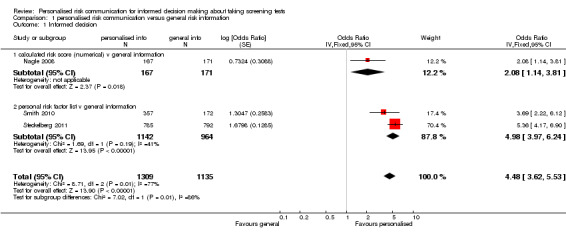
Main results: We included 41 studies involving 28,700 people. Nineteen new studies were identified in this update, adding to the 22 studies included in the previous two iterations of the review. Three studies measured informed decision with regard to the uptake of screening following personalised risk communication as a part of their intervention. All of these three studies were at low risk of bias and there was strong evidence that the interventions enhanced informed decision making, although with heterogeneous results. Overall 45.2% (592/1309) of participants who received personalised risk information made informed choices, compared to 20.2% (229/1135) of participants who received generic risk information. The overall odds ratios (ORs) for informed decision were 4.48 (95% confidence interval (CI) 3.62 to 5.53 for fixed effect) and 3.65 (95% CI 2.13 to 6.23 for random effects). Nine studies measured increase in knowledge, using different scales. All of these studies showed an increase in knowledge with personalised risk communication. In three studies the interventions showed a trend towards more accurate risk perception, but the evidence was of poor quality. Four out of six studies reported non-significant changes in anxiety following personalised risk communication to the participants. Overall there was a small non-significant decrease in the anxiety scores. Most studies (32/41) measured the uptake of screening tests following interventions. Our results (OR 1.15 (95% CI 1.02 to 1.29)) constitute low quality evidence, consistent with a small effect, that personalised risk communication in which a risk score was provided (6 studies) or the participants were given their categorised risk (6 studies), increases uptake of screening tests.
Authors' conclusions: There is strong evidence from three trials that personalised risk estimates incorporated within communication interventions for screening programmes enhance informed choices. However the evidence for increasing the uptake of such screening tests with similar interventions is weak, and it is not clear if this increase is associated with informed choices. Studies included a diverse range of screening programmes. Therefore, data from this review do not allow us to draw conclusions about the best interventions to deliver personalised risk communication for enhancing informed decisions. The results are dominated by findings from the topic area of mammography and colorectal cancer. Caution is therefore required in generalising from these results, and particularly for clinical topics other than mammography and colorectal cancer screening.
Conflict of interest statement
None known.
Figures




Update of
-
Personalised risk communication for informed decision making about taking screening tests.Cochrane Database Syst Rev. 2006 Oct 18;(4):CD001865. doi: 10.1002/14651858.CD001865.pub2. Cochrane Database Syst Rev. 2006. Update in: Cochrane Database Syst Rev. 2013 Feb 28;(2):CD001865. doi: 10.1002/14651858.CD001865.pub3. PMID: 17054144 Updated.
Comment in
-
The impact of personalized risk communication on screening decisions.Am Fam Physician. 2014 Feb 1;89(3):175-6. Am Fam Physician. 2014. PMID: 24506117 No abstract available.
References
References to studies included in this review
Bastani 1999 {published data only}
-
- Bastani R, Maxwell AE, Bradford C, Das IP, Yan KX. Tailored risk notification for women with a family history of breast cancer. Preventive Medicine 1999;29(5):355‐64. - PubMed
Bloom 2006 {published data only}
-
- Bloom JR, Stewart SL, Chang S, You M. Effects of a telephone counseling intervention on sisters of young women with breast cancer. Preventive Medicine 2006;43(5):379‐84. - PubMed
Bodurtha 2009 {published data only}
Bowen 2002 {published data only}
-
- Bowen D, Burke W, Yasui Y, McTiernan A, McLeran D. Effects of risk counseling on interest in breast cancer genetic testing for lower risk women. Genetics in Medicine 2002;4(5):359‐65. - PubMed
Bowen 2006 {published data only}
-
- Bowen DJ, Powers D, Greenlee H. Effects of breast cancer risk counseling for sexual minority women. Health Care for Women International 2006;27(1):59‐74. - PubMed
Bowen 2010 {published data only}
-
- Bowen DJ, Powers D. Effects of a mail and telephone intervention on breast health behaviors. Health Education and Behavior 2010;37(4):479‐89. - PubMed
Campbell 1997 {published data only}
-
- Campbell E, Peterkin D, Abbott R, Rogers J. Encouraging underscreened women to have cervical cancer screening: the effectiveness of a computer strategy. Preventive Medicine 1997;26(6):801‐7. - PubMed
Champion 1994 {published data only}
-
- Champion V. Strategies to increase mammography utilization. Medical Care 1994;32(2):118‐29. - PubMed
Champion 1995 {published data only}
-
- Champion V, Huster G. Effect of interventions on stage of mammography adoption. Journal of Behavioral Medicine 1995;18(2):169‐87. - PubMed
Champion 2000a {published data only}
-
- Champion VL, Ray DW, Heilman DK, Springston J. A tailored intervention for mammography among low‐income African‐American women. Journal of Psychosocial Oncology 2000;18(4):1‐13.
Champion 2002 {published data only (unpublished sought but not used)}
-
- Champion V, Skinner C, Menon U, Seshadri R, Anzalone D, Rawl S. Comparisons of tailored mammography interventions at two months postintervention. Annals of Behavioral Medicine 2002;24(3):211‐8. - PubMed
Champion 2003 {published data only}
-
- Champion V, Maraj M, Hui S, Perkins AJ, Tierney W, Menon U, et al. Comparison of tailored interventions to increase mammography screening in nonadherent older women. Preventive Medicine 2003;36(2):150‐8. - PubMed
Champion 2007 {published data only}
Curry 1993 {published data only}
-
- Curry SJ, Taplin SH, Anderman C, Barlow WE, McBride C. A randomized trial of the impact of risk assessment and feedback on participation in mammography screening. Preventive Medicine 1993;22(3):350‐60. - PubMed
Geller 2006 {published data only}
-
- Geller AC, Emmons KM, Brooks DR, Powers C, Zhang Z, Koh HK, et al. A randomized trial to improve early detection and prevention practices among siblings of melanoma patients. Cancer 2006;107(4):806‐14. - PubMed
Glanz 2007 {published data only}
-
- Glanz K, Steffen AD, Taglialatela LA. Effects of colon cancer risk counseling for first‐degree relatives. Cancer Epidemiology, Biomarkers & Prevention 2007;16(7):1485‐91. - PubMed
Glazebrook 2006 {published data only}
-
- Glazebrook C, Garrud P, Avery A, Coupland C, Williams H. Impact of multimedia intervention "Skinsafe" on patients' knowledge and protective behaviours. Preventive Medicine 2006;42:449‐54. - PubMed
Helmes 2006 {published data only}
-
- Helmes AW, Culver JO, Bowen DJ. Results of a randomized study of telephone versus in‐person breast cancer risk counseling. Patient Education and Counseling 2006;64(1‐3):96‐103. - PubMed
Hutchison 1998 {published data only}
Jibaja‐Weiss 2003 {published data only}
-
- Jibaja‐Weiss M, Volk R, Kingery P, Smith Q, Holcomb J. Tailored messages for breast and cervical cancer screening of low‐income and minority women using medical records data. Patient Education and Counseling 2003;50(2):123‐32. - PubMed
-
- Jibaja‐Weiss M, Volk R, Smith Q, Holcomb J, Kingery P. Differential effects of messages for breast and cervical cancer screening. Journal of Health Care for the Poor and Underserved 2005;16(1):42‐52. - PubMed
Kreuter 1996 {published data only}
-
- Kreuter MW, Strecher VJ. Do tailored behaviour change messages enhance the effectiveness of health risk appraisal? Results from a randomized trial. Health Education Research 1996;11(1):97‐105. - PubMed
Lee 1991 {published data only}
-
- Lee CY. A randomized controlled trial to motivate work site fecal occult blood testing. Yonsei Medical Journal 1991;32(2):131‐8. - PubMed
Lerman 1995 {published data only}
-
- Lerman C, Lustbader E, Rimer B, Daly M, Miller S, Sands C, et al. Effects of individualized breast cancer risk counseling: a randomised trial. Journal of the National Cancer Institute 1995;87(4):286‐92. - PubMed
-
- Lerman C, Schwartz MD, Miller SM, Daly M, Sands C, Rimer BK. A randomized trial of breast cancer risk counseling: interacting effects of counseling, educational level, and coping style. Health Psychology 1996;15(2):75‐83. - PubMed
Lerman 1997 {published data only}
-
- Lerman C, Biesecker B, Bekendorf JL, Kerner J, Gomez‐Caminero A, Hughes C, et al. Controlled trial of pretest education approaches to enhance informed decision‐making for BRCA1 gene testing. Journal of the National Cancer Institute 1997;89(2):148‐57. - PubMed
Lipkus 2005 {published data only}
-
- Lipkus I, Skinner C, Dement J, Pompeii L, Moser B, Samsa G, et al. Increasing colorectal cancer screening among individuals in the carpentry trade: test of risk communication interventions. Preventive Medicine 2005;40(5):489‐501. - PubMed
-
- Lipkus I, Skinner C, Green L, Dement J, Samsa G, Ransohoff D. Modifying attributions of colorectal cancer risk. Cancer Epidemiology Biomarkers and Prevention 2004;13(4):560–6. - PubMed
Lipkus 2007b {published data only}
-
- Lipkus IM, Klien WM. Effects of communicating social comparison information on risk perceptions for colorectal cancer. Journal of Health Communication 2007;11(4):391‐407. - PubMed
Manne 2009 {published data only}
Manne 2010 {published data only}
Marcus 2005 {published data only}
-
- Marcus AC, Mason M, Wolfe P, Rimer BK, Lipkus I, Strecher V, et al. The efficacy of tailored print materials in promoting colorectal cancer screening: results from a randomized trial involving callers to the National Cancer Institute's cancer information service. Journal of Health Communication 2005;10(1):83‐104. - PubMed
Myers 1999 {published data only}
-
- Myers R, Chodak G, Wolf T, Burgh D, McGrory G, Marcus S, et al. Adherence by African American men to prostate cancer education and early detection. Cancer 1999;86(1):88‐104. - PubMed
Nagle 2008 {published data only}
-
- Nagle C, Gunn J, Bell R, Lewis S, Meiser B, Metcalfe S, et al. Use of a decision aid for prenatal testing of fetal abnormalities to improve women's informed decision making: a cluster randomised controlled trial. British Journal of Obstetrics and Gynaecology 2008;115(3):339‐47. - PubMed
Rawl 2008 {published data only}
Rimer 2002 {published data only}
-
- Rimer B, Halabi S, Skinner C, Lipkus I, Strigo T, Kaplan E, et al. Effects of a mammography decision‐making intervention at 12 and 24 months. American Journal of Preventive Medicine 2002;22(4):247‐57. - PubMed
-
- Rimer B, Halabi S, Sugg Skinner C, Kaplan E, Crawford Y, Samsa G, et al. The short‐term impact of tailored mammography decision‐making interventions. Patient Education and Counseling 2001;43(3):269‐85. - PubMed
Saywell 1999 {published data only}
-
- Saywell RM Jr, Champion VL, Skinner CS, McQuillen D, Martin D, Maraj M. Cost‐effectiveness comparison of five interventions to increase mammography screening. Preventive Medicine 1999;29(5):374‐82. - PubMed
Schwartz 1999 {published data only}
Sequist 2011 {published data only}
Skinner 1994 {published data only (unpublished sought but not used)}
Skinner 2002 {published data only}
-
- Skinner C, Schildkraut J, Berry D, Calingaert B, Marcom P, Sugarman J, et al. Pre‐counseling education materials for BRCA testing: does tailoring make a difference?. Genetic Testing 2002;6(2):93‐105. - PubMed
Smith 2010 {published data only}
Steckelberg 2011 {published data only}
Trevena 2008 {published data only}
-
- Trevena LJ, Irwig L, Barratt A. Randomized trial of a self‐administered decision aid for colorectal cancer screening. Journal of Medical Screening 2008;15(2):76‐82. - PubMed
References to studies excluded from this review
Alexander 1996 {published data only}
-
- Alexander NE, Ross J, Sumner W, Nease RF Jr, Littenberg B. The effect of an educational intervention on the perceived risk of breast cancer. Journal of General Internal Medicine 1996;11(2):92‐7. - PubMed
Arimori 2006 {published data only}
-
- Arimori N. Randomized controlled trial of decision aids for women considering prenatal testing: the effect of the Ottawa Personal Decision Guide on decisional conflict. Japan Journal of Nursing Science 2006;3:119‐30.
Champion 2000b {published data only}
-
- Champion V, Skinner C, Foster J. The effects of standard care counseling or telephone/in‐person counseling on beliefs, knowledge, and behavior related to mammography screening. Oncology Nursing Forum 2000;27(10):1565‐71. - PubMed
Champion 2006b {published data only}
-
- Champion VL, Springston JK, Zollinger TW, Saywell Jr RM, Monahan PO, Zhao Q, et al. Comparison of three interventions to increase Mammography screening in low income African American women. Cancer Detection and Prevention 2006;30:535‐44. - PubMed
Chan 2011 {published data only}
-
- Chan ECY, McFall SL, Byrd TL, Mullen PD, Volk RJ, Ureda J, et al. A community‐based intervention to promote informed decision making for prostate cancer screening among Hispanic American men changed knowledge and role preferences: a cluster RCT. Patient Education and Counseling 2011;84:e44‐51. - PubMed
Costanza 2007 {published data only}
-
- Costanza ME, Luckmann R, Stoddard AM, White M, Stark JR, Avrunin JS, et al. Using tailored telephone counseling to accelerate the adoption of colorectal cancer screening. Cancer Detection and Prevention 2007;31:191‐8. - PubMed
Dignan 1996 {published data only}
-
- Dignan M, Michielutte R, Blinson K, Wells HB, Case LD, Sharp P, et al. Effectiveness of health education to increase screening for cervical cancer among eastern band Cherokee Indian women in North Carolina. Journal of the National Cancer Institute 1996;88(22):1670‐6. - PubMed
Engelstad 2005 {published data only}
-
- Engelstad L, Stewart S, Otero‐Sabogal R, Leung M, Davis P, Pasick R. The effectiveness of a community outreach intervention to improve follow‐up among underserved women at highest risk for cervical cancer. Preventive Medicine 2005;41(3):741‐8. - PubMed
Gagnon 1996 {published data only}
-
- Gagnon P, Massie MJ, Gronert M, Heerdt AS, Brown K, et al. Perception of breast cancer risk and psychological distress in women attending a surveillance program. Psycho‐oncology 1996;5:259‐69.
Giles 2001 {published data only}
-
- Giles JT, Kennedy DT, Dunn EC, Wallace WL, Meadows SL, Cafiero AC. Results of a community pharmacy‐based breast cancer risk‐assessment and education program. Pharmacotherapy 2001;21(2):243‐53. - PubMed
Jerant 2007 {published data only}
-
- Jerant A, Kravitz RL, Rooney M, Amerson S, Kreuter M, Franks P. Effects of a tailored interactive multimedia computer program on determinants of colorectal cancer screening: a randomized controlled pilot study in physician offices. Patient Education and Counseling 2007;66:67‐74. - PubMed
Kadison 1998 {published data only}
-
- Kadison P, Pelletier EM, Mounib EL, Oppedisano P, Harry T. Improved screening for breast cancer associated with a telephone‐based risk assessment. Preventive Medicine 1998;27(3):493‐501. - PubMed
Kreuter 2005 {published data only}
-
- Kreuter M, Sugg‐Skinner C, Holt C, Clark E, Haire‐Joshu D, Fu Q, et al. Cultural tailoring for mammography and fruit and vegetable intake among low‐income African‐American women in urban public health centers. Preventive Medicine 2005;41(1):53‐62. - PubMed
Leigh 1991 {published data only}
-
- Leigh J, Harrison J. Reduction of ischaemic heart disease risk factors following direct probabilistic risk communication in the workplace. Journal of Occupational Health & Safety 1991;7:467‐72.
Lipkus 2000 {published data only}
-
- Lipkus IM, Rimer BK, Halabi S, Strigo TS. Can tailored interventions increase mammography use among HMO women?. American Journal of Preventive Medicine 2000;18(1):1‐10. - PubMed
Miller 2005 {published data only}
-
- Miller S, Fleisher L, Roussi P, Buzaglo J, Schnoll R, Slater E, et al. Facilitating informed decision making about breast cancer risk and genetic counseling among women calling the NCI's Cancer Information Service. Journal of Health Communication 2005;10(Suppl 1):119‐36. - PubMed
Misra 2011 {published data only}
Myers 2007 {published data only}
-
- Myers RE, Sifri R, Hyslop T, Rosenthal M, Vernon SW, Cocroft J, et al. A randomized control trial of the impact of targeted and tailored interventions on colorectal cancer screening. Cancer 2007;110(9):2083‐91. - PubMed
Ockhuysen‐Vermey 2008 {published data only}
Pye 1988 {published data only}
-
- Pye G, Christie M, Chamberlain JO, Moss SM, Hardcastle JD. A comparison of methods for increasing compliance within a general practitioner based screening project for colorectal cancer and the effect on practitioner workload. Journal of Epidemiology and Community Health 1988;42(1):66‐71. - PMC - PubMed
Rakowski 1998 {published data only}
-
- Rakowski W, Ehrich B, Goldstein MG, Rimer BK, Pearlman DN, Clark MA, et al. Increasing mammography among women aged 40‐74 by use of a stage‐matched, tailored intervention. Preventive Medicine 1998;27(5 pt 1):748‐56. - PubMed
Rhodes 2001 {published data only}
-
- Rhodes K, Lauderdale D, Stocking C, Howes D, Roizen M, Levinson W. Better health while you wait: a controlled trial of a computer‐based intervention for screening and health promotion in the emergency department. Annals of Emergency Medicine 2001;37(3):284‐91. - PubMed
Rimer 1999 {published data only}
-
- Rimer BK, Conaway M, Lyna P, Glassman B, Yarnall KSH, Lipkus I, et al. The impact of tailored interventions on a community health center population. Patient Education and Counseling 1999;37(2):125‐40. - PubMed
Russell 2010 {published data only}
Schroy 2008 {published data only}
-
- Schroy PC, Glick JT, Wilson S, Robinson PA, Heeran TC. An effective educational strategy for improving knowledge, risk perception and risk communication among colorectal adenoma patients. Journal of Clinical Gastroenterology 2008;42:708‐14. - PubMed
Vernon 2011 {published data only}
-
- Vernon SW, Bartholomew LK, McQueen A, Bettencourt JL, Greisinger A, Coan SP, et al. A randomized controlled trial of a tailored interactive computer‐delivered intervention to promote colorectal cancer screening: sometimes more is just the same. Annals of Behavioral Medicine 2011;41(3):284‐99. - PMC - PubMed
Walker 2008 {published data only}
Walsh 2010 {published data only}
Weber 1997 {published data only}
-
- Weber B, Reilly B. Enhancing mammography use in the inner city: a randomized trial of intensive case management. Archives of Internal Medicine 1997;157:2345‐9. - PubMed
References to ongoing studies
Glenn 2011 {published data only}
Lowery 2012 {published data only}
Additional references
Ahmed 2012
-
- Ahmed H, Naik G, Willoughby H, Edwards AG. Communicating risk. BMJ 2012;344:e3996. - PubMed
Albada 2009
-
- Albada A, Ausems MGEM, Bensing JM, Dulmen S. Tailored information about cancer risk and screening: a systematic review. Patient Education and Counseling 2009;77(2):155‐71. - PubMed
Barratt 1999
-
- Barratt A, Irwig L, Glasziou P, Cumming RG, Raffle A, Hicks N, et al. Users' Guides to the Medical Literature XVII. How to Use Guidelines and Recommendations About Screening. Evidence‐Based Medicine Working Group. Journal of American Medical Association 1999;281(21):2029–34. - PubMed
Barratt 2005
-
- Barratt A, Edwards A, Trevena L, McCaffery K, Woloshin S, Bekker H, et al. Presenting probabilities. In: O’Connor A, Llewellyn‐Thomas H, Stacey D editor(s). IPDAS Collaboration Background Document. Draft VIII ed. IPDAS Collaboration, 2005:11‐16.
Barry 1997
-
- Barry MJ, Cherkin D, Chang Y, Fowler C, Skates S. A randomized trial of a multimedia shared decision‐making program for men facing a treatment decision for benign prostatic hyperplasia. Disease Management and Clinical Outcomes 1997;1:5‐14.
Beauchamp 2001
-
- Beauchamp T, Childress J. Principles of Biomedical Ethics. 5th Edition. Oxford: Oxford University Press, 2001.
Becker 1974
-
- Becker MH. The Health Belief Model and Personal Health Behavior. San Francisco: Society for Public Health Education, 1974.
Bekker 1999
-
- Bekker H, Thornton JG, Airey CM, Connelly JB, Hewison J, Robinson MB, et al. Informed decision making: an annotated bibliography and systematic review. Health Technology Assesment 1999;3(1):1‐156. - PubMed
Bewley 2011
-
- Bewley S. The NHS breast screening programme needs independent review. BMJ 2011;343:d6894. - PubMed
Bonfill 2001
Bottorff 1996
-
- Bottorff JD, Ratner PA, Johnson JL, Lovato CY, Joab SA. Uncertainties and challenges: communicating risk in the context of familial cancer. Report to the National Cancer Institute of Canada. Vancouver: School of Nursing and Institute of Health Promotion Research, University of British Columbia, 1996.
Brawley 2012
-
- Brawley O, Byers T, Chen A, Pignone M, Ransohoff D, Schenk M, et al. New American Cancer Society process for creating trustworthy cancer screening guidelines. JAMA 2012;306(22):2495‐9. - PubMed
Briss 2004
-
- Briss P, Rimer B, Reilley B, Coates R, Lee N, Mullen P, et al. Promoting informed decisions about cancer screening in communities and healthcare systems. American Journal of Preventive Medicine 2004;26(1):67‐80. - PubMed
Cacioppo 1984
-
- Cacioppo JT, Petty RE. The Elaboration Likelihood model of persuasion. Advances in Consumer Research 1984;11:673‐5.
Collins 2011
Covello 1986
-
- Covello VT, Winterfeldt D, Slovic P. Risk communication: a review of the literature. Risk Abstracts 1986;3(4):171‐81.
Deeks 2011
-
- Deeks JJ, Higgins JPT, Altman DG (editors). Chapter 9: Analysing data and undertaking meta‐analyses. In: Higgins JPT, Green S editor(s). Cochrane Handbook for Systematic Reviews of Interventions. Version 5.1.0. The Cochrane Collaboration, Updated March 2011. Available from www.cochrane‐handbook.org.
Edwards 1999a
-
- Edwards AGK, Elwyn GJ. How should 'effectiveness' of risk communication to aid patients' decisions be judged? A review of the literature. Medical Decision Making 1999;19(4):428‐34. - PubMed
Edwards 2003a
-
- Edwards A, Elwyn G, Hood K, Robling M, Atwell C, Holmes‐Rovner M, et al. The development of COMRADE – a patient‐based outcome measure to evaluate the effectiveness of risk communication and treatment decision making in consultations. Patient Education and Counseling 2003;50(3):311‐22. - PubMed
Elwyn 2000
Everett 2011
Fischhoff 1979
-
- Fischhoff B, Slovic P, Lichtenstein S. Which risks are acceptable?. Environment 1979;21:17‐38.
Fishbein 1975
-
- Fishbein M, Ajzen I. Belief, Attitude, Intention and Behaviour: An Introduction to Theory and Research. Reading, Massachusetts: Addison‐Wesley Publishing Company, Inc, 1975.
Flight 2004
-
- Flight IHK, Wilson CL, Griffiths L, Myers RE. Interventions for improving uptake of population‐based screening for colorectal cancer using fecal occult blood testing. Cochrane Database of Systematic Reviews 2004, Issue 4. [DOI: 10.1002/14651858.CD005035] - DOI
Foster 1998
Gail 1989
-
- Gail MH, Brinton LA, Byar DP, Corle DK, Green SB, Schairer C, et al. Projecting individualized probabilities of developing breast cancer for white females who are being examined annually. Journal of the National Cancer Institute 1989;81(24):1879‐86. - PubMed
Ghosh 2005
-
- Ghosh AK, Ghosh K. Translating evidence‐based information into effective risk communication: current challenges and opportunities. Journal of Laboratory and Clinical Medicine 2005;145(4):171‐80. - PubMed
GMC 1998
-
- The General Medical Council. Seeking patients' consent: the ethical considerations. London, United Kingdom: General Medical Council, 1998.
Guadagnoli 1998
-
- Guadagnoli E, Ward P. Patient participation in decision‐making. Social Science & Medicine 1998;47(3):329‐39. - PubMed
Guyatt 2008
Gøtzsche 2011
Hackshaw 2012
-
- Hackshaw A. Benefits and harms of mammography screening. BMJ 2012;344:d8279. - PubMed
Heart 1999
Higgins 2011
-
- Higgins JPT, Altman DG, Sterne JAC (editors). Chapter 8: Assessing risk of bias in included studies. In: Higgins JPT, Green S editor(s). Cochrane Handbook for Systematic Reviews of Interventions. Version 5.1.0. The Cochrane Collaboration, Updated March 2011. Available from www.cochrane‐handbook.org.
Hippisley‐Cox 2008
Holland 2005
-
- Holland W, Stewart S. Key issues in screening: genetics, information and economics. In: Holland W, Stewart S editor(s). Screening in Disease Prevention: What Works?. 1st Edition. Oxford: Radcliffe, 2005:17‐32.
Holmes‐Rovner 1996
-
- Holmes‐Rovner M, Kroll J, Schmitt N, Rovner DR, Breer ML, Rothert ML, et al. Patient satisfaction with health care decisions: the satisfaction with decision scale. Medical Decision Making 1996;16(1):58‐64. - PubMed
Jepson 2000
-
- Jepson R, Clegg A, Forbes C, Lewis R, Sowden A, Kleijnen J. The determinants of screening uptake and interventions for increasing uptake: a systematic review. Health Technology Assessment Programme, UK National Health Service 2000; Vol. 4, issue 14. - PubMed
Jepson 2005
Kanis 2009
-
- Kanis JA, Oden A, Johanssen H, Borgström F, Ström O, McCloskey E. FRAX® and its applications to clinical practice. Bone 2009;44:734‐43. - PubMed
Keeney 1986
-
- Keeney RL, Winterfeldt D. Improving risk communication. Risk Analysis 1986;6(4):417‐24. - PubMed
Kellar 2011
-
- Kellar I, Mann E, Kinmonth AL, Prevost AT, Sutton S, Marteau TM. Can informed choice invitations lead to inequities in intentions to make lifestyle changes among participants in a primary care diabetes screening programme? Evidence from a randomized trial. Public Health 2011;125(9):645‐52. - PubMed
Kreuter 1999a
-
- Kreuter MW, Farrell DW, Olevitch LR, Brennan LK. Tailoring Health Messages: Customizing Communication with Computer Technology. New Jersey: Lawrence Erlbaum Associates, Inc, 1999.
Kreuter 1999b
-
- Kreuter MW, Bull FC, Clark EM, Oswald DL. Understanding how people process health information: a comparison of tailored and nontailored weight‐loss materials. Health Psychology 1999;18(5):487‐94. - PubMed
Liao 1996
-
- Liao L, Jollis JG, DeLong ER, Peterson ED, Morris KG, Mark DB. Impact of an interactive video on decision making of patients with ischaemic heart disease. Journal of General Internal Medicine 1996;11(6):373‐6. - PubMed
Lipkus 2007a
-
- Lipkus IM. Numeric, verbal, and visual formats of conveying health risks: suggested best practices and future recommendations. Medical Decision Making 2007;27(5):696‐713. - PubMed
Llewelyn‐Thomas 1995
-
- Llewellyn‐Thomas HA. Patients' health care decision‐making: a framework for descriptive and experimental investigations. Medical Decision Making 1995;15:101‐6. - PubMed
Marteau 2001
Marteau 2002
Matthews 1999
-
- Matthews E, Edwards A, Barker J, Bloor M, Covey J, Hood K, et al. Efficient literature searching in diffuse topics: lessons from a systematic review of research on communicating risk to patients in primary care. Health Libraries Review 1999;16(2):112‐20. - PubMed
McPherson 2010
-
- McPherson K. Screening for breast cancer—balancing the debate. BMJ 2010;340:c3106. - PubMed
Michie 2002
-
- Michie S, Dormandy E, Marteau TM. The multi‐dimensional measure of informed choice: a validation study. Patient Education and Counseling 2002;48(1):87‐91. - PubMed
Mullen 2006
-
- Mullen PD, Allen JD, Glanz K, Fernandez ME, Bowen DJ, Pruitt SL, et al. Measures used in studies of informed decision making about cancer screening: a systematic review. Annals of Behavioral Medicine 2006;32(3):188‐201. - PubMed
Naik 2012
Nelson 2009
NHS Information Centre 2011a
-
- The NHS Information Centre. Breast Screening Programme, England 2009‐10 [Online]. Available at: http://www.ic.nhs.uk/webfiles/publications/008_Screening/Breastscrn0910/... 2011 (accessed on 12/02/2012).
NHS Information Centre 2011b
-
- The NHS Information Centre. Cervical Screening Programme, England 2010‐11 [Online]. Available at: http://www.ic.nhs.uk/webfiles/publications/008_Screening/cervscreen1011/..., 2011 (accessed on 12/02/2012).
Noar 2007
-
- Noar SM, Benac CN, Harris MS, et al. Does tailoring matter? Meta‐analytic review of tailored print health behavior change interventions. Psychological Bulletin 2007;133(4):673‐93. - PubMed
O'Connor 1995
-
- O'Connor AM. Validation of a decisional conflict scale. Medical Decision Making 1995;15(1):25‐30. - PubMed
Prochaska 1992
-
- Prochaska JO, DiClemente CC. Stages of change in the modification of problem behaviors. Progress in Behavior Modification 1992;28:183‐218. - PubMed
Prochaska 1997
-
- Prochaska JO, Velicer WF. The transtheoretical model of health behavior change. American Journal of Health Promotion 1997;12(1):38‐48. - PubMed
Raffle 2001
RCGP 2002
-
- Royal College of General Practitioners. Fellowship by Assessment Handbook. 13th Edition. London: Royal College of General Practitioners, 2002.
Richards 2011
-
- Richards M. Breast cancer screening; an independent review is under way. BMJ 2011;343:d6843. - PubMed
Rogers 2002
Rose 1978
Rosenstock 1988
-
- Rosenstock IM, Strecher VJ, Becker MH. Social learning theory and the Health Belief Model. Health Education Quarterly 1988;15(2):175‐83. - PubMed
Rosenstock 2000
-
- Rosenstock IM. Health Belief model. In: Kazdin, AE editor(s). Encyclopedia of Psychology. 4th Edition. Vol. 4, Washington DC: American Psychological Association; Oxford University Press, 2000:78‐80.
Sarfati 1998
-
- Sarfati D, Howden‐Chapman P, Woodward, Salmond C. Does the frame affect the picture? A study into how attitudes to screening for cancer are affected by the way benefits are expressed. Journal of Medical Screening 1998;5:137‐40. - PubMed
Slaytor 1998
Stacey 2011
Stefanek 2011
-
- Stefanek M E. Uninformed Compliance or Informed Choice? A Needed Shift in our Approach to Cancer Screening. Journal of the National Cancer Institute 2011;103(24):1821‐26. - PubMed
Stewart‐Brown 1997
Thomson 2005
UK National Screening Portal
-
- UK National Screening Committee. UK Screening Portal (Online). Available at: http://www.screening.nhs.uk/programmes (accessed on 12/02/2012).
UKNSC 1998
-
- UK National Screening Committee. First Report. Departments of Health for England, Scotland, Northern Ireland, and Wales web site, Available at http://www.dh.gov.uk 1998 (accessed on 12/02/2012).
UKNSC 2000
-
- UK National Screening Committee. Second Report. Departments of Health for England, Scotland, Northern Ireland, and Wales web site, Available at http://www.dh.gov.uk. London, 2000 (accessed on 12/02/2012).
US PSTF 2005
-
- US Preventive Services Task Force. Genetic risk assessment and BRCA mutation testing for breast and ovarian cancer susceptibility: recommendation statement. Annals of Internal Medicine 2005; Vol. 143:355‐61. - PubMed
Vlek 1987
-
- Vlek C. Risk assessment, risk perception and decision making about courses of action involving genetic risk: an overview of concepts and methods. Birth Defects: Original Article Series 1987;23(2):171‐207. - PubMed
Weinstein 2002
-
- Weinstein ND, Sandman PM. The precaution adoption process model. In: Glanz K, Rimmer BK, Lewis FM editor(s). Health Behaviour and Health Education: Theory, Research and Practice. 3rd Edition. San Francisco: Jossey‐Bass, 2002:121‐43.
Wilson 1968
-
- Wilson JMG, Jungner G. Principles and Practice of Screening for Disease (Public Health Paper Number 34). Geneva: World Health Organisation, 1968.
References to other published versions of this review
Edwards 1999b
-
- Edwards A, Hood K, Matthews E, Russell I, Wilkinson C. Personalised risk communication in health screening programs. Cochrane Database of Systematic Reviews 1999, Issue 4.
Edwards 2003b
Edwards 2003c
Publication types
MeSH terms
LinkOut - more resources
Full Text Sources
Other Literature Sources
