


Effectiveness of a randomized school-based intervention involving families and teachers to prevent excessive weight gain among adolescents in Brazil
- PMID: 23451237
- PMCID: PMC3581462
- DOI: 10.1371/journal.pone.0057498
Effectiveness of a randomized school-based intervention involving families and teachers to prevent excessive weight gain among adolescents in Brazil
Abstract
Objective: To evaluate the effectiveness of a school-based intervention involving the families and teachers that aimed to promote healthy eating habits in adolescents; the ultimate aim of the intervention was to reduce the increase in body mass index (BMI) of the students.
Design: Paired cluster randomized school-based trial conducted with a sample of fifth graders.
Setting: Twenty classes were randomly assigned into either an intervention group or a control group.
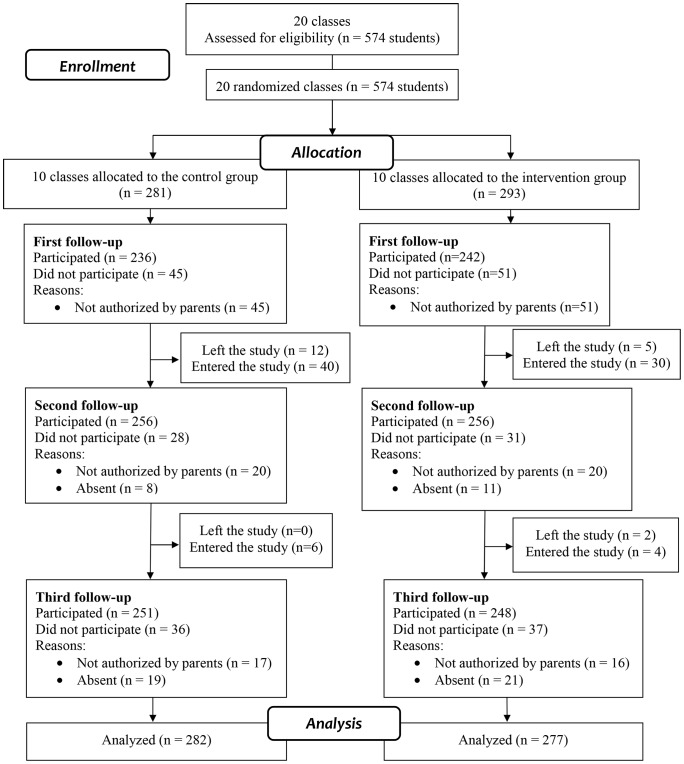
Participants: From a total of 574 eligible students, 559 students participated in the study (intervention: 10 classes with 277 participants; control: 10 classes with 282 participants). The mean age of students was 11 years.
Intervention: Students attended 9 nutritional education sessions during the 2010 academic year. Parents/guardians and teachers received information on the same subjects.
Main outcome measurement: Changes in BMI and percentage of body fat.
Results: Intention-to-treat analysis showed that changes in BMI were not significantly different between the 2 groups (β = 0.003; p = 0.75). There was a major reduction in the consumption of sugar-sweetened beverages and cookies in the intervention group; students in this group also consumed more fruits.
Conclusion: Encouraging the adoption of healthy eating habits promoted important changes in the adolescent diet, but this did not lead to a reduction in BMI gain. Strategies based exclusively on the quality of diet may not reduce weight gain among adolescents.
Trial registration: Clinicaltrials.gov NCT01046474.
Conflict of interest statement
Figures
References
-
- IBGE – Instituto Brasileiro de Geografia e Estatística (2011) National Household Budget Survey 2002–2003: Anthropometry and nutritional status of children, teenagers and adults in Brazil (in Portuguese). Rio de Janeiro : IBGE.
-
- Brug J, Lien N, Klepp KI, van Lenthe FJ (2010) Exploring overweight, obesity and their behavioural correlates among children and adolescents: results from the Health-promotion through Obesity Prevention across Europe project. Public Health Nutr 13: 1676–1679. - PubMed
-
- Schmidt MI, Duncan BB, Azevedo e Silva G, Menezes AM, Monteiro CA, et al. (2011) Chronic non-communicable diseases in Brazil: burden and current challenges. Lancet 377: 1949–1961. - PubMed
-
- Levy RB, Castro IR, Cardoso LO, Tavares LF, Sardinha LM, et al. (2010) [Food consumption and eating behavior among Brazilian adolescents: National Adolescent School-based Health Survey (PeNSE), 2009]. Cien Saude Colet 15 Suppl 23085–3097. - PubMed
-
- Verstraeten R, Roberfroid D, Lachat C, Leroy JL, Holdsworth M, et al. (2012) Effectiveness of preventive school-based obesity interventions in low- and middle-income countries: a systematic review. Am J Clin Nutr. 96: 415–38. - PubMed
Publication types
MeSH terms
Associated data
Grants and funding
LinkOut - more resources
Full Text Sources
Other Literature Sources
Medical
