


Effectiveness of a government-organized and hospital-initiated treatment for multidrug-resistant tuberculosis patients--a retrospective cohort study
- PMID: 23451263
- PMCID: PMC3581541
- DOI: 10.1371/journal.pone.0057719
Effectiveness of a government-organized and hospital-initiated treatment for multidrug-resistant tuberculosis patients--a retrospective cohort study
Abstract
Background: In contrast to the conventional model of hospital-treated and government directly observed treatment (DOT) for multidrug-resistant tuberculosis (MDR-TB) patient care, the Taiwan MDR-TB Consortium (TMTC) was launched in May 2007 with the collaboration of five medical care groups that have provided both care and DOT. This study aimed to determine whether the TMTC provided a better care model for MDR-TB patients than the conventional model.
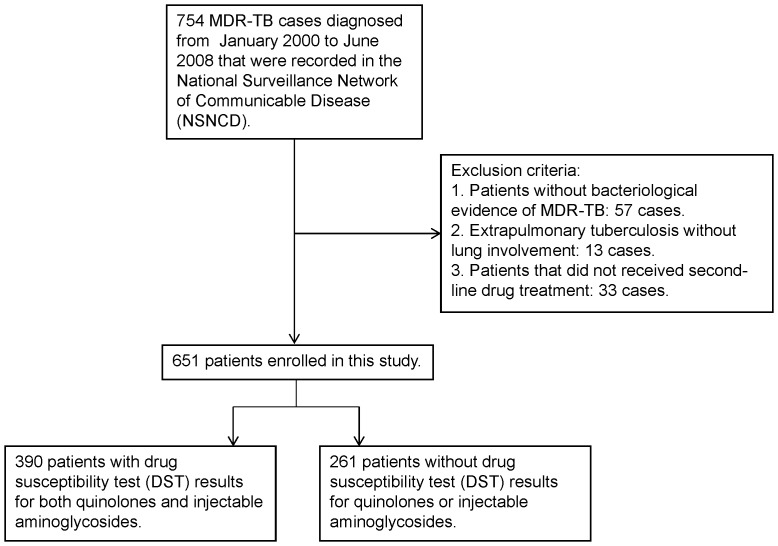
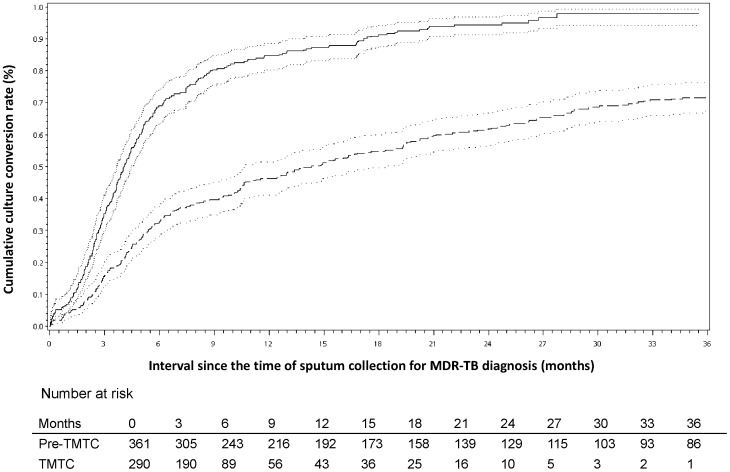
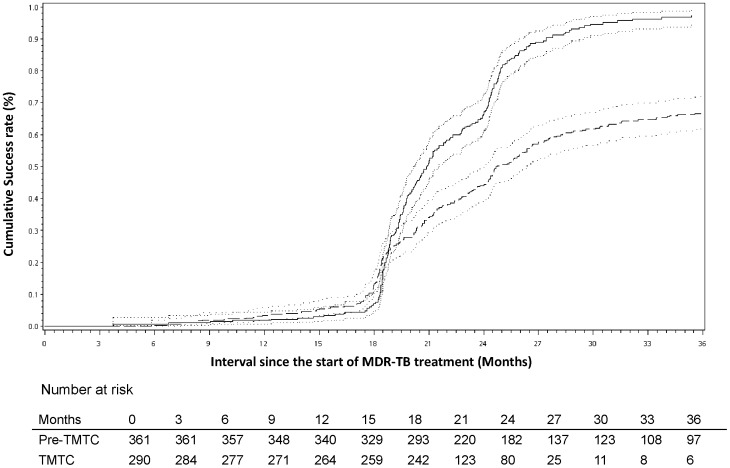
Methods and findings: A total of 651 pulmonary MDR-TB patients that were diagnosed nation-wide from January 2000-August 2008 were enrolled. Of those, 290 (45%) MDR-TB patients whose initial sputum sample was taken in January 2007 or later were classified as patients in the TMTC era. All others were classified as patients in the pre-TMTC era. The treatment success rate at 36 months was better in the TMTC era group (82%) than in the pre-TMTC era group (61%) (p<0.001). With multiple logistic regressions, diagnosis in the TMTC era (adjusted odds ratio (aOR) 2.8, 95% confidence interval (CI) 1.9-4.2) was an independent predictor of a higher treatment success rate at 36 months. With the time-dependent proportional hazards method, a higher treatment success rate was still observed in the TMTC era group compared to the pre-TMTC era group (adjusted hazard ratio 6.3, 95% CI 4.2-9.5).
Conclusion: The improved treatment success observed in the TMTC era compared to the pre-TMTC era is encouraging. The detailed TMTC components that contribute the most to the improved outcome will need confirmation in follow-up studies with large numbers of MDR-TB patients.
Conflict of interest statement
Figures
References
-
- World Health Organization (2008) Anti-tuberculosis drug resistance in the world: fourth global report. The WHO/IUATLD Global Project on Anti-tuberculosis Drug Resistance Surveillance 2002–2007. Geneva: World Health Organization. 37 p.
-
- Taiwan CDC (2009) Taiwan Tuberculosis Control Report 2009. Available: http://www.cdc.gov.tw/uploads/files/cd38b0db-50f5-40ff-abfe-fd11902c1f0b.... Accessed 2012 May 22.
-
- Johnston JC, Shahidi NC, Sadatsafavi M, Fitzgerald JM (2009) Treatment outcomes of multidrug-resistant tuberculosis: a systematic review and meta-analysis. PLoS One 4: e6914 doi:10.1371/journal.pone.0006914. - DOI - PMC - PubMed
-
- World Health Organization (2008) Guidelines for the programmatic management of drug-resistant tuberculosis: Emergency update 2008. Available: http://whqlibdoc.who.int/publications/2008/9789241547581_eng.pdf. Accessed 2012 July 27.
-
- Leimane V, Riekstina V, Holtz TH, Zaroyska E, Skripconoka V, et al. (2005) Clinical outcome of individualised treatment of multi-drug-resistant tuberculosis in Latvia: a retrospective cohort study. Lancet 365: 318–326. - PubMed
Publication types
MeSH terms
Substances
LinkOut - more resources
Full Text Sources
Other Literature Sources
