Flap endonuclease 1
- PMID: 23451868
- PMCID: PMC3679248
- DOI: 10.1146/annurev-biochem-072511-122603
Flap endonuclease 1
Abstract
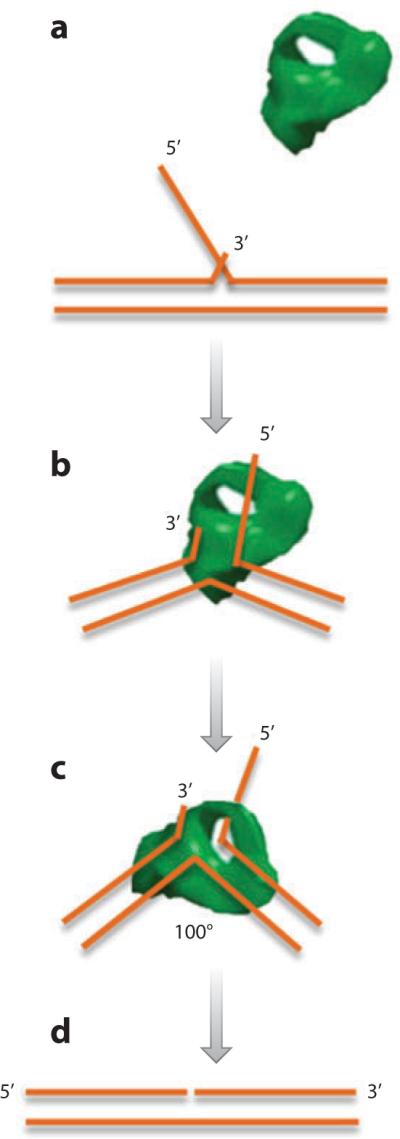
First discovered as a structure-specific endonuclease that evolved to cut at the base of single-stranded flaps, flap endonuclease (FEN1) is now recognized as a central component of cellular DNA metabolism. Substrate specificity allows FEN1 to process intermediates of Okazaki fragment maturation, long-patch base excision repair, telomere maintenance, and stalled replication fork rescue. For Okazaki fragments, the RNA primer is displaced into a 5' flap and then cleaved off. FEN1 binds to the flap base and then threads the 5' end of the flap through its helical arch and active site to create a configuration for cleavage. The threading requirement prevents this active nuclease from cutting the single-stranded template between Okazaki fragments. FEN1 efficiency and specificity are critical to the maintenance of genome fidelity. Overall, recent advances in our knowledge of FEN1 suggest that it was an ancient protein that has been fine-tuned over eons to coordinate many essential DNA transactions.
Figures

References
-
- Liu Y, Kao HI, Bambara RA. Flap endonuclease 1: a central component of DNA metabolism. Annu. Rev. Biochem. 2004;73:589–615. - PubMed
-
- Rossi ML, Bambara RA. Reconstituted Okazaki fragment processing indicates two pathways of primer removal. J. Biol. Chem. 2006;281:26051–61. - PubMed
-
- Bae SH, Bae KH, Kim JA, Seo YS. RPA governs endonuclease switching during processing of Okazaki fragments in eukaryotes. Nature. 2001;412:456–61. - PubMed
Publication types
MeSH terms
Substances
Grants and funding
LinkOut - more resources
Full Text Sources
Other Literature Sources
Miscellaneous