


Review
doi: 10.1172/JCI57175.
Epub 2013 Mar 1.
Control of inflammation by integration of environmental cues by regulatory T cells
Affiliations
- PMID: 23454755
- PMCID: PMC3582113
- DOI: 10.1172/JCI57175
Item in Clipboard
Review
Control of inflammation by integration of environmental cues by regulatory T cells
J Clin Invest.
2013 Mar.
Abstract
Tregs have been implicated in control of homeostasis in the immune system and beyond. These cells restrain inflammatory responses to self antigens, commensal microorganisms, allergens, and pathogens and adapt their homeostatic and functional capabilities to a particular environment. In this review, we discuss a general model of integration of environmental cues by Tregs in which specialized Treg homeostatic, migratory, and suppression programs are established in dynamically changing inflammatory environments by maintaining an optimal threshold of activation of transcription factors involved in regulation of the corresponding type of effector immune responses.
Figures
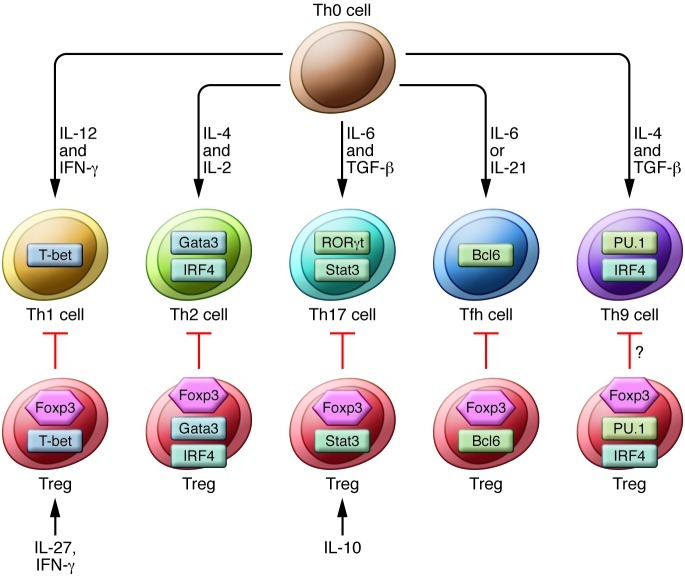
Th1 cell differentiation is driven by IL-12 and IFN-γ, Th2 cell development is dependent on IL-4, IL-6 in combination with TGF-β mediates Th17 differentiation, and Tfh cell differentiation requires Stat3-inducing factors, such as IL-6 or IL-21, while Th9 cells generation is dependent on IL-4 and TGF-β. Genetic evidence suggests that coopting of factors required for effector T cell differentiation by Foxp3 endows Tregs to tailor their suppression program for control of the corresponding type of immune responses. Activation of a Th1 suppression module in Tregs is dependent on IFN-γ and IL-27, while Th17 suppression requires IL-10–mediated Stat3 activation in Tregs.
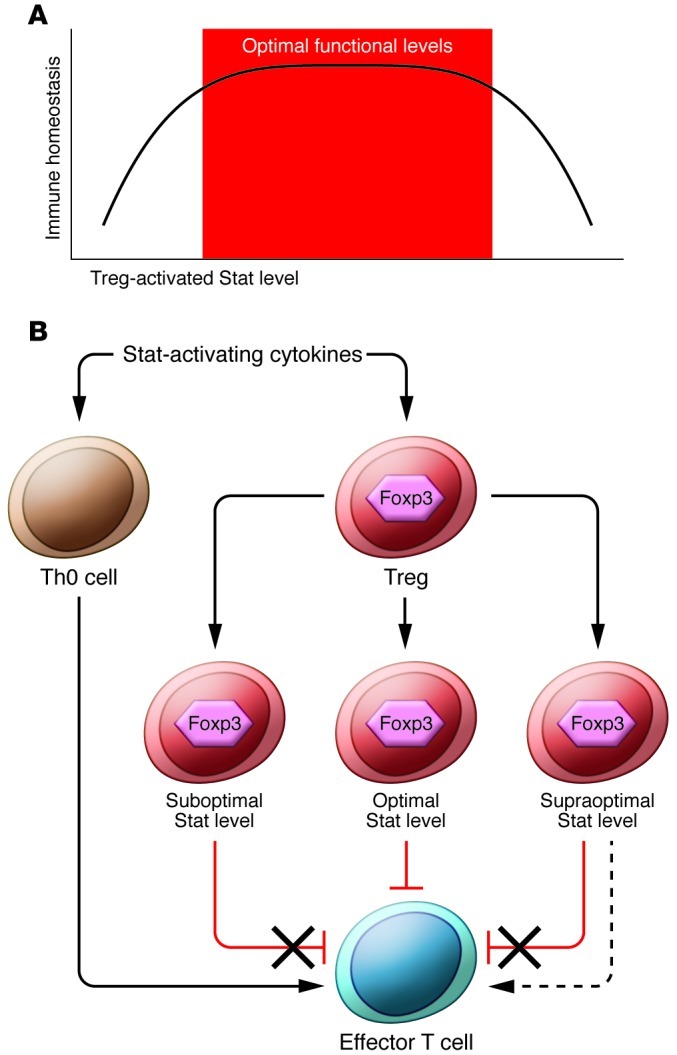
(A) An optimal window of Stat activation in Tregs is required for immune homeostasis. (B) Stat-activating cytokines induce activation of Tregs when Stat levels are optimized. Genetic evidence indicates that sub- or supraoptimal Stat levels result in immune-mediated pathology.
References
Publication types
MeSH terms
Substances
Grants and funding
LinkOut - more resources
Full Text Sources
Other Literature Sources
