. 2013 Apr 1;190(7):3732-9.
doi: 10.4049/jimmunol.1202964. Epub 2013 Mar 1.

Reversion of somatic mutations of the respiratory syncytial virus-specific human monoclonal antibody Fab19 reveal a direct relationship between association rate and neutralizing potency

Affiliations

Reversion of somatic mutations of the respiratory syncytial virus-specific human monoclonal antibody Fab19 reveal a direct relationship between association rate and neutralizing potency

John T Bates et al. J Immunol. .

Abstract

The role of affinity in determining neutralizing potency of mAbs directed against viruses is not well understood. We investigated the kinetic, structural, and functional advantage conferred by individual naturally occurring somatic mutations in the Ab H chain V region of Fab19, a well-described neutralizing human mAb directed to respiratory syncytial virus. Comparison of the affinity-matured Ab Fab19 with recombinant Fab19 Abs that were variants containing reverted amino acids from the inferred unmutated ancestor sequence revealed the molecular basis for affinity maturation of this Ab. Enhanced binding was achieved through mutations in the third H chain CDR (HCDR3) that conferred a markedly faster on-rate and a desirable increase in antiviral neutralizing activity. In contrast, most somatic mutations in the HCDR1 and HCDR2 regions did not significantly enhance Ag binding or antiviral activity. We observed a direct relationship between the measured association rate (Kon) for F protein and antiviral activity. Modeling studies of the structure of the Ag-Ab complex suggested the HCDR3 loop interacts with the antigenic site A surface loop of the respiratory syncytial virus F protein, previously shown to contain the epitope for this Ab by experimentation. These studies define a direct relationship of affinity and neutralizing activity for a viral glycoprotein-specific human mAb.


Figures
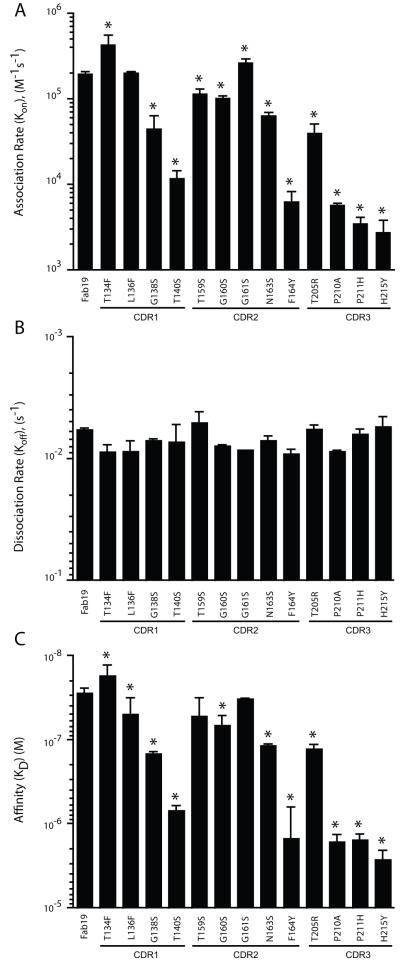
Figure 1
Figure 1. Kinetics of Fab 19 or Fab 19 inferred germline-reversion variant binding to RSV F protein, measured by surface plasmon resonance
Each variant is labeled to indicate the amino acid position with the somatically mutated residue from the matured antibody (to left) and the inferred germline residue to which it was reverted (to right). Association (A) or dissociation (B) rate of Fab 19 or Fab19 inferred germline-reversion variant binding to RSV F protein. Steady-state affinity [KD] of Fab19 or Fab19 inferred germline-reversion variants for binding to the RSV F protein (C). Each bar represents the mean rate constant or affinity (± standard deviation) calculated from experiments run in triplicate. * Indicates p < 0.05 compared to Fab19, as calculated by an unpaired t test.
Figure 2
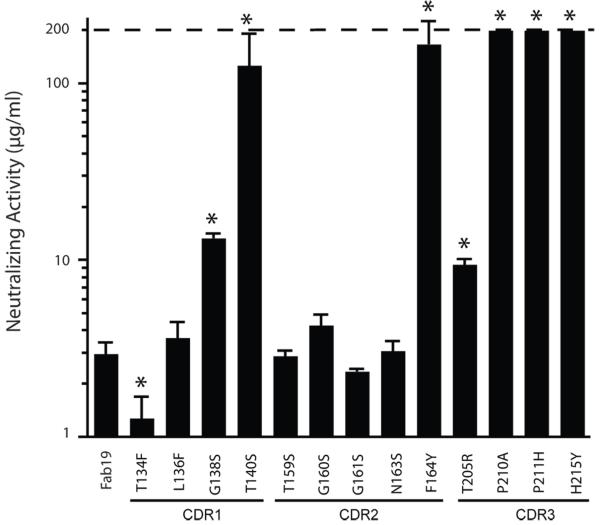
Figure 2. Neutralizing activity of Fab19 or Fab19 inferred germline-reversion variants
Activity was determined by plaque reduction (antibody concentration needed to reduce the number of RSV plaques by 60%). Greater values indicate less potent neutralizing activity. The range of antibody concentration tested was from 0.1 μg/mL to 200 μg/mL. Dotted line indicates upper limit of detection. Each bar represents the mean (± standard deviation) neutralization activity calculated from plaque reduction assays run in triplicate. * Indicates p < 0.05 compared to Fab19, as calculated by an unpaired t test.
Figure 3
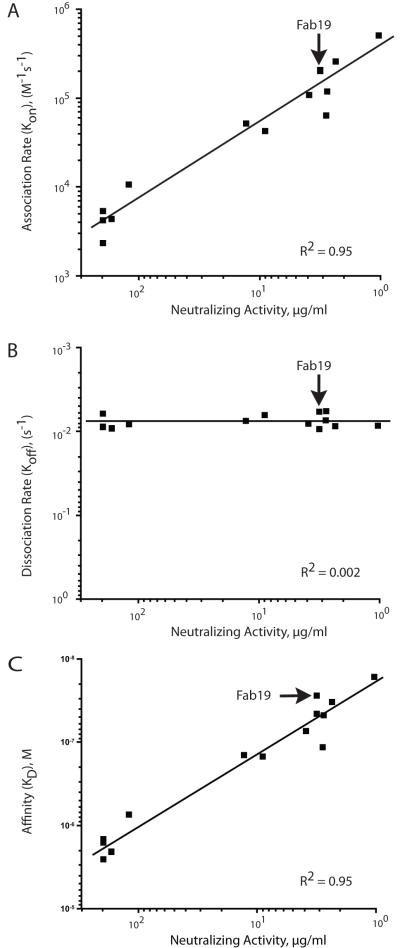
Figure 3. Relationship between association rate (A), dissociation rate (B), or steady-state affinity (B) and neutralizing activity of Fab19 inferred germline reversion mutations
The trend lines are shown with the correlation coefficients (R2).
Figure 4
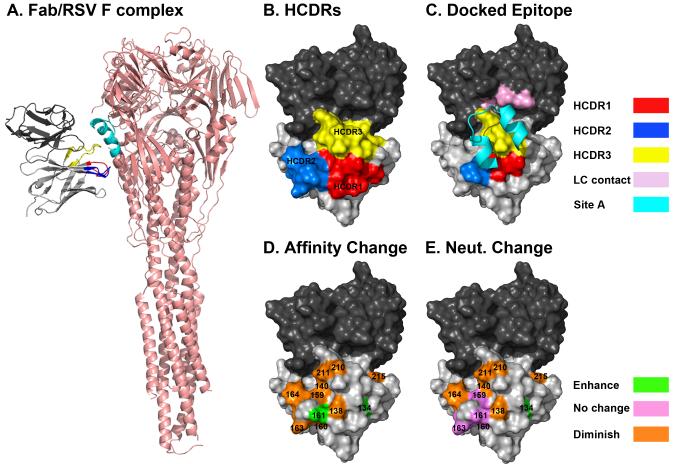
Figure 4. Docking model of Fab19 bound to the RSV F protein predicts interaction between the known RSV F protein antigenic site A and the HCDRs of Fab19
(A) Surface projection of the predicted structural model of Fab19 showing the heavy chain (light gray), light chain (dark gray), HCDR1 (red), HCDR2 (blue), and HCDR3 (yellow) (B). The surface of Fab19, which the model predicts to be within 5Å of RSV F protein antigenic site A (cyan) is colored, as described above. Light chain residues within 5 Å of antigenic site A are shown in pink (C). Inferred germline reversion mutations are color coded according to their effect on the neutralizing activity of Fab19 (green – enhanced activity, violet – no effect, orange – reduced activity) (D). Inferred germline reversion mutations are color coded according to their effect on the Kon of Fab19, as described above (E).

References

    1. Hacking D, J Hull. Respiratory syncytial virus--viral biology and the host response. J. Infect. 2002;45:18–24. - PubMed
    1. Handforth J, Friedland JS, Sharland M. Basic epidemiology and immunopathology of RSV in children. Paediatr Respir Rev. 2000;1:210–214. - PubMed
    1. Domachowske JB, Rosenberg HF. Respiratory syncytial virus infection: immune response, immunopathogenesis, and treatment. Clin. Microbiol. Rev. 1999;12:298–309. - PMC - PubMed
    1. The IMpact-RSV Study Group Palivizumab, a humanized respiratory syncytial virus monoclonal antibody, reduces hospitalization from respiratory syncytial virus infection in high-risk infants. Pediatrics. 1998;102:531–537. - PubMed
    1. Groothuis JR, Nishida H. Prevention of respiratory syncytial virus infections in high-risk infants by monoclonal antibody (palivizumab) Pediatr. Int. 2002;44:235–241. - PubMed

Publication types

MeSH terms

Substances