


doi: 10.1038/nchembio.1202.
Epub 2013 Mar 3.
Atomic-resolution monitoring of protein maturation in live human cells by NMR
Affiliations
- PMID: 23455544
- PMCID: PMC4017183
- DOI: 10.1038/nchembio.1202
Item in Clipboard
Atomic-resolution monitoring of protein maturation in live human cells by NMR
Nat Chem Biol.
2013 May.
Abstract
We use NMR directly in live human cells to describe the complete post-translational maturation process of human superoxide dismutase 1 (SOD1). We follow, at atomic resolution, zinc binding, homodimer formation and copper uptake, and discover that copper chaperone for SOD1 oxidizes the SOD1 intrasubunit disulfide bond through both copper-dependent and copper-independent mechanisms. Our approach represents a new strategy for structural investigation of endogenously expressed proteins in a physiological (cellular) environment.
Figures
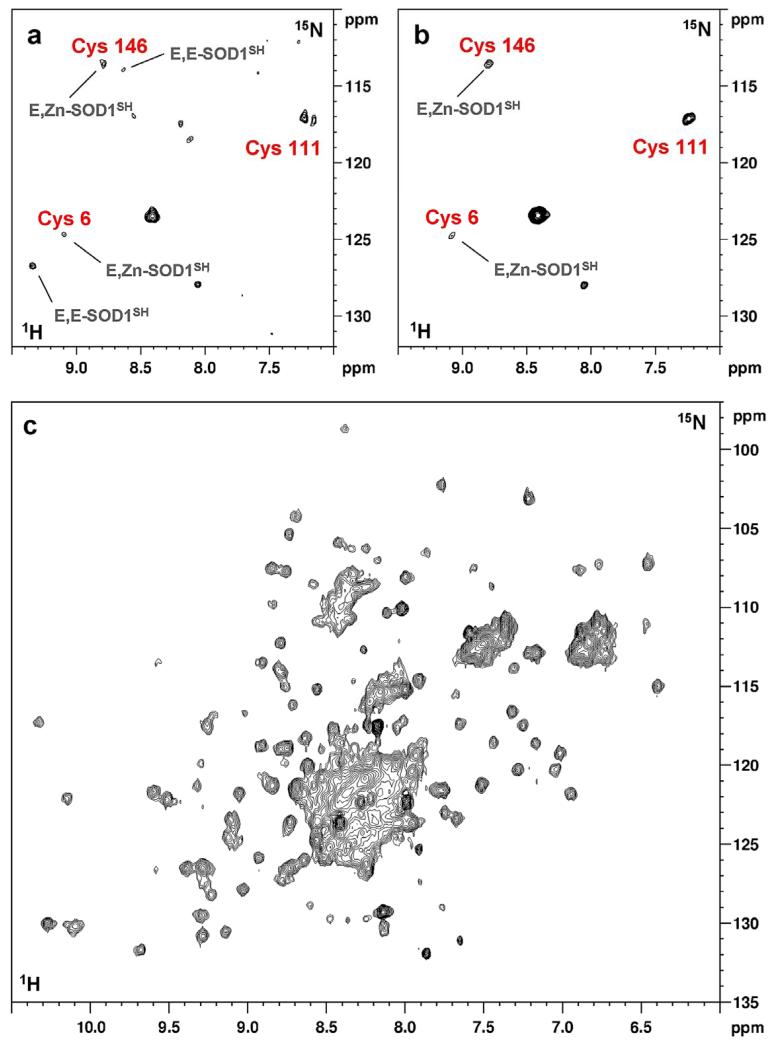
1H-15N SOFAST HMQC spectra were acquired on human cells expressing 15N-cysteine labelled SOD1: a, in absence of metals; b, with Zn(II) added to the culture medium. Assigned cysteine residues are indicated in red. When two species of SOD1 are present, labels indicate the species to which each crosspeak belongs (E,E-SOD1SH: reduced apo-SOD1; E,Zn-SOD1SH: reduced SOD1 containing one Zn2+ ion per subunit). In both species, cysteine 57 crosspeak is not detected. Unlabelled crosspeaks correspond to cellular background signals; c, 1H-15N SOFAST HMQC acquired on human cells expressing uniformly 15N-labelled SOD1 in Zn(II)-supplemented medium. The region between 8.0 and 8.5 (1H) ppm contains overlapped signals arising from non-specific labelling of the cells, which can be subtracted to obtain a cleaner spectrum (Supplementary Fig. 5). By comparing the chemical shift of the assigned crosspeaks in the in-cell spectrum with backbone assignments of SOD1 in different metallation and redox state in vitro, it was possible to assess the species present in the cytoplasm (Supplementary Fig. 6).

Histidine region of 1H NMR spectra were acquired on human cells expressing unlabelled SOD1: a, in Zn(II)-supplemented medium, after incubation with Cu(II); b, in Zn(II)-supplemented medium without incubation with Cu(II); c, in medium without added metals. d, 1H NMR spectrum of human cells co-expressing SOD1 and CCS in Zn(II)-supplemented medium, after incubation with Cu(II). Histidine protons unambiguously assigned to Cu(I),Zn-SOD1 species are indicated.

1H-15N SOFAST HMQC spectra were acquired on human cells: a, co-expressing 15N-cysteine labelled SOD1 and CCS in Zn(II)-supplemented medium; b, co-expressing 15N-cysteine labelled SOD1 and CCS in Zn(II)-supplemented medium, after incubation with Cu(II). Assigned cysteine residues are indicated in red. When two species of SOD1 are present, labels indicate the disulfide redox state of each species. Unlabelled crosspeaks are cellular background signals. c, drawing summarizing SOD1 maturation steps. Left cell: SOD1 expressed in cells with no addition of metals is present mainly it the apo form, which is monomeric and partially unfolded. A fraction of SOD1 binds the zinc present in the expression medium. Central cell: when Zn(II) (cyan) is added to the expression medium SOD1 quantitatively binds one zinc ion per monomer and dimerizes; the intrasubunit disulfide bridge is completely reduced. Right cell: when both Zn(II) and Cu(II) (blue) are added to the expression medium, and CCS is co-expressed, a fraction of SOD1 binds Cu(I) (orange); the disulfide bridge is completely oxidized (yellow circles).
References
Publication types
MeSH terms
Substances
Grants and funding
LinkOut - more resources
Full Text Sources
Other Literature Sources
Miscellaneous
