


Molecular pathogenesis of multiple myeloma: basic and clinical updates
- PMID: 23456262
- PMCID: PMC3962846
- DOI: 10.1007/s12185-013-1291-2
Molecular pathogenesis of multiple myeloma: basic and clinical updates
Abstract
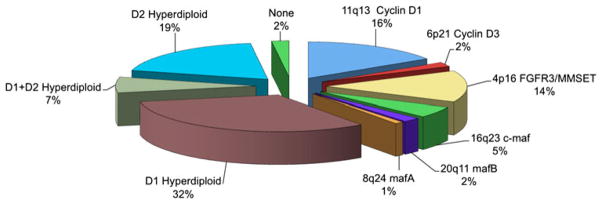
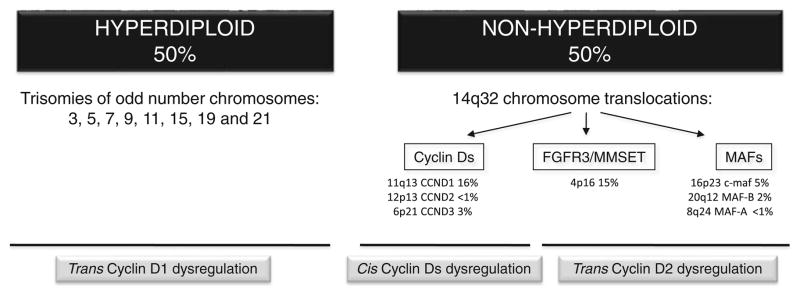
Multiple myeloma is divided into two distinct genetic subtypes based on chromosome content. Hyperdiploid myeloma is characterized by multiple trisomies of chromosomes 3, 5, 7, 9 11, 15, 19 and 21, and lacks recurrent immunoglobulin gene translocations. Non-hyperdiploid myeloma in contrast is characterized by chromosome translocations t(4;14), t(14;16), t(14;20), t(6;14) and t(11;14). A unifying event in the pathogenesis of multiple myeloma is the dysregulated expression of a cyclin D gene, either directly by juxtaposition to an immunoglobulin enhancer, as a result of ectopic expression of a MAF family transcription factor, or indirectly by as yet unidentified mechanisms. Secondary genetic events include rearrangements of MYC, activating mutations of NRAS, KRAS or BRAF, a promiscuous array of mutations that activate NFkB and deletions of 17p. Among the poor-risk genetic features are t(4;14), t(14;16), t(14;20), del 17p and gains of 1q. Available evidence supports the use of a risk-stratified approach to the treatment of patients with multiple myeloma, with the early and prolonged use of bortezomib particularly in patients with t(4;14) and del 17p.
Figures

References
-
- Malpas JS, Bergsagel DE, Kyle R, Anderson K. Multiple myeloma: biology and management. Oxford: Oxford University Press; 2004.
-
- Howlader N, Noone AM, Krapcho M, Neyman N, Aminou R, Altekruse SF, Kosary CL, Ruhl J, Tatalovich Z, Cho H, Mariotto A, Eisner MP, Lewis DR, Chen HS, Feuer EJ, Cronin KA, editors. SEER cancer statistics review 1975–2009 (Vintage 2009 Populations) Bethesda: National Cancer Institute; 2012. http://seer.cancer.gov/csr/1975_2009_pops09/
-
- Siegel R, Naishadham D, Jemal A. Cancer statistics. CA Cancer J Clin. 2013;63(1):11–30. - PubMed
-
- Avet-Loiseau H, Attal M, Campion L, Caillot D, Hulin C, Marit G, et al. Long-term analysis of the IFM 99 trials for myeloma: cytogenetic abnormalities [t(4;14), del(17p), 1q gains] play a major role in defining long-term survival. J Clin Oncol. 2012;30(16):1949–52. - PubMed
-
- Kuehl WM, Bergsagel PL. Multiple myeloma: evolving genetic events and host interactions. Nat Rev Cancer. 2002;2(3):175–87. - PubMed
Publication types
MeSH terms
Substances
Grants and funding
LinkOut - more resources
Full Text Sources
Other Literature Sources
Medical
Research Materials
Miscellaneous
