. 2013 Sep;42(5):541-8.
doi: 10.1007/s13280-013-0387-5. Epub 2013 Mar 3.

Novel organisms: comparing invasive species, GMOs, and emerging pathogens

Affiliations

Novel organisms: comparing invasive species, GMOs, and emerging pathogens

Jonathan M Jeschke et al. Ambio. 2013 Sep.

Abstract

Invasive species, range-expanding species, genetically modified organisms (GMOs), synthetic organisms, and emerging pathogens increasingly affect the human environment. We propose a framework that allows comparison of consecutive stages that such novel organisms go through. The framework provides a common terminology for novel organisms, facilitating knowledge exchange among researchers, managers, and policy makers that work on, or have to make effective decisions about, novel organisms. The framework also indicates that knowledge about the causes and consequences of stage transitions for the better studied novel organisms, such as invasive species, can be transferred to more poorly studied ones, such as GMOs and emerging pathogens. Finally, the framework advances understanding of how climate change can affect the establishment, spread, and impacts of novel organisms, and how biodiversity affects, and is affected by, novel organisms.


Figures
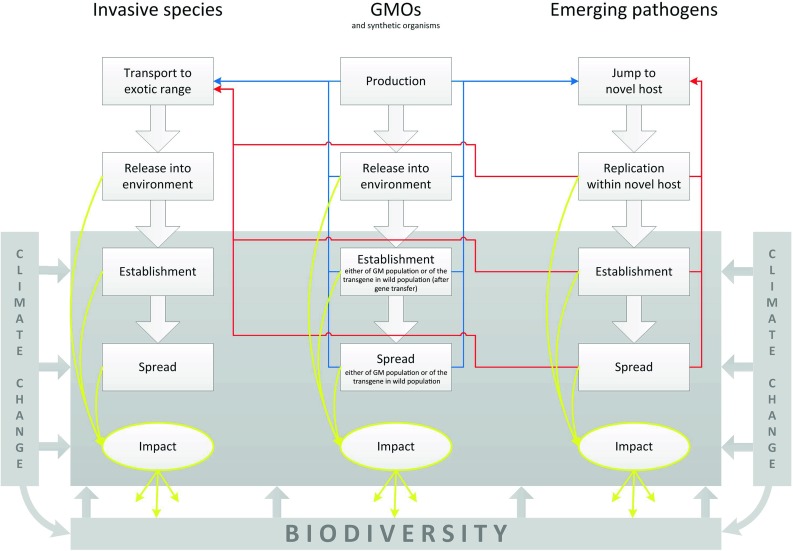
Fig. 1
Fig. 1
Proposed framework for comparing novel organisms. Invasive species, range-expanding species, GMOs, synthetic organisms, and emerging pathogens go through consecutive stages drawn as framed boxes. For example, transport, release, establishment, and spread for invasive species. The process can be stopped at each transition between two stages (drawn as thick white arrows), for example, a pathogen that has jumped to and replicated within a novel host (stage 2) may not establish itself in the novel host (e.g., Lyme disease with humans as novel host species). Those species that are released or established, and especially those that have spread can have severe environmental and economic impacts (yellow arrows), for example, by influencing biodiversity. To improve clarity, range-expanding species are not depicted explicitly. They are similar to invasive species, except they are not transported to a non-native range and released there, but instead are naturally dispersing to a non-native range where climate change may facilitate their establishment and spread. Blue (for GMOs) and red (for pathogens) arrows starting from different stages and pointing to the transport stage of invasive species illustrate that both GMOs and pathogens can become invasive, too: they can be transported beyond the region where they were first produced (GMOs) or where they first jumped to and replicated within a novel host (emerging pathogens). The probability that they will be transported beyond this region increases with their abundance, so it is higher for later stages of their processes (establishment and spread). Arrows pointing at the jump-to-novel-host stage of emerging pathogens illustrate that GMOs can serve as novel hosts (blue arrows) and that emergent pathogens can be a source for further novel pathogens (red arrows), again with higher probabilities in later stages of the processes. Invasive species can serve as novel hosts as well (not illustrated to improve the figure’s clarity). The grey-shaded boxes illustrate that altered climate and biodiversity affect probabilities of species to establish, spread, and have impacts. The effect of climate change is therefore both direct (because the new climate can, for example, better match a species’ fundamental ecological niche) and indirect (e.g., by reducing biodiversity). Biodiversity itself is also changed by impacts of novel organisms

References

    1. Bellard C, Bertelsmeier C, Leadley P, Thuiller W, Courchamp F. Impacts of climate change on the future of biodiversity. Ecology Letters. 2012;15:365–377. doi: 10.1111/j.1461-0248.2011.01736.x. - DOI - PMC - PubMed
    1. Blackburn TM, Jeschke JM. Invasion success and threat status: Two sides of a different coin? Ecography. 2009;32:83–88. doi: 10.1111/j.1600-0587.2008.05661.x. - DOI
    1. Blackburn TM, Pyšek P, Bacher S, Carlton JT, Duncan RP, Jarošík V, Wilson JRU, Richardson DM. A proposed unified framework for biological invasions. Trends in Ecology & Evolution. 2011;26:333–339. doi: 10.1016/j.tree.2011.03.023. - DOI - PubMed
    1. Cassey P, Blackburn TM, Jones KE, Lockwood JL. Mistakes in the analysis of exotic species establishment: Source pool designation and correlates of introduction success among parrots (Aves: Psittaciformes) of the world. Journal of Biogeography. 2004;31:277–284. doi: 10.1046/j.0305-0270.2003.00979.x. - DOI
    1. Chambers CP, Whiles MR, Rosi-Marshall EJ, Tank JL, Royer TV, Griffiths NA, Evans-White MA, Stojak AR. Responses of stream macroinvertebrates to Bt maize leaf detritus. Ecological Applications. 2010;20:1949–1960. doi: 10.1890/09-0598.1. - DOI - PubMed

Publication types

LinkOut - more resources
