


Anterior tibialis CMAP amplitude correlations with impairment in CMT1A
- PMID: 23456782
- PMCID: PMC3608739
- DOI: 10.1002/mus.23614
Anterior tibialis CMAP amplitude correlations with impairment in CMT1A
Abstract
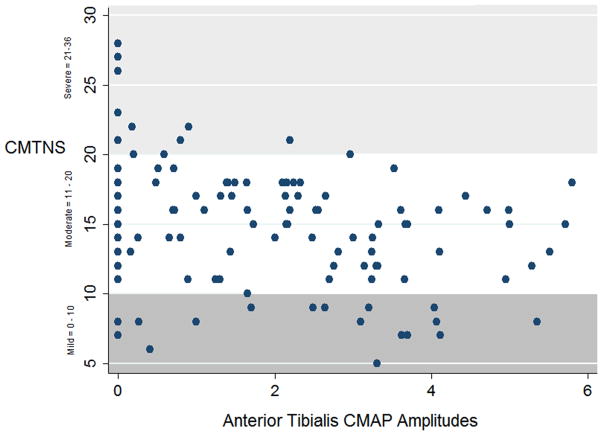
Introduction: CMT1A is the most common form of Charcot-Marie-Tooth disease (CMT), a slowly progressive neuropathy in which impairment is length dependent. Fibular nerve conduction studies to the anterior tibialis muscle (AT) may serve as a physiological marker of disease progression in patients with CMT1A. The objective of this study is to determine whether the AT compound muscle action potential (CMAP) amplitude correlates with impairment in patients with CMT1A.
Methods: We correlated AT CMAP amplitudes and impairment measured by the CMT Neuropathy Score (CMTNS) in a cross-section of 121 patients with CMT1A and a subset of 27 patients with longitudinal data.
Results: AT CMAP amplitudes correlated with impairment as measured by the CMTNS in cross sectional analysis. Longitudinal changes in the AT CMAP showed a strong inverse correlation with leg strength but not other components of the CMTNS.
Conclusions: AT CMAP amplitude may serve as a useful outcome measure for physiological changes in natural history studies and clinical trials for patients with CMT1A.
Copyright © 2012 Wiley Periodicals, Inc.
Figures
References
-
- Skre H. Genetic and clinical aspects of Charcot-Marie-Tooth’s disease. Clin Genet. 1974;6:98–118. - PubMed
-
- Thomas PK, Marques W, Jr, Davis MB, Sweeney MG, King RH, Bradley JL, et al. The phenotypic manifestations of chromosome 17p11.2 duplication. Brain. 1997;120:465–478. - PubMed
-
- Lupski JR, de Oca-Luna RM, Slaugenhaupt S, Pentao L, Guzzeta V, Trask BJ, et al. DNA duplication associated with Charcot-Marie-Tooth disease type 1A. Cell. 1991;66:219–232. - PubMed
-
- Raeymaekers P, Timmerman V, Nelis E, De Jonghe P, Hoogendijk JE, Baas F, et al. Duplication in chromosome 17p11.2 in Charcot-Marie-Tooth neuropathy type 1a (CMT 1a). The HMSN Collaborative Research Group. Neuromuscul Disord. 1991;1:93–97. - PubMed
-
- Niemann A, Berger P, Suter U. Pathomechanisms of mutant proteins in Charcot-Marie-Tooth disease. Neuromolecular Med. 2006;8:217–242. - PubMed
Publication types
MeSH terms
Grants and funding
LinkOut - more resources
Full Text Sources
Other Literature Sources
Medical
