


Canine behaviour problems: discussions between veterinarians and dog owners during annual booster consultations
- PMID: 23457279
- PMCID: PMC3593187
- DOI: 10.1136/vr.101125
Canine behaviour problems: discussions between veterinarians and dog owners during annual booster consultations
Abstract
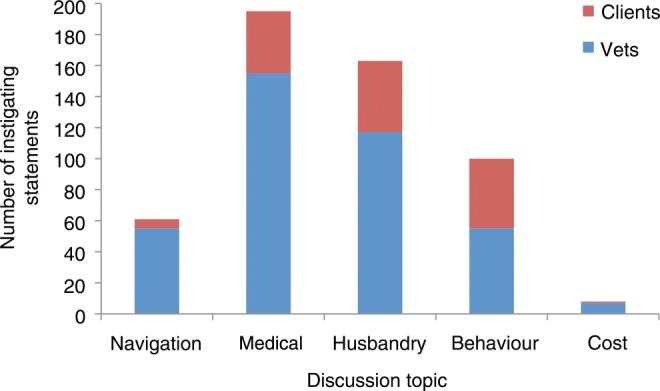
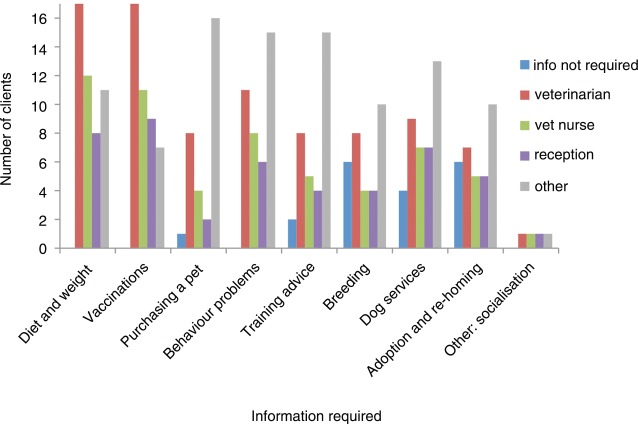
The veterinary profession recently acknowledged its responsibility to provide behaviour support, following criticism for focussing on the physiological aspects of welfare and overlooking the psychological. To further understand the practising of behavioural medicine, a 'fly-on-the-wall' approach was used to investigate welfare discussions during dog booster vaccinations. Seventeen consultations involving six veterinarians in two UK small-animal practices were videoed. Qualitative methods were used to analyse themes discussed and questionnaires completed to obtain participant information and perceptions. Five main topics of discussion were identified: navigation, medical, husbandry, behaviour and cost. Veterinarians led the discussion of all topics except behaviour which was instigated approximately equally by veterinarian and client. All clients reported one or more behaviours that were a concern to them, totalling 58 across the sample. Disconcertingly, only 10 were discussed during consultations and none fully explored nor managed beyond the consultation. Behaviour discussion varies between veterinarians; this may reflect their experience, confidence or clients' requests. Owners access welfare information from a variety of sources, not always from veterinarians. Where sources are not knowledgeable, both human and animal welfare can be seriously compromised. Veterinarians need to ensure that clients are enabled to discuss behaviour issues and are provided with appropriate support, be that in-house or via referral.
Figures
Comment in
-
Time to talk about behavioural problems.Vet Rec. 2013 Mar 2;172(9):233-4. doi: 10.1136/vr.f1208. Vet Rec. 2013. PMID: 23457278 No abstract available.
References
-
- ANON (2007) British Veterinary Association Council News in Brief: definition of ‘animal welfare’. Veterinary Record 161, 44
-
- Arborelius E., Timpka T. (1990) General practitioners' comments on video recorded consultations as an aid to understanding the doctor-patient relationship. Family Practice 7, 84–90 - PubMed
-
- Bergman L., Hart B. L., Bain M., Cliff K. (2002) Evaluation of urine marking by cats as a model for understanding veterinary diagnostic and treatment approaches and client attitudes. Journal of the American Veterinary Medical Association 221, 1282–1286 - PubMed
-
- Blackwell E., Casey R., Bradshaw J. (2005) Firework fears and phobias in the domestic dog. Scientific report for the RSPCA. Bristol, UK: University of Bristol; www.rspca.org.uk/servlet/Satellite?blobcol=urlblob&blobheader=applicatio... Accessed September 20, 2012
-
- Boyatzis R. E. (1998) Transforming Qualitative Information: Thematic Analysis and Code Development. USA: Sage Publications Inc
MeSH terms
LinkOut - more resources
Full Text Sources
