


Identification of the genes chemosensitizing hepatocellular carcinoma cells to interferon-α/5-fluorouracil and their clinical significance
- PMID: 23457527
- PMCID: PMC3574150
- DOI: 10.1371/journal.pone.0056197
Identification of the genes chemosensitizing hepatocellular carcinoma cells to interferon-α/5-fluorouracil and their clinical significance
Abstract
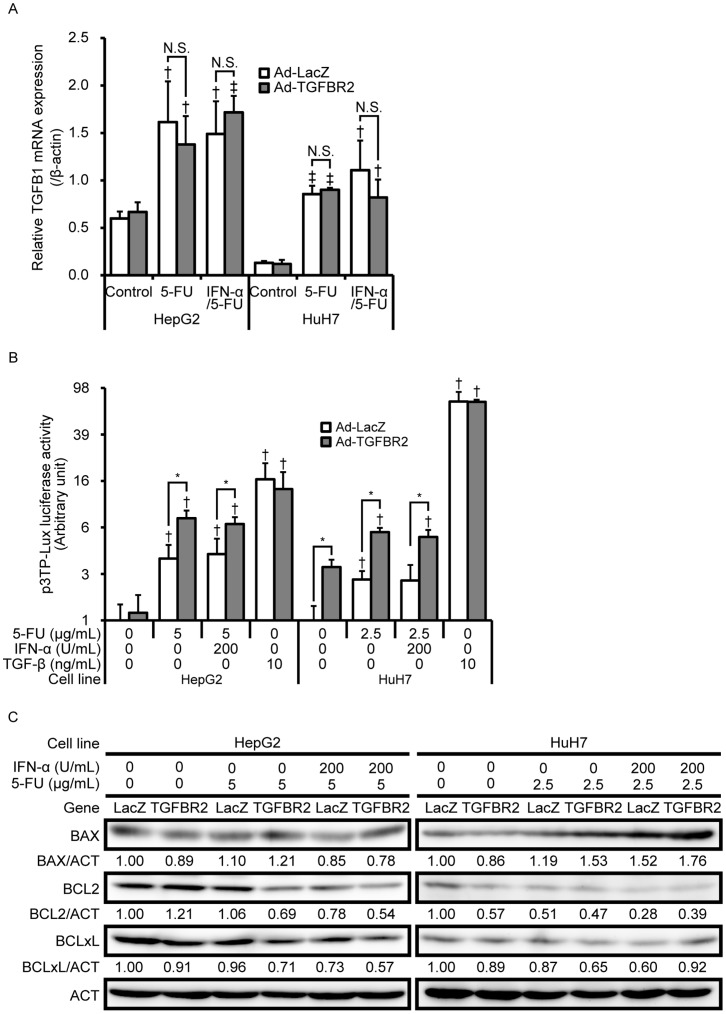
The incidence of advanced hepatocellular carcinoma (HCC) is increasing worldwide, and its prognosis is extremely poor. Interferon-alpha (IFN-α)/5-fluorouracil (5-FU) therapy is reportedly effective in some HCC patients. In the present study, to improve HCC prognosis, we identified the genes that are sensitizing to these agents. The screening strategy was dependent on the concentration of ribozymes that rendered HepG2 cells resistant to 5-FU by the repeated transfection of ribozymes into the cells. After 10 cycles of transfection, which was initiated by 5,902,875 sequences of a ribozyme library, three genes including protein kinase, adenosine monophosphate (AMP)-activated, gamma 2 non-catalytic subunit (PRKAG2); transforming growth factor-beta receptor II (TGFBR2); and exostosin 1 (EXT1) were identified as 5-FU-sensitizing genes. Adenovirus-mediated transfer of TGFBR2 and EXT1 enhanced IFN-α/5-FU-induced cytotoxicity as well as 5-FU, although the overexpression of these genes in the absence of IFN-α/5-FU did not induce cell death. This effect was also observed in a tumor xenograft model. The mechanisms of TGFBR2 and EXT1 include activation of the TGF-β signal and induction of endoplasmic reticulum stress, resulting in apoptosis. In HCC patients treated with IFN-α/5-FU therapy, the PRKAG2 mRNA level in HCC tissues was positively correlated with survival period, suggesting that PRKAG2 enhances the effect of IFN-α/5-FU and serves as a prognostic marker for IFN-α/5-FU therapy. In conclusion, we identified three genes that chemosensitize the effects of 5-FU and IFN-α/5-FU on HCC cells and demonstrated that PRKAG2 mRNA can serve as a prognostic marker for IFN-α/5-FU therapy.
Conflict of interest statement
Figures




References
-
- Umemura T, Ichijo T, Yoshizawa K, Tanaka E, Kiyosawa K (2009) Epidemiology of hepatocellular carcinoma in Japan. J Gastroenterol 44: 102–107. - PubMed
-
- Llovet JM, Ricci S, Mazzaferro V, Hilgard P, Gane E, et al. (2008) Sorafenib in advanced hepatocellular carcinoma. N Engl J Med 359: 378–390. - PubMed
-
- Cheng AL, Kang YK, Chen Z, Tsao CJ, Qin S, et al. (2009) Efficacy and safety of sorafenib in patients in the Asia-Pacific region with advanced hepatocellular carcinoma: a phase III randomised, double-blind, placebo-controlled trial. Lancet Oncol 10: 25–34. - PubMed
-
- Yau T, Chan P, Ng KK, Chok SH, Cheung TT, et al. (2009) Phase 2 open-label study of single-agent sorafenib in treating advanced hepatocellular carcinoma in a hepatitis B-endemic Asian population: presence of lung metastasis predicts poor response. Cancer 115: 428–436. - PubMed
-
- Patt YZ, Hassan MM, Lozano RD, Brown TD, Vauthey JN, et al. (2003) Phase II trial of systemic continuous fluorouracil and subcutaneous recombinant interferon Alfa-2b for treatment of hepatocellular carcinoma. J Clin Oncol 21: 421–427. - PubMed
Publication types
MeSH terms
Substances
LinkOut - more resources
Full Text Sources
Other Literature Sources
Medical
Miscellaneous
