


Genetic variation and exchange in Trypanosoma cruzi isolates from the United States
- PMID: 23457528
- PMCID: PMC3572986
- DOI: 10.1371/journal.pone.0056198
Genetic variation and exchange in Trypanosoma cruzi isolates from the United States
Abstract
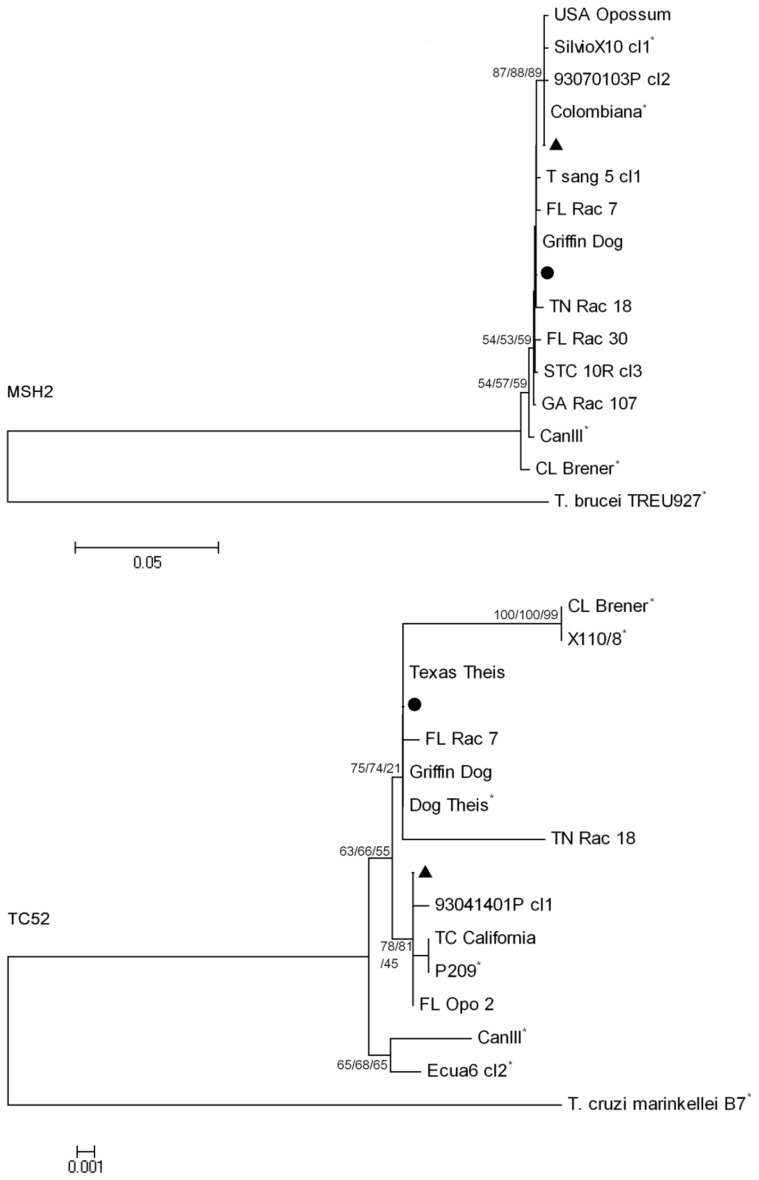
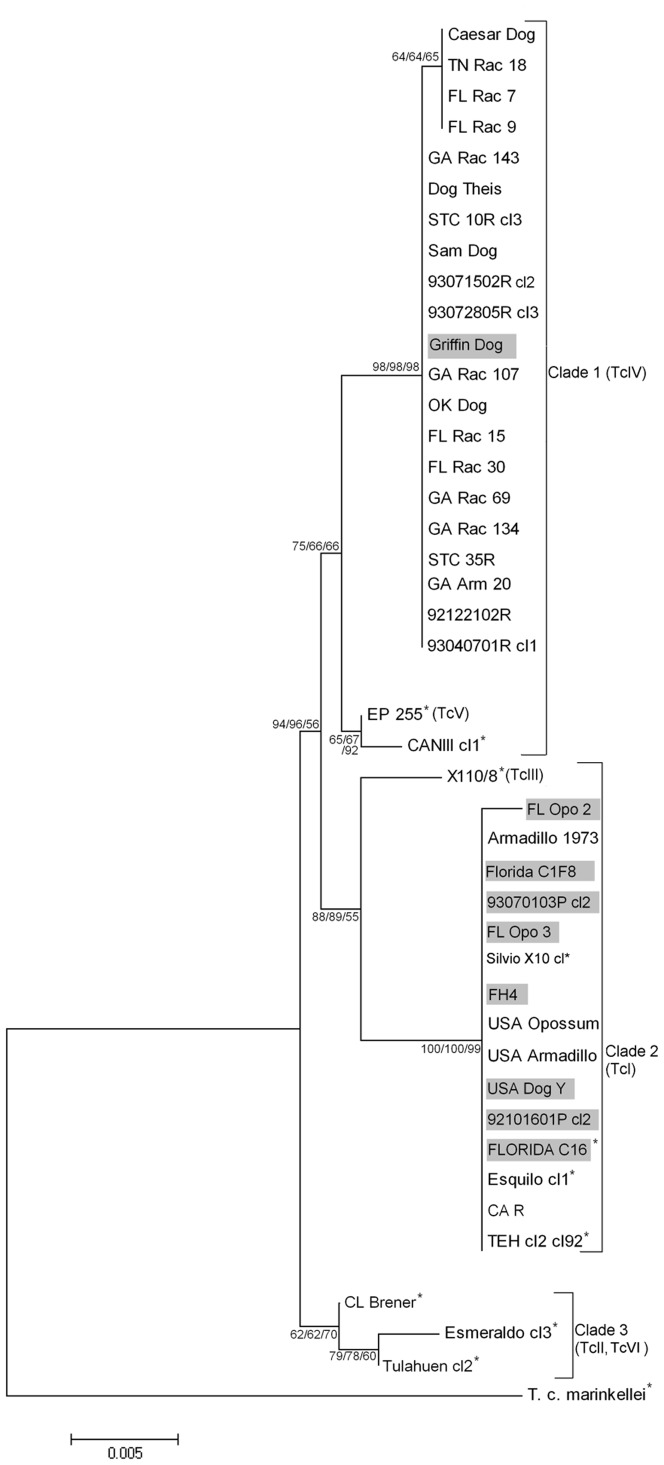
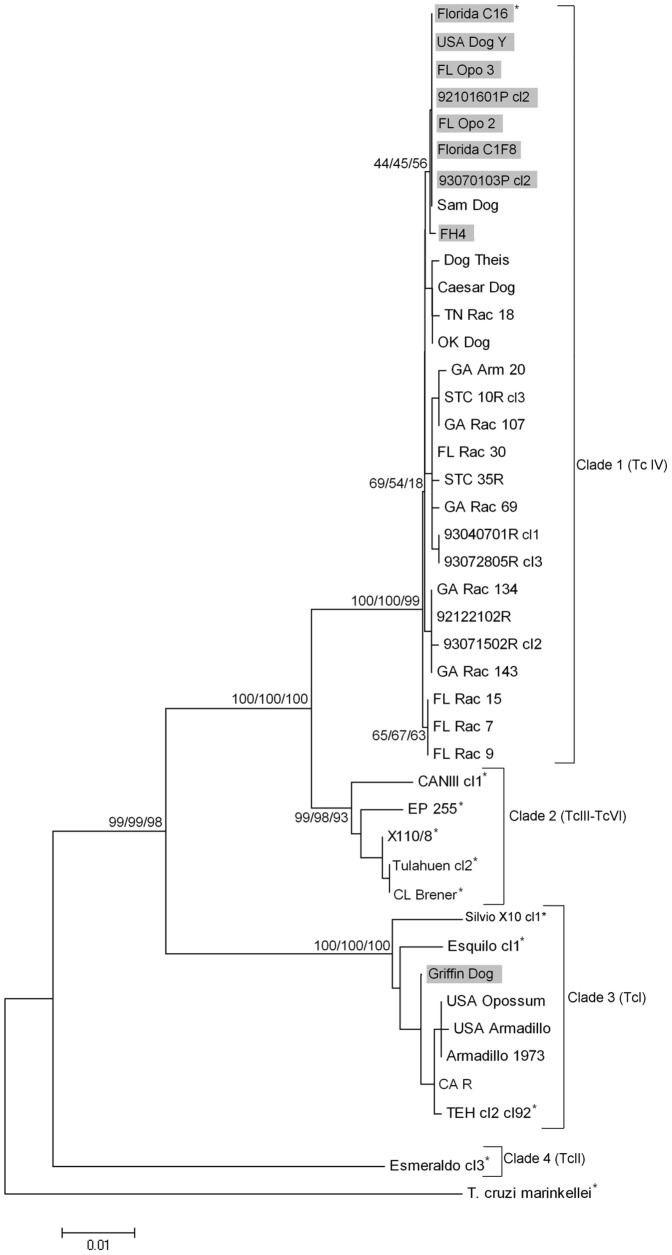
Trypanosoma cruzi, the causative agent of Chagas disease, is a multiclonal parasite with high levels of genetic diversity and broad host and geographic ranges. Molecular characterization of South American isolates of T. cruzi has demonstrated homologous recombination and nuclear hybridization, as well as the presence of 6 main genetic clusters or "discrete typing units" (DTUs). Few studies have extensively investigated such exchange events and genetic diversity in North American isolates. In the current study, we genetically characterized over 50 US isolates from wildlife reservoirs (e.g., raccoons, opossums, armadillos, skunks), domestic dogs, humans, nonhuman primates, and reduviid vectors from nine states (TX, CA, OK, SC, FL, GA, MD, LA, TN) using a multilocus sequencing method. Single nucleotide polymorphisms were identified in sequences of the mismatch-repair class 2 (MSH2) and Tc52 genes. Typing based on the two genes often paralleled genotyping by classic methodologies using mini-exon and 18S and 24Sα rRNA genes. Evidence for genetic exchange was obtained by comparing sequence phylogenies of nuclear and mitochondrial gene targets, dihydrofolate reductase-thymidylate synthase (DHFR-TS) and the cytochrome oxidase subunit II- NADH dehydrogenase subunit I region (COII-ND1), respectively. We observed genetic exchange in several US isolates as demonstrated by incongruent mitochondrial and nuclear genes phylogenies, which confirms a previous finding of a single genetic exchange event in a Florida isolate. The presence of SNPs and evidence of genetic exchange illustrates that strains from the US are genetically diverse, even though only two phylogenetic lineages have been identified in this region.
Conflict of interest statement
Figures
References
-
- Miles MA, Souza A, Povoa M, Shaw JJ, Lainson E, et al. (1978) Isozymic heterogeneity of Trypanosoma cruzi in the first autochthonous patients with Chagas' disease in Amazonian Brazil. Nature 272: 819–821. - PubMed
-
- Miles MA (1979) Transmission cycles and the heterogeneity of Trypanosoma cruzi in Amazonian forest. In: WHR Lumsden, DA Evans (eds), Biology of Kinetoplastida, Vol. 2, London, New York, San Francisco: Academic Press. p. 117–196.
-
- Barretto MP, Ribeiro RD (1979) Reservatorios silvestres do Trypanosoma cruzi . Rev Inst Adolfo Lutz 39: 25–26 [in Portugese].
-
- Hoare CA (1972) The trypanosomes of mammals. Oxford, UK: Blackwell Scientific. p. 753.
-
- Brisse S, Barnabé C, Tibayrenc M (2000) Identification of six Trypanosoma cruzi phylogenetic lineages by random amplified polymorphic DNA and multilocus enzyme electrophoresis. Int J Parasitol 30: 35–44. - PubMed
Publication types
MeSH terms
Substances
Grants and funding
LinkOut - more resources
Full Text Sources
Other Literature Sources
Medical
