


Epidemiology of cryptococcal meningitis in the US: 1997-2009
- PMID: 23457543
- PMCID: PMC3574138
- DOI: 10.1371/journal.pone.0056269
Epidemiology of cryptococcal meningitis in the US: 1997-2009
Abstract
Cryptococcal meningitis (CM) causes significant morbidity and mortality globally; however, recent national trends have not been described. Incidence and trends for CM-associated hospitalizations in 18 states were estimated using the Agency for Healthcare and Research Quality (AHRQ) State Inpatient Databases (SID) datasets for 1997 through 2009. We identified 30,840 hospitalizations coded for CM, of which 21.6% were among HIV-uninfected patients. CM in-hospital mortality was significant (12.4% for women and 10.8% for men) with a total of 3,440 deaths over the study period. Co-morbidities of CM coded at increased frequency in HIV-uninfected CM hospitalized populations included hydrocephalus and acute/chronic renal failure as well as possible predispositions including transplantation, combined T and B cell defects, Cushing's syndrome, liver disease and hypogammaglobulinemia. Median hospitalization costs were significant for CM and higher for HIV-uninfected patients (16,803.01 vs. 15,708.07; p<0.0001). Cryptococcal meningitis remains a disease with significant morbidity and mortality in the U.S. and the relative burden among persons without HIV infection is increasing.
Conflict of interest statement
Figures
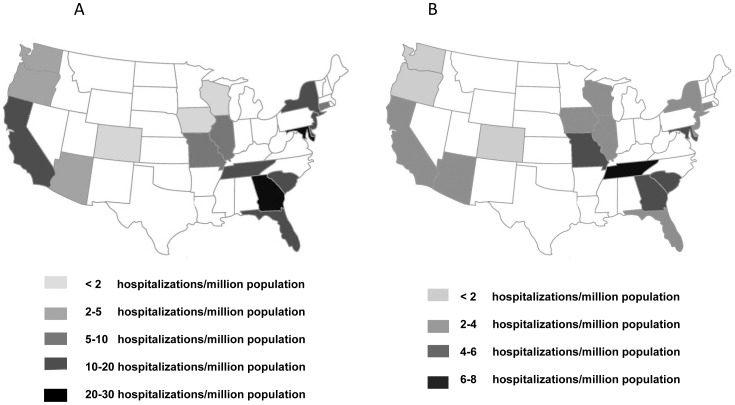
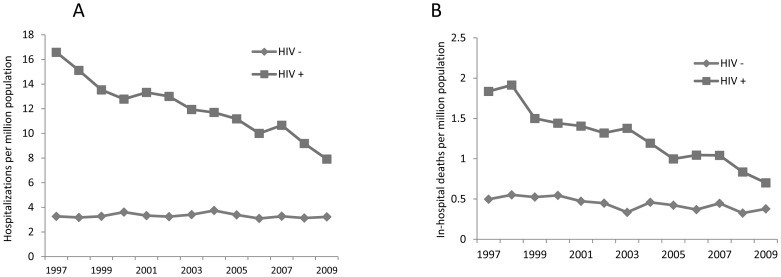
References
-
- Park BJ, Wannemuehler KA, Marston BJ, Govender N, Pappas PG, et al. (2009) Estimation of the current global burden of cryptococcal meningitis among persons living with HIV/AIDS. Aids 23: 525–530. - PubMed
-
- Mirza SA, Phelan M, Rimland D, Graviss E, Hamill R, et al. (2003) The changing epidemiology of cryptococcosis: an update from population-based active surveillance in 2 large metropolitan areas, 1992–2000. Clin Infect Dis 36: 789–794. - PubMed
-
- Hoang LM, Maguire JA, Doyle P, Fyfe M, Roscoe DL (2004) Cryptococcus neoformans infections at Vancouver Hospital and Health Sciences Centre (1997–2002): epidemiology, microbiology and histopathology. J Med Microbiol 53: 935–940. - PubMed
-
- Chayakulkeeree M, Perfect JR (2006) Cryptococcosis. Infect Dis Clin North Am 20: 507–544, v-vi. - PubMed
-
- Littman ML, Borok R (1968) Relation of the pigeon to cryptococcosis: natural carrier state, heat resistance and survival of Cryptococcus neoformans . Mycopathol Mycol Appl 35: 329–345. - PubMed
Publication types
MeSH terms
Grants and funding
LinkOut - more resources
Full Text Sources
Other Literature Sources
