


Projected near-future levels of temperature and pCO2 reduce coral fertilization success
- PMID: 23457572
- PMCID: PMC3572969
- DOI: 10.1371/journal.pone.0056468
Projected near-future levels of temperature and pCO2 reduce coral fertilization success
Abstract
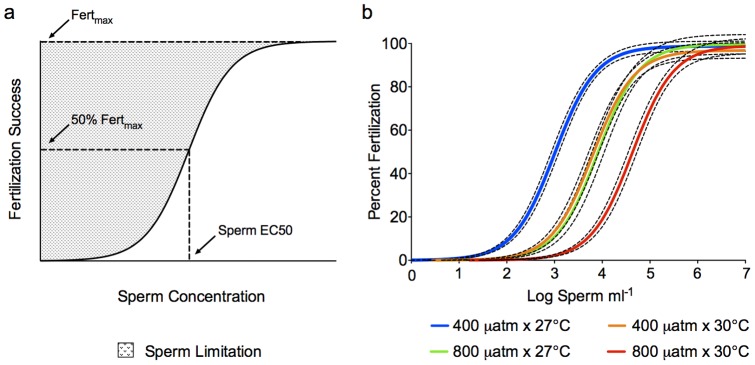
Increases in atmospheric carbon dioxide (pCO2) are projected to contribute to a 1.1-6.4°C rise in global average surface temperatures and a 0.14-0.35 reduction in the average pH of the global surface ocean by 2100. If realized, these changes are expected to have negative consequences for reef-building corals including increased frequency and severity of coral bleaching and reduced rates of calcification and reef accretion. Much less is known regarding the independent and combined effects of temperature and pCO2 on critical early life history processes such as fertilization. Here we show that increases in temperature (+3°C) and pCO2 (+400 µatm) projected for this century negatively impact fertilization success of a common Indo-Pacific coral species, Acropora tenuis. While maximum fertilization did not differ among treatments, the sperm concentration required to obtain 50% of maximum fertilization increased 6- to 8- fold with the addition of a single factor (temperature or CO2) and nearly 50- fold when both factors interact. Our results indicate that near-future changes in temperature and pCO2 narrow the range of sperm concentrations that are capable of yielding high fertilization success in A. tenuis. Increased sperm limitation, in conjunction with adult population decline, may have severe consequences for coral reproductive success. Impaired sexual reproduction will further challenge corals by inhibiting population recovery and adaptation potential.
Conflict of interest statement
Figures
References
-
- IPCC (2007) The Physical Science Basis: Contribution of Working Group I to the Fourth Assessment Report of the Intergovernmental Panel on Climate Change. Cambridge University Press.
-
- Andersson AJ, Mackenzie FT, Gattuso JP (2011) Effects of ocean acidification on benthic processes, organisms, and ecosystems. In: Gattuso JP, Hansson L, editors. Ocean Acidification. Oxford University Press. pp. 122–153.
-
- Baker AC, Glynn PW, Riegl B (2008) Climate change and coral reef bleaching: An ecological assessment of long-term impacts, recovery trends and future outlook. Estuar Coast Shelf Sci 80: 435–471.
-
- Pandolfi JM, Connolly SR, Marshall DJ, Cohen AL (2011) Projecting coral reef futures under global warming and ocean acidification. Science 333: 418–422. - PubMed
-
- Hughes TP, Baird AH, Dinsdale EA, Moltschaniwskyj NA, Pratchett MS, et al. (2012) Assembly rules of reef corals are flexible along a steep climatic gradient. Curr Biol 22: 736–741. - PubMed
Publication types
MeSH terms
Substances
LinkOut - more resources
Full Text Sources
Other Literature Sources
Research Materials
Miscellaneous
