


Local and systemic oxidative stress status in chronic obstructive pulmonary disease patients
- PMID: 23457673
- PMCID: PMC3628645
- DOI: 10.1155/2013/985382
Local and systemic oxidative stress status in chronic obstructive pulmonary disease patients
Abstract
Background: Previous studies have indicated that oxidative stress plays an important role in the pathogenesis of chronic obstructive pulmonary disease (COPD).
Objectives: To study local and systemic oxidative stress status in COPD patients, and to clarify the relationship between local and systemic oxidative stress.
Methods: Lipid peroxide malondialdehyde (MDA), glutathione (GSH), superoxide dismutase (SOD) and GSH peroxidase (GSH-PX) levels in induced sputum and plasma, as well as glucocorticoid receptor (GR) levels in peripheral blood leukocytes were examined in 43 acute exacerbation of COPD patients (group A), 35 patients with stable COPD (group B) and 28 healthy controls (14 smokers [group C]; 14 nonsmokers [group D]).
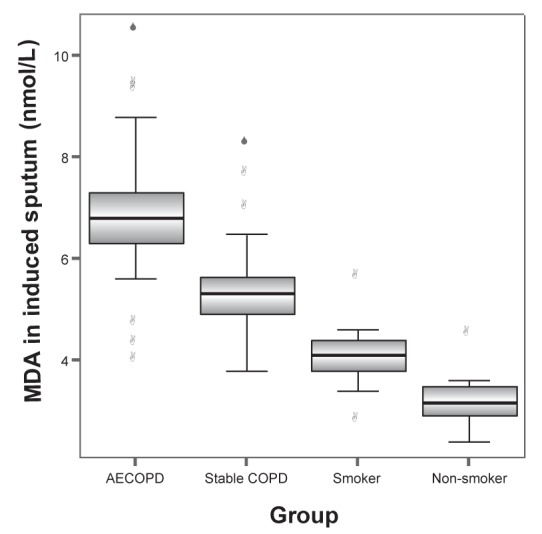
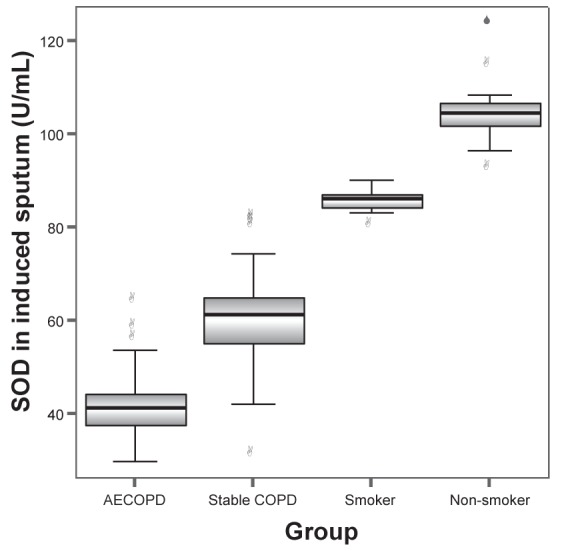
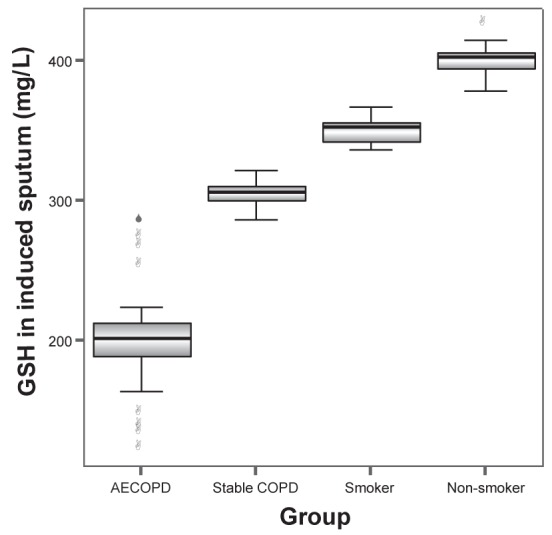
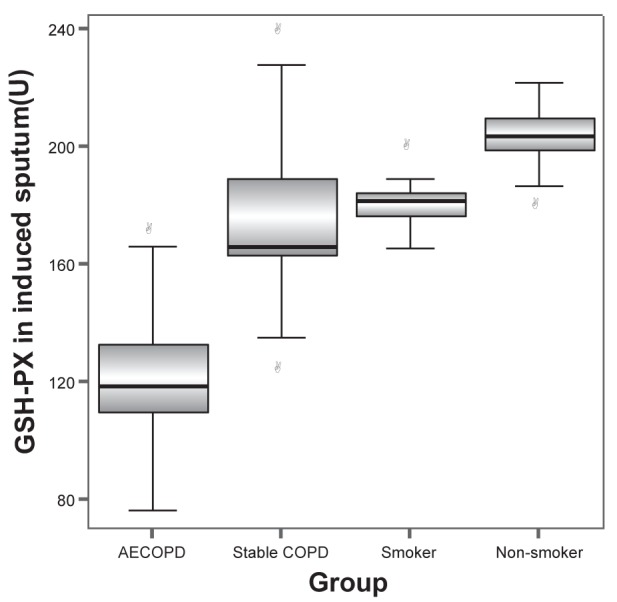
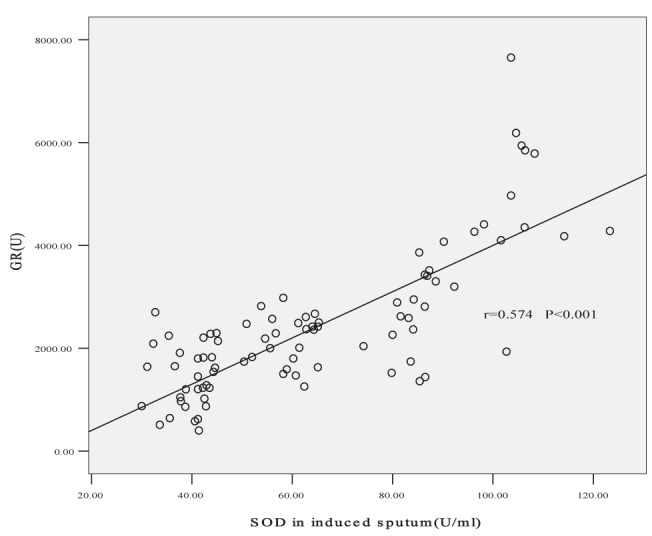
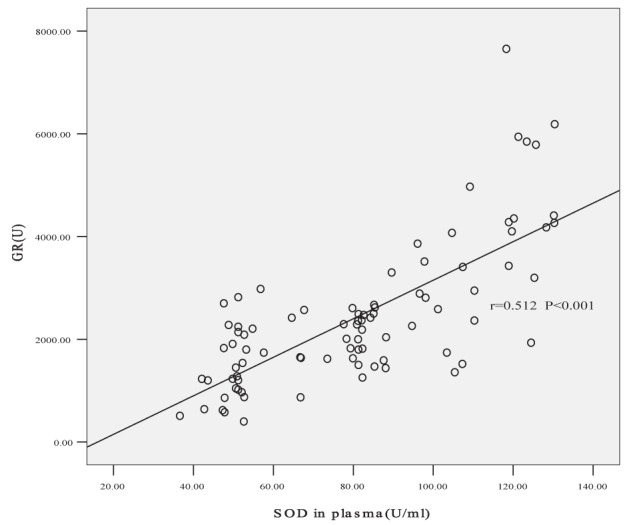
Results: MDA levels in induced sputum and plasma decreased progressively in groups A to D, with significant differences between any two groups (P<0.001). GSH, SOD and GSH-PX levels in both induced sputum and plasma increased progressively in groups A to D, with significant differences between any two groups (P<0.001). GR levels in peripheral blood leukocytes decreased progressively in groups D to A (all comparisons P<0.001). Pearson analysis revealed strong correlations between MDA, GSH, SOD and GSH-PX levels in plasma and induced sputum. The activity of SOD in plasma and sputum were both positively correlated with GR levels (partial correlation coefficients 0.522 and 0.574, respectively [P<0.001]).
Conclusions: Oxidative stress levels were elevated in COPD patients. There was a correlation between local and systemic oxidative status in COPD, and between decreased SOD activity and decreased GR levels in COPD patients.
HISTORIQUE :: Selon des études antérieures, le stress oxydatif joue un rôle important dans la pathogenèse de la maladie pulmonaire obstructive chronique (MPOC).
OBJECTIFS :: Étudier l’état de stress oxydatif local et systémique chez les patients atteints d’une MPOC et clarifier le lien entre le stress oxydatif local et systémique.
MÉTHODOLOGIE :: Les chercheurs ont étudié les taux de formation de malondialdéhyde par le peroxyde lipidique (MDA), de glutathion (GSH), de superoxyde dismutase (SOD) et de GSH peroxydase (GSH-PX) dans les expectorations provoquées et le plasma, ainsi que les taux de récepteur des glucocorticoïdes (RG) dans les leucocytes du sang périphérique de 43 patients atteints d’une MPOC ayant une exacerbation aiguë (groupe A), de 35 patients ayant une MPOC stable (groupe B) et de 28 sujets témoins en santé (14 fumeurs [groupe C]; 14 non-fumeurs [groupe D]).
RÉSULTATS :: Les taux de MDA dans les expectorations provoquées et le plasma ont diminué progressivement dans les groupes A à D, et les différences sont significatives entre deux groupes, quels qu’ils soient (P<0,001). Les taux de GSH, de SOD et de GSH-PX dans les expectorations provoquées et le plasma ont augmenté progressivement dans les groupes A à D, et les différences sont significatives entre deux groupes, quels qu’ils soient (P<0,001). Les taux de RG dans les leucocytes du sang périphérique ont diminué progressivement dans les groupes D à A (toutes les comparaisons P<0,001). L’analyse de Pearson a révélé de fortes corrélations entre les taux de MDA, de GSH, de SOD et de GSH-PX dans le plasma et les expectorations provoquées. L’activité de la SOD dans le plasma et les expectorations étaient tous deux corrélés de manière positive avec les taux de RG (coefficients de corrélation partielle de 0,522 et de 0,574, respectivement [P<0,001]).
CONCLUSIONS :: Les patients atteints d’une MPOC présentaient un taux de stress oxydatif élevé. On constatait une corrélation entre le statut oxydatif local et systémique en cas de MPOC, et entre la diminution de l’activité de SOD et du taux de RG chez les patients atteints d’une MPOC.
Figures
Comment in
-
Oxidative stress in chronic obstructive pulmonary disease: a lung and systemic process.Can Respir J. 2013 Jan-Feb;20(1):27-9. doi: 10.1155/2013/509130. Can Respir J. 2013. PMID: 23457671 Free PMC article. No abstract available.
References
-
- Rabe KF, Hurd S, Anzueto A, et al. Global strategy for the diagnosis, management, and prevention of COPD: GOLD executive summary. Am J Respir Crit Care Med. 2007;176:532–55. - PubMed
-
- Kinnula VL, Ilumets H, Myllarniemi M, et al. 8-Isoprostane as a marker of oxidative stress in nonsymptomatic cigarette smokers and COPD. Eur Respir J. 2007;29:51–5. - PubMed
-
- Altuntas E, Turgut T, Ilhan N, et al. The levels of oxidant and antioxidant in patients with COPD. Tuberk Toraks. 2003;51:373–9. - PubMed
MeSH terms
Substances
LinkOut - more resources
Full Text Sources
Other Literature Sources
Medical
