


Dysregulated fear predicts social wariness and social anxiety symptoms during kindergarten
- PMID: 23458273
- PMCID: PMC3675171
- DOI: 10.1080/15374416.2013.769170
Dysregulated fear predicts social wariness and social anxiety symptoms during kindergarten
Abstract
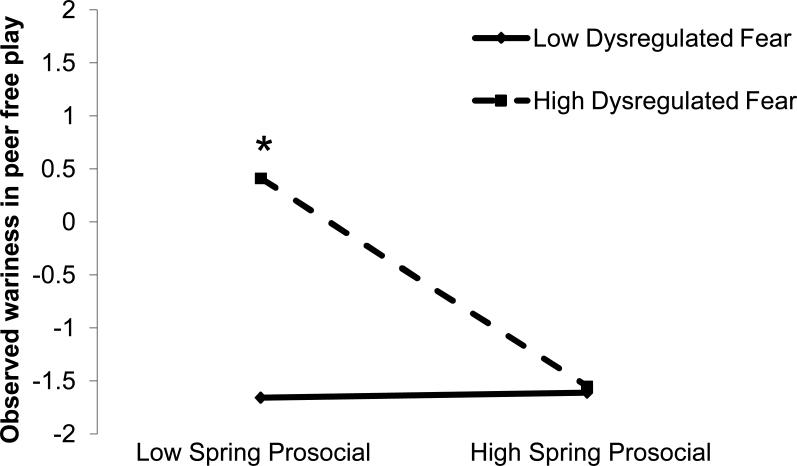
Fearful temperament is associated with risk for the development of social anxiety disorder in childhood; however, not all fearful children become anxious. Identifying maladaptive trajectories is thus important for clarifying which fearful children are at risk. In an unselected sample of 111 two-year-olds (55% male, 95% Caucasian), Buss ( 2011 ) identified a pattern of fearful behavior, dysregulated fear, characterized by high fear in low threat situations. This pattern of behavior predicted parent- and teacher-reported withdrawn/anxious behaviors in preschool and at kindergarten entry. The current study extended original findings and examined whether dysregulated fear predicted observed social wariness with adults and peers, and social anxiety symptoms at age 6. We also examined prosocial adjustment during kindergarten as a moderator of the link between dysregulated fear and social wariness. Consistent with predictions, children with greater dysregulated fear at age 2 were more socially wary of adults and unfamiliar peers in the laboratory, were reported as having more social anxiety symptoms, and were nearly 4 times more likely to manifest social anxiety symptoms than other children with elevated wariness in kindergarten. Results demonstrated stability in the dysregulated fear profile and increased risk for social anxiety symptom development. Dysregulated fear predicted more social wariness with unfamiliar peers only when children became less prosocial during kindergarten. Findings are discussed in relation to the utility of the dysregulated fear construct for specifying maladaptive trajectories of risk for anxiety disorder development.
Figures
References
-
- Arbeau KA, Coplan RJ, Weeks M. Shyness, teacher-child relationships, and socio-emotional adjustment in grade 1. International Journal of Behavioral Development. 2010;34(3):259–269.
-
- Arcus DM. Inhibited and uninhibited children. In: Wachs TD, Kohnstamm GA, editors. Temperament in context. Lawrence Erlbaum Associates; Mahwah, NJ: 2001. pp. 43–60.
-
- Armstrong JM, Goldstein LH. Manual for the MacArthur Health and Behavior Questionnaire (HBQ 1.0) 2003.
-
- Biederman J, Hirshfeld-Becker DR, Rosenbaum JF, Herot C, Friedman D, Snidman N, Faraone SV. Further evidence of association between behavioral inhibition and social anxiety in children. American Journal of Psychiatry. 2001;158(10):1673–1679. - PubMed
-
- Biederman J, Rosenbaum JF, Bolduc-Murphy BA, Faraone SV, Chaloff J, Hirshfeld DR, Kagan J. A 3-year follow-up of children with and without behavioral inhibition. Journal of the American Academy of Child and Adolescent Psychiatry. 1993;32:814–821. - PubMed
Publication types
MeSH terms
Grants and funding
LinkOut - more resources
Full Text Sources
Other Literature Sources
Medical
