


A prospective, randomized trial of complete avoidance of steroids in liver transplantation with follow-up of over 7 years
- PMID: 23458449
- PMCID: PMC3608983
- DOI: 10.1111/j.1477-2574.2012.00576.x
A prospective, randomized trial of complete avoidance of steroids in liver transplantation with follow-up of over 7 years
Abstract
Objectives: Steroids are a mainstay of treatment in orthotopic liver transplantation (OLT) and are associated with significant morbidity. This trial was conducted to assess the efficacy of steroids avoidance.
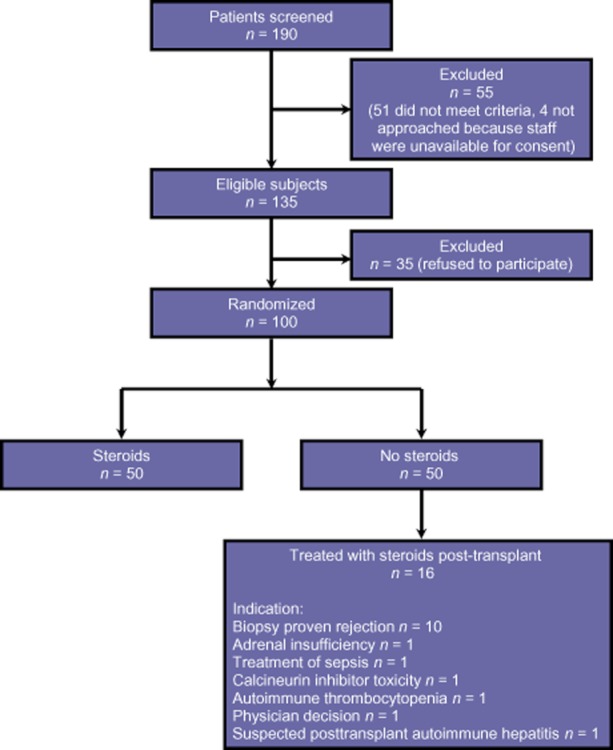
Methods: Patients undergoing OLT between June 2002 and April 2005 were entered into a prospective, randomized trial of complete steroids avoidance and followed until November 2011. Recipients received either standard therapy (n = 50) or complete steroids avoidance (n = 50). Analyses were performed on an intention-to-treat basis. The mean follow-up of all recipients was 2095 ± 117 days. Sixteen (32%) recipients randomized to the steroids avoidance group ultimately received steroids for clinical indications.
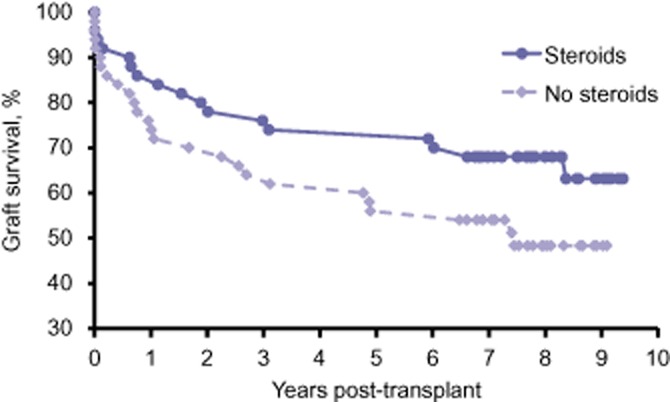
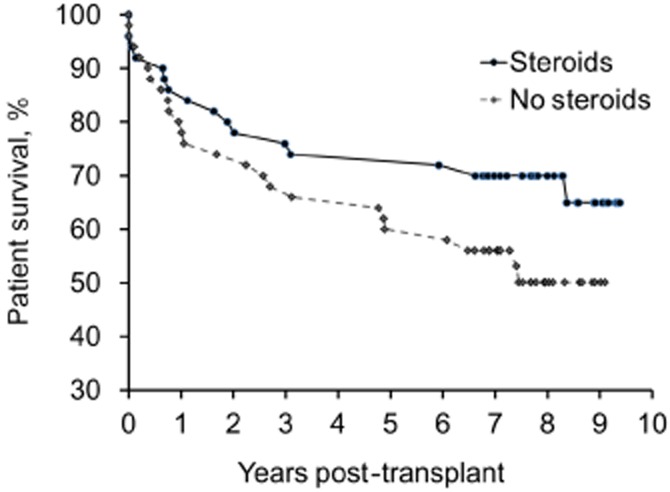
Results: Incidences of diabetes and hypertension prior to or after OLT were similar in both groups, as was the incidence of rejection. Patient and graft survival rates at 1, 3 and 5 years were lower in the steroids avoidance group than in the standard therapy group (patient survival: 1-year, 80% versus 86%; 3-year, 68% versus 76%; 5-year, 60% versus 72%; graft survival: 1-year, 76% versus 76%; 3-year, 64% versus 74%; 5-year, 56% versus 72%), but the differences were not statistically different.
Conclusions: Complete steroids avoidance provides liver transplant recipients with minimal benefit and appears to result in a concerning trend towards decreased graft and recipient survival. The present data support the use of at least a short course of steroids after liver transplantation.
© 2012 International Hepato-Pancreato-Biliary Association.
Figures
References
-
- Lerut JP. Avoiding steroids in solid organ transplantation. Transpl Int. 2003;16:213–224. - PubMed
-
- Lake JR. The role of immunosuppression in recurrence of hepatitis C. Liver Transpl. 2003;9(Suppl):63–66. - PubMed
-
- Sheiner PA, Schwartz ME, Mor E, Schluger LK, Theise N, Kishikawa K, et al. Severe or multiple rejection episodes are associated with early recurrence of hepatitis C after orthotopic liver transplantation. Hepatology (Baltimore, MD) 1995;21:30–34. - PubMed
-
- Charlton M, Seaberg E. Impact of immunosuppression and acute rejection on recurrence of hepatitis C: results of the National Institute of Diabetes and Digestive and Kidney Diseases Liver Transplantation Database. Liver Transpl Surg. 1999;5(4 Suppl. 1):107–114. - PubMed
Publication types
MeSH terms
Substances
LinkOut - more resources
Full Text Sources
Other Literature Sources
Medical
Miscellaneous
