


Different definitions of prevalent hypertension impact: the clinical epidemiology of hypertension and attainment of Healthy People goals
- PMID: 23458586
- PMCID: PMC3589732
- DOI: 10.1111/jch.12057
Different definitions of prevalent hypertension impact: the clinical epidemiology of hypertension and attainment of Healthy People goals
Abstract
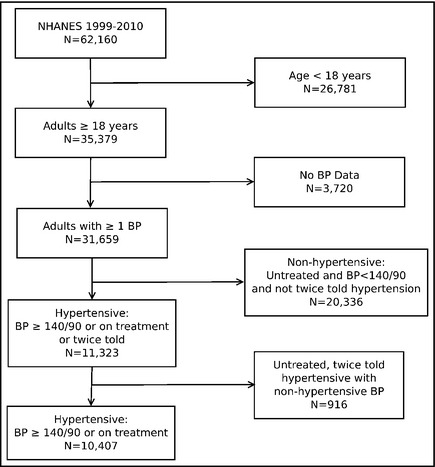
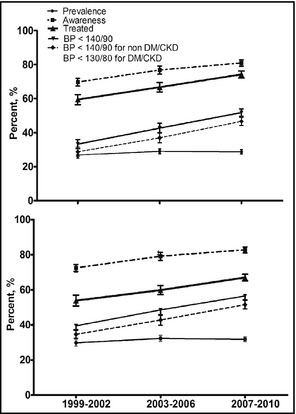
Prevalent hypertension in National Health and Nutrition Examination Surveys (NHANES) is traditionally defined as blood pressure (BP) ≥140 mm Hg systolic and/or ≥90 diastolic and/or currently taking antihypertensive medications. When estimating prevalent hypertension, American Heart Association (AHA) statistical updates include the traditional definition of hypertension (tHTN) and untreated individuals with nonhypertensive BP told twice that they were hypertensive (nontraditional [ntHTN]). The characteristics of ntHTN and their impact on the clinical epidemiology of hypertension and Healthy People prevention and control goals are undefined. NHANES 1999-2002, 2003-2006, and 2007-2010 were analyzed. The ntHTN group was younger and had less diabetes and lower BP than the tHTN group but higher BP than the normotensive group. When classifying ntHTN as hypertensive, prevalent hypertension increased approximately 3% and control 5% to 6% across NHANES periods. In 2007-2010, the Healthy People 2010 goal of controlling BP in 50% of all hypertensive patientss was attained when ntHTN was classified as hypertension (56.5% [95% confidence interval (CI), 54.2-58.7]) and nonhypertension (51.8% [95% CI, 49.6-53.9]). When including ntHTN in prevalent hypertension estimates, the Healthy People 2020 goal of controlling BP in 60% of hypertensive patients becomes more attainable, whereas reducing prevalent hypertension to 26.9% (31.8% [95% CI, 30.5-33.1]) vs 28.7% [95% CI, 27.5-30.0]) becomes more challenging.
© 2012 Wiley Periodicals, Inc.
Figures
References
-
- Chobanian AV, Bakris GL, Black HR, et al. Seventh report of the joint national committee on prevention, detection, evaluation, and treatment of high blood pressure. Hypertension. 2003;42(6):1206–1252. - PubMed
-
- U.S. Department of Health and Human Services . Healthy People 2010. With Understanding and Improving Health and Objectives for Improving Health, 2 vols, 2nd edn. Washington, D.C.: U.S. Government Printing Office; 2000.
-
- Healthy People 2020 Objective Topic Areas and Page Numbers . Heart Disease and Stroke, pp. 150–159. http://www.healthypeople.gov/2020/topicsobjectives2020/pdfs/HP2020object.... Accessed July 11, 2012.
-
- Egan BM, Zhao Y, Axon RN. US trends in prevalence, awareness, treatment, and control of hypertension, 1988–2008. JAMA. 2010;303:2043–2050. - PubMed
-
- Hajjar I, Kotchen TA. Trends in prevalence, awareness, treatment and control of hypertension in the United States, 1988–2000. JAMA. 2003;290:199–206. - PubMed
Publication types
MeSH terms
Substances
Grants and funding
LinkOut - more resources
Full Text Sources
Medical
