Review
. 2013 Jun;138(3):428-40.
doi: 10.1016/j.pharmthera.2013.02.005. Epub 2013 Feb 28.

Neuroimmune communication in hypertension and obesity: a new therapeutic angle?

Affiliations
Review

Neuroimmune communication in hypertension and obesity: a new therapeutic angle?

Annette D de Kloet et al. Pharmacol Ther. 2013 Jun.

Abstract

Hypertension is an epidemic health concern and a major risk factor for the development of cardiovascular disease. Although there are available treatment strategies for hypertension, numerous hypertensive patients do not have their clinical symptoms under control and it is imperative that new avenues to treat or prevent high blood pressure in these patients are developed. It is well established that increases in sympathetic nervous system (SNS) outflow and enhanced renin-angiotensin system (RAS) activity are common features of hypertension and various pathological conditions that predispose individuals to hypertension. More recently, hypertension has also become recognized as an immune condition and accumulating evidence suggests that interactions between the RAS, SNS and immune systems play a role in blood pressure regulation. This review summarizes what is known about the interconnections between the RAS, SNS and immune systems in the neural regulation of blood pressure. Based on the reviewed studies, a model for RAS/neuroimmune interactions during hypertension is proposed and the therapeutic potential of targeting RAS/neuroimmune interactions in hypertensive patients is discussed. Special emphasis is placed on the applicability of the proposed model to obesity-related hypertension.


Conflict of interest statement

Conflict of Interest

The authors declare that there are no conflicts of interest.

Figures
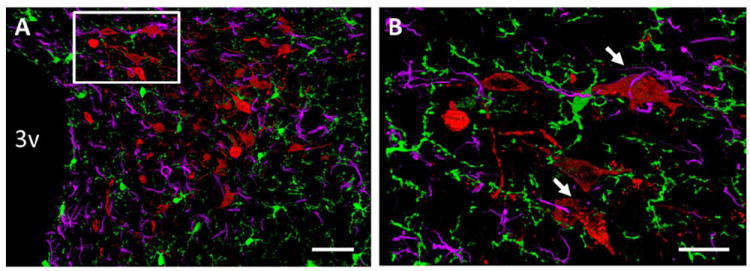
Figure 1
Figure 1. Interactions between microglia, astrocytes and preautonomic RVLM-projecting PVN neurons
(A) 20× and (B) 63× images of microglia (green), astrocytes (purple) and preautonomic RVLM-projecting neurons within an adult mouse PVN. Adult mice were injected bilaterally into the RVLM with the retrograde tract tracer, fluorogold. Seven days later mice were perfused and brains were processed for triple-label immunohistochemistry for Iba-1 (a microglial marker), GFAP (an astrocytic marker), and fluorogold (preautonomic neurons) using previously published protocols (Ulrich-Lai et al., 2011; Thaler et al., 2012). 3v = third cerebral ventricle. Arrows highlight interactions between microglia, astrocytes and RVLM-projecting neurons. Scale bars = 50 μm (A) and 20 μm (B).
Figure 2
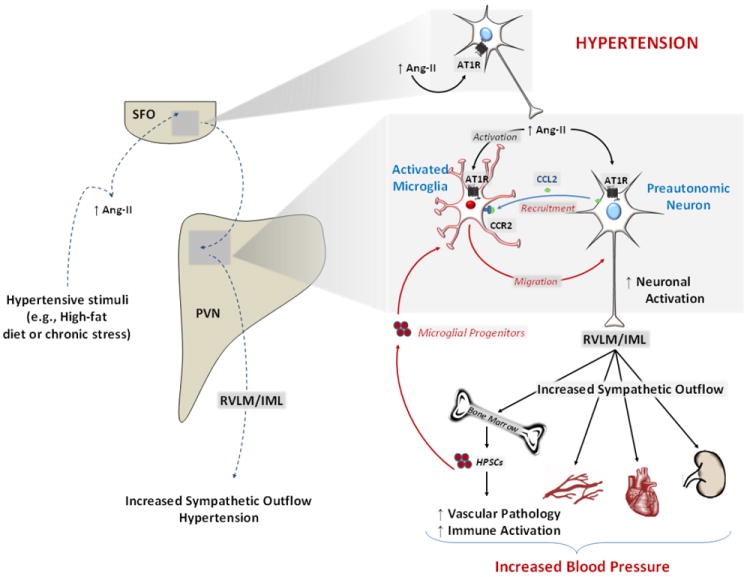
Figure 2. Proposed model for immune/central nervous system interactions during hypertension
Hypertensive stimuli (e.g., obesity and chronic stress), cause increases in circulating factors (e.g., Ang-II) that are sensed by CVOs, such as the SFO. The SFO then transmits these signals to the preautonomic region of PVN, leading to stimulation of intermediolateral cell column (IML) and rostralventrolateral medulla (RVLM)-projecting neurons and resulting in increased sympathetic outflow and blood pressure. Furthermore, during neurogenic hypertension, the enhanced direct neuronal actions of Ang-II at AT1R in the PVN leads to an over-stimulation of preautonomic neurons. Direct effects of Ang-II at microglia leads to sustained induction of both the central and peripheral immune systems. We propose that initially Ang-II directly activates microglia, and indirectly (via MCP-1/CCL-2 released from neurons) causes their migration towards preautonomic neurons. This proinflammatory microenvironment within the PVN then stimulates the brain to signal via the SNS to mobilize the peripheral immune system and to the bone marrow to mobilize microglial progenitors that are recruited to the PVN, likely via a CCL2/CCR2-dependent mechanism. This increase in microglial progenitors within the PVN then contributes to the population of innate immune cells within this nucleus, feeding-forward to activate preautonomic PVN neurons thereby augmenting and sustaining the elevations in blood pressure.

References

    1. Abboud FM. Effects of sodium, angiotensin, and steroids on vascular reactivity in man. Fed Proc. 1974;33:143–149. - PubMed
    1. Adams JM, McCarthy JJ, Stocker SD. Excess dietary salt alters angiotensinergic regulation of neurons in the rostral ventrolateral medulla. Hypertension. 2008;52:932–937. - PMC - PubMed
    1. Agarwal D, Welsch MA, Keller JN, Francis J. Chronic exercise modulates RAS components and improves balance between pro- and anti-inflammatory cytokines in the brain of SHR. Basic Res Cardiol. 2011;106:1069–1085. - PMC - PubMed
    1. Allaman I, Belanger M, Magistretti PJ. Astrocyte-neuron metabolic relationships: for better and for worse. Trends Neurosci. 2011;34:76–87. - PubMed
    1. Alonso-Galicia M, Brands MW, Zappe DH, Hall JE. Hypertension in obese Zucker rats. Role of angiotensin II and adrenergic activity. Hypertension. 1996;28:1047–1054. - PubMed

Publication types